
7 October 07
Shadow of Pink Chocolate
A long day for us — we volunteered as radio hams for a new bicycling event along the American River Parkway called the Princess Promenade. This event was designed to encourage women and girls to ride confidently along the 32-mile long bike trail which runs from Old Sacramento to Folsom Lake. There were three options to the ride — a little five-mile jaunt, a thirty-mile round trip, and finally a sixty-mile round trip doing almost the entire length of the trail.
Pica’s role was as a shadow for the event organizer Janaé — she kept Janaé in communication with the radio base station at the start/finish point. My job was to patrol one section of the route as a bicycle mobile ham. I started off with the little jaunt to the east and then made three trips from the start/finish down to the Nimbus Fish Hatchery, covering about 30 miles total. The last such run was to shepherd the tail-end rider home, who turned out to be a celebrity, the reigning Mrs. California. The story was she’d hadn’t been on a bike since age 15 or so but heard of the event some weeks back and decided to do the 60-mile option. She had no trouble completing it either.
Pink was definitely the color theme of the event. Pica was dressed in the pink t-shirt given out for the ride, a pink child’s tiara she picked up yesterday, plus her radio headset. Along the way she got ‘blinged’ with a sprinking of glitter. At the start/finish there was also the most decadent thing I’ve ever seen, a chocolate fountain. Many baskets of strawberries were consumed as dipping material. Those things must be the devil to clean, though.
3 September 07
Change Of Mode
The weekly Yolo Amateur Radio Society net tonight went quite well, all things considered. We ran this without the help of a repeater for the first time in quite a while. This wasn’t by choice — most of the repeaters on the 440 mHz band in the Sacramento area have been taken off the air by request of the US Air Force, who are concerned about interference with their PAVE PAWS radar site at Beale Air Force Base near Marysville. Why the repeaters have just now become a problem for the Air Force after many years of coexistence is a question nobody is at liberty to answer for us, and it is also slightly disturbing to think that the missile warning radar system could be so easily perturbed by just a handful of 50-watt transmitters nearby.
Ham radio operators are nothing if not adaptable, and we operated simplex tonight. I wasn’t worried about our setup here — we have a nice portable Yagi antenna for such purposes which I can get up to about 20’ above ground on its current mast. The only stations we nor most of the participants were not able to hear were the two folks in Woodland who were trying to call in using only a handitalkie. That works fine if it is a repeater-based net, but handitalkie signals don’t propagate very far otherwise. 13 checkins total this evening, which may have been a YARS record.
16 August 07
Wireless For Frogs And Mice
On Monday I heard a presentation about Quail Ridge Reserve, one of the University of California natural reserves that is administered by UC Davis. Quail Ridge sticks out as a peninsula into Lake Berryessa, about 40 kilometers west of here. Quail Ridge Reserve has gone hi-tech. In a collaboration with the computer science department, the reserve managers have set up towers and repeaters to create a wireless mesh network covering much of the reserve. The technology used is the standard wireless found in many a laptop, but the environment and scale of the network is of a degree to make the project interesting to computer scientists.
Putting a natural reserve on the Internet leads to some neat possibilities. One researcher, who left UC Davis for a position at the University of Michigan, can continue to monitor the calling of frogs he was studying in real time. Webcams have been set up that can be reoriented over the net, looking for foxes, mountain lions, and snakes. And plans are afoot to set up a triangulation network that will enable tracking of critters such as radio-collared mice down to accuracies of less than a meter. The only other such triangulation network is at Barro Colorado Island in Panama, with much less favorable topography.
22 July 07
Opening
Thursday evening found me listening to the 20 meter band on my transceiver. At this stage in the sunspot cycle — we’re at the bottom — 20 meters is basically a daytime and early evening band. The propagation is best on 20 meters over daylight portions of the earth. I am tuning around the Morse Code section of the band and copy the callsign LZ1MS from a signal that is booming in. I know a prefix beginning in L is not a US station; I don’t have the table of prefixes memorized but think “L — that’s probably Argentina, right?”
The table of prefixes is at hand though, and I look up LZ1. It’s Bulgaria (I was close on Argentina though — its prefixes are LO-LW). This is a strange location to have signals coming in from, since it’s mostly nighttime between here and there. Other people are contacting this station and he disappears before I have a chance to contact him on Morse Code.
I go to the Web where I look up the current long-distance ham radio activity (there is a system in place where hams briefly log to the Net current long-distance contacts) and find that LZ1MS has moved to the voice portion of the 20 meter band, alas in a section I don’t have privileges to transmit on. I tune around the voice portion and hear folks transmitting from Bulgaria, Croatia, Romania, and Estonia. In my short 6-month career on the high frequency bands I’ve not heard anything like this opening to Eastern Europe before.
Not that I managed to contact anybody there. But I did have luck in the opposite direction, and had my first contact on voice into Japan that evening!
13 June 07
QSLing
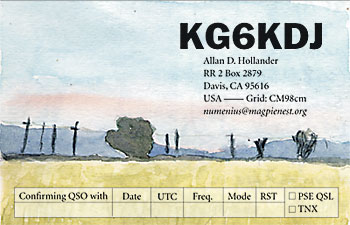 There is a tradition in ham radio to send out a card in confirmation of a contact with another ham, and to expect to receive one in return. This is called a QSL card. A week-and-a-half ago I received one out of the blue from a ham who I had a contact with in Oklahoma City, and this prompted me to put my own into production. The result is at left; the underlying image is a little watercolor I did three years ago looking west over the field next to our house towards the Vaca Mountains.
QSLing is definitely not as popular as it once was, the blame for such being put on the rise of the Internet, the cost of postage, or just the frenzy of modern life. But it’s a great tradition, motivated in part by the need to document contacts for various amateur radio awards. I’m now sending my own card to recent contacts. And just today, I received another QSL card out of the blue, this time from Pennsylvania — I’m all set with one to send in reply.
21 May 07
Davis Double Century 2007
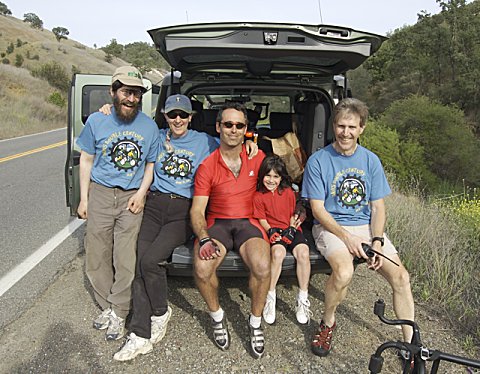 Yesterday we spent the entire day providing radio support for the Davis Double Century, a 200-mile bicycling event. Here is an account. (Photo at left is by Dutch Martinich.)
Prelude: Friday evening proved to be more hectic than planned. In the afternoon, one of Pica’s coworkers spotted some kittens under a trailer building near where Pica works. They proceeded to try to catch them. By the time Pica left work, three of the four were in captivity, with a live trap set out for the fourth. We returned after dinner to find the fourth kitten in the trap. The kittens went off to the house of Pica’s boss for over the weekend, and happily it looks like all four will find homes. But the episode with the kittens delays our packing for the day by a bit, adding to our usual disorganization.
2 AM. Pica notices that the dome light in Nellie, our Honda Element, is on. It would be seriously bad news if the car doesn’t start, and she goes out to check. It’s okay.
4 AM It’s time to get up. Charlie nudges me awake (it’s breakfast time, silly human) ahead of the alarm. We need to head out early because we are the radio support at the first rest stop.
Crisis. We set out for Rest Stop 1 at 5 AM, powering on the mobile transceiver in Nellie. At 5:15 AM, we hear over the radio a report from the ham operators heading up to Rest Stop 2 which is at Monticello Dam on Lake Berryessa. There is a fire in the canyon, and no traffic being allowed through. Our 750 riders on the road suddenly have no place to go. We know the ride director back at start/finish is now in high decision-making mode, and we await instructions. At 5:32 we are approaching Rest Stop 1, and we get the announcement over the air all riders are to halt at that stop. At the moment we arrive the folks at RS 1 know none of this, and we immediately leap into informing them. A few riders have already passed the rest stop, but not many, and the rest stop soon fills up with impatient and chilly cyclists.
The word comes of the alternative plan, reverse the route. This followed by the adopted variant — turn the ride from a loop into an out-and-back ride, heading north up the Capay Valley, ending up in the hills of Lake County, and then returning the same way. There are massive amounts of logistics to sort out to accomplish this shift, and the riders are still instructed to hold.
An hour later the riders are released, and the rest stop soon clears out. Once everyone is out we change our mission and start driving north as a sag support vehicle.
Tail-end Charlie. Since we were at the rest stop until it closed, all the riders are now in front of us, and it is now our lot to keep track of the final rider. This is rider number 181, who seems particularly geographically challenged, and we have to redirect him twice to get him up to the highway headed up the Capay Valley. He would get lost at least one more time over the course of the ride.
Personal Mishap. We drive up the Capay Valley looking for stray riders, and arrive at the now-relocated Rest Stop 2. Very few riders need a sag at this point, but we see one rider who has enough and decides to ride back to Davis. What’s his rider number? I chase after him on foot, shouting. Then running to the rest stop over uneven but flat ground I somehow lose my balance and fall, but wind up in a quite well-executed roll. (When I was a little kid I took some tumbling classes and practiced those sorts of falls. I must have retained the muscle memory.) I am unhurt except for tweaking my side a bit.
Extremely Bad Karma. We continue to sag northward. Over the radio we hear that a tandem is getting a privately-provided sag further up the course by a black Honda. Private sags are absolutely not allowed on this double century because of the potential for confusion and traffic hazards, and when one of our patrol vehicles catches up with them, they are disqualified.
Nevertheless, they continue to ride from rest stop to rest stop, refueling themselves on the way. Pica later in the afternoon glares at them, says “oh, you’re the renegade tandem couple”.
As it turns out that not only are they having private sag support, only one of them has registered for the ride, thus cheating the bike club out of $120, the per-person entry fee. They get their comeuppance at the very end. Pica recognizes them as they try to get their ride dinner at the finish point, fetches the ride director, who promptly chews them out and boots them out of the building.
[Not] In The Air. Our radio support task is greatly facilitated by having an airplane (“Air One”) flying up about 5000’ serving as an airborne repeater. In the deeper canyons of the ride there is no other way to get a decent radio signal to the sag vehicles. Several of the local hams are pilots and take turns flying. We are headed south towards Davis with a couple of sagged passengers, and drive past the county airport, just after when Air One has set down for refuelling. Pica notices a plane landing funny. She doesn’t see this, but in fact this plane goes off the end of the runway. Nobody is hurt, but flight operations at the airport are halted for 45 minutes, and our airborne repeater is stuck on the ground for that time.
Wedding. We find out that there is another bicycle event going on that is sharing part of the course and even a rest stop. This is the Northern California AIDS Challenge, whose 60 riders have raised $120,000. Since our double century has turned into an out-and-back ride, our old friend Rest Stop 1 is also the penultimate Rest Stop 9. On our second trip out this day we stop there and see a mock wedding party going on at Rest Stop 9, with three guys in white wedding dresses behind a nice-looking cake. This is part of the festivities for the AIDS challenge ride. In fact we run into a friend of ours, Joaquin, at the stop who is riding that ride.
Heartfelt Sag. It 5 PM and we are at Rest Stop 7, 65 miles from the finish. We want to start making our way back to Davis — we are tired and have kitties to feed. The thought is that we can sag in riders further along the course as we head “Davisly” (using the term coined by one of the net control operators). We head south, and are in the Cache Creek canyon area when we get a call from net control asking if we can sag a tandem that is on the other side of Rest Stop 7. It is not the direction we want to be going, but okay. There is no other vehicle that can sag a tandem in the vicinity.
Our Honda Element has two nice tricks — the rear seats can fold up against the walls and the gear shift is mounted on the front panel rather than the floor. Amazingly, this allows one to fit a tandem entirely inside if one takes the front wheel off and slides the front of the bike between the front seats, the fork just touching the front of the interior. One can’t carry the tandem’s passengers that way, but another sag can and would take them.
Several miles west of Rest Stop 7 we spot the tandem, with the other sag already there. It’s the little girl. At the beginning of the day at Rest Stop 1 we were endeared to see a dad captaining a tandem with his seven-year old daughter as the stoker. She was delighted to be on the bike.
But she had gotten tired. By that point they had just finished a metric double century — 200 kilometers. The girl was quite chipper though, and still wanted to finish the ride under their own power, so the plan was to take them to Rest Stop 9 and see how they felt then. The photo at top shows us all on the trunk of Nellie.
We reconvene at Rest Stop 9. Still tired, they stop to grab munchies, and we start sagging them the twenty miles left to Davis. At the first turn, the other sag vehicle honks us over. The girl wants to ride the final mile into the finish line. Well, we can arrange that, and once in Davis, I locate a suitable spot for them, and we stop. They reassemble the tandem, and ride off, arriving at the finish line to considerable applause.
Bird list. Pica contributes the following list of birds seen throughout the day:
Canada goose
mallard
wild turkey
California quail
great egret
cattle egret
black crowned night-heron
white-faced ibis
turkey vulture
white-tailed kite
northern harrier
Cooper’s hawk
Swainson’s hawk
red-tailed hawk
American kestrel
American coot
killdeer
black-necked stilt
American avocet
gull sp.
rock pigeon
mourning dove
Eurasian collared dove
barn owl
great-horned owl
black swift
Anna’s hummingbird
Nuttall’s woodpecker
northern flicker
black phoebe
western scrub-jay
yellow-billed magpie
American crow
common raven
rough-winged swallow
cliff swallow
barn swallow
American robin
northern mockingbird
European starling
western tanager
lazuli bunting
red-winged blackbird
tricolored blackbird
western meadowlark
brewer’s blackbird
Bullock’s oriole
house finch
house sparrow
1 May 07
Sag 10
We’ve received our assignment for helping out with the radio communications during the Davis Double Century 200-mile bike event, which is two weeks from this Saturday. First, we’re off to run the radio station at Rest Stop 1 at the bright and early hour of 5:30 AM. That’s all right, we’ve had plenty of practice of getting up at oh-dark-thirty during our Colorado trip. We then change gears, go mobile, and start following the course, having turned our Honda Element into a radio-equipped sag wagon (“Net control, this is Sag 10.”), and finishing our duties around 5 in the afternoon. A long day, but hardly as long as what the riders end up doing.
4 April 07
Geezers and Young Ladies
I got referred to on the air on Monday night as a “young lady,” something I haven’t been called for years, and probably only ever by my father. But it’s standard radiospeak for “woman ham,” even if the woman in question is 95. Strange and patronizing, though not altogether unpleasant — like learning morse code, it just feels jolly retro.
We attended a meeting last night of the local ham group. I was, as usual, the only woman there. They were kind and argued about this antenna and that battery and why something wasn’t working (all total gobbledegook) and I felt acutely self-consciously alien. (This is a good thing: not a problem to be reminded that this is an experience most African Americans, say, have not just in meetings, but ALL THE TIME, here in Davis. Damn but it must wear you down. Oh. Then try doing calculus…)
There’s a certain sense in radio gatherings — many of these guys are gray, some of them hams from the 30s — that I’m hanging out with clones my grandfathers. One, in particular, is 85; got his license as a teenager in 1938, went to Berkeley. Like other hams in those days, all Tom’s equipment was stuff he had made himself, flinging wires out from the second-floor of his boarding house for antennas.
Also like other hams in those days, and still today, Tom sent out cards to those with whom he made contact, listing the time, frequency, his call sign, report of signal strength and clarity — a QSL card. These cards are often a wonder (more often, a curiosity) of graphic design and in aggregate they can tell a ham’s life story. (One such story was the basis for Danny Gregory’s Hello World.) Tom had never kept any of these first cards, but one showed up in a box of QSL cards that were heading for the dumpster from an estate sale when they were rescued by Rob, who recognized Tom’s call sign. Tom and his card were reunited.
More stories from Alien Radio Planet will follow, I’m sure…
28 March 07
KDRT In Trouble
Our local low-power (all of 83 watts) FM community radio station, KDRT is about to be stomped on by a big and bad commercial station. KMJE, a 6-kilowatt station 73 miles north of here on the same frequency as KDRT, has filed with the FCC to move their station to within 3 miles of Davis, which would annihilate the signal from KDRT and put it off the air.
KDRT has been on the air for a little over two years, and has established a diverse program lineup ranging from Davis gardening (Pica’s favorite show) to Bollywood music. Though modest in power, their signal comes in quite well here, south of town.
The term for such a move is encroachment. Unfortunately, low-power FM stations are second-class citizens on the FM spectrum according to FCC regulations, and even though KMJE clearly would be the bully in this event, it is the low-power station that has to yield to the full-power station. Moreover, a recent change in FCC procedures has reduced the time it takes for a full power station to change its community of license from several years to a couple of months.
KDRT is now looking for support in the form of donations to pay for lawyers and engineers to make their case as well as informal letters of objection to the FCC.
19 March 07
West African French
Preparing a set of training materials on avian flu for a workshop in Djibouti starting on Thursday has had me dusting off my rusty French. I can now say, with complete conviction, IAHP, influenza aviaire hautement pathogène; have been gently rehearsing my plural possessives.
One of the veterinarians who will be teaching this course is Senegalese. His plane tickets to Djibouti via Nairobi got all messed up. His English is rudimentary. He was frantic. I took a deep breath and called him on his cellphone in Dakar; he calmed down.
It comes back: The words, the intonation, the oddly puzzled expression necessary for these morphemes, the different facial musculature. Now Nicole’s gone east, I’ve not had much chance to speak in French at all, and it’s a shame.
Yesterday, up the hill in Winters, we heard a crackle on the radio. Cameroun??— I said. It wasn’t: it was Côte d’Ivoire, but I had the accent quite close. He was talking on the radio to a man from the Midi who was on a sailing trip (?) somewhere in the Caribbean. When they switched frequencies we lost the Africa portion but continued to hear the twice-repeated phrases from Guadeloupe or wherever it was.
I would LOVE to get on the radio in French. And Spanish. There are possibilities looming, here…