
16 March 09
Some Assembly Required
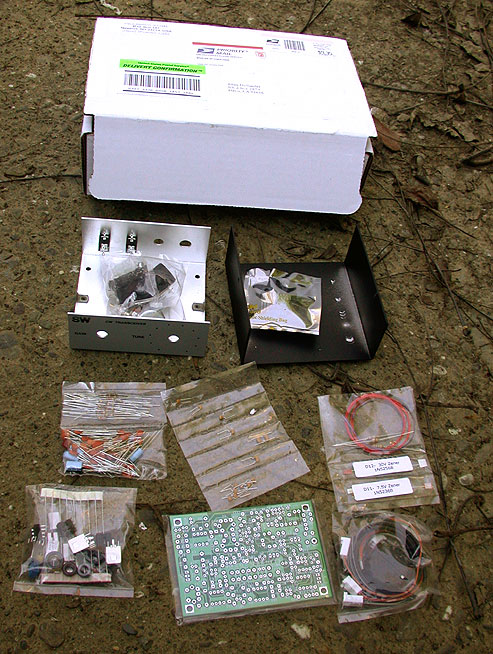 I finished building the bat detector last weekend (no bats heard yet — they are in hibernation or haven’t returned from down south) and have moved on to the next project — building a Small Wonder Labs SW-40+ 40 meter QRP transceiver. It has a lot of parts.
But I’ve been making a good bit of headway. 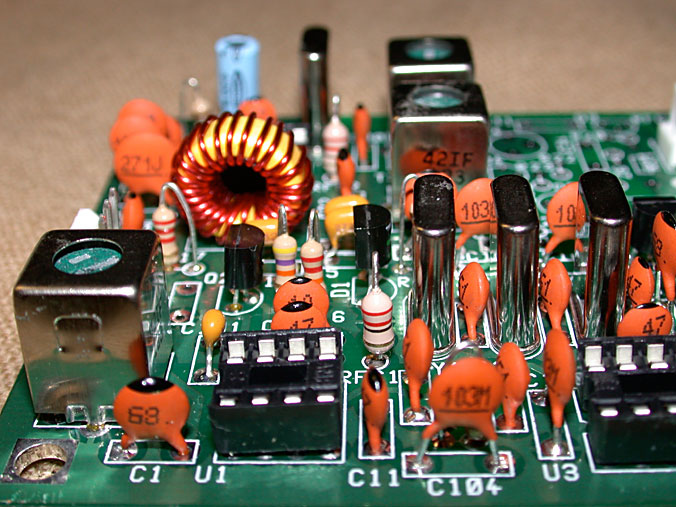
5 March 09
Leaping Into Hardware
The two replacement parts for the bat detector arrived today, so I’m all set to finish the project up (assuming of course I can manage to desolder the old parts). Already I’m leaping ahead though. The kit I’m building after this one is a low-power 40 meter transceiver, the SW-40+. Leap one after that is learning how to build circuits without having a printed circuit board for the project. Leap two may be wading into working with microcontrollers — I am quite intrigued by the Arduino platform. Visions of building a sun tracking platform for the solar oven are in my head.
Meanwhile, a reader of ours has sent along an illustration showing kit-building in the early days. Thanks, Susan!
28 February 09
Building The Bat Detector
 While Pica headed off to Stitches West today, I worked on my bat detector kit. It was a long haul — double-checking that the right parts were in the right place, soldering them in place, checking the soldering, clipping the leads, checking the step off in the instructions. The kit has testing instructions at various steps in the build, but the later testing steps are hard to do without a signal generator for a 40 kHz signal and ideally a scope. So I carried on. I somehow managed to do in the power indicator LED (it worked before lunch, it wasn’t working after lunch, I may have shorted it out with wire leavings underneath the circuit board), but didn’t let that stop me. The most troublesome point was when the leads to the 9 volt battery broke off the board. Cleaning out the holes in the board so I could resolder the leads was a major ordeal.
As shown above, the kit is now all wired, but not put in its case yet. Testing it (no bat required, rather it suffices to jingle some keys) revealed another problem besides the LED: the 10K thumbwheel pot for the volume control is internally loose, makes very poor contact, and probably needs replacement. I’m learning that electromechanical parts are frequent points of failure. At least all my soldering seems fine. So I’ll finish up the project once I get replacement parts.
12 February 09
Kit Building
My Ultra RX-1 ultrasound receiver kit AKA the bat detector arrived yesterday. It joins my kit-building queue, behind a Elecraft dummy load kit and ahead of a SW-40+ QRP transceiver kit I recently ordered. The Elecraft kit is simple, about the same level of complexity as the crystal radio I put together a week-and-a-half ago ; I don’t expect to receive the SW-40+ kit for a couple of months so the bat detector kit is something to put together in the interim.
As Pica says, much of working by hand is putting pieces together: this is certainly true in electronic kit building where the exercise is to take a box of resistors, capacitors, ICs and so on and delicately yet precisely solder them on to a printed circuit board to make up a working piece of gear. The bat detector kit has 78 parts, many more than the dozen or so parts of the crystal radio kit. I need to figure out a system for keeping all the parts sorted (capacitors the size of grains of millet are awfully easy to lose). Egg cartons? Those plastic boxes to hold sewing bits and bobs??
Part of the appeal in learning to build these kits is opening up the black box. An electronic device gets transformed from being a mysterious gizmo that somehow does stuff to being something whose internals one understands, at least in broad outline. It is a great leap to go from the kit-building stage to actually being able to design these devices, but the tinkering and learning that goes along with kit-building is how you get there.
On a completely different topic, happy birthday Charles Darwin and Abraham Lincoln, both born 200 years ago today!
1 February 09
Crystal Roots
The tradition of building one’s own equipment is as old as the hobby of radio. Originally this was by necessity, but the tradition still continues, especially in the building of low-power and often quite portable transceivers. I like the notion of going hiking with a rig packed into an Altoids tin and making a Morse Code contact or two with it, so this angle of the hobby appeals to me. There is no shortage of high quality kits to put together as well.
One does have to know how to solder to build these things, which hitherto has been an stumbling block for me, but last weekend I took the plunge and bought a 25-watt soldering iron, and managed to solder a couple of wires onto an RF connector. This weekend I moved onto an actual kit. This was a very simple crystal radio kit put out by The Xtal Set Society. A crystal radio is a very simple radio receiver, quite popular in the early days of broadcast radio in the 1920s, that derives all its power from the energy in the radio wave, no batteries or amplification is involved.
I built the kit pretty quickly yesterday evening, but didn’t manage to hear anything on it last night. So this morning I took it out and tested it with a better antenna and ground. With a bit of tuning, I could hear tinny voices from its special earpiece put well into my ear. Amazing! The radio is unpowered, remember. I was picking up KHTK 1140 AM, a Sacramento sports radio station. I even heard a bit of the Sacramento Kings’ game (not that they are worth listening to for very much this season.) Changing to the lower tuning band of this radio, I also heard KSTE 650 AM, a Sacramento news/talk station.
It’s all quite fun. More kits await me.
17 January 09
Antarctica Calling
I’m still in a bit of disbelief about having had a radio contact with Antarctica late this afternoon. After a long walk, a late lunch, and a trip to Woodland we got back to the house around 4 PM local time when I settled into doing a little radio. There was an SSB contest going on so I figured I’d set up on 20 meters and try for a few quick voice contacts. The backdrop to this is that band conditions have been horrible of late (will we ever see sunspots again?) and I wasn’t surprised that 20 meters, being basically a daytime band, was pretty dead with nobody coming in from the east, though I did have a contact with a station in Hawaii.
I tuned around a bit more and heard “CQ CQ CQ this is Kilo Charlie Four Uniform Sierra Victor from McMurdo Station, Antarctica.” coming in weakly but clearly. Nobody else is trying to contact him either. Nothing ventured, nothing gained, I think (a good rule in radio), and pick up the mike and reply. To my amazement he comes back having copied half my callsign. After several go-arounds he gets my name, full callsign, and location (he mentions he once took a couple of courses in Davis); signals both ways are weak but readable.
I’m not sure what fluke of propagation enabled that contact, but it was definitely a thrill. It’s 8500 miles from here to McMurdo Station, not bad for 75 watts into my little Buddipole antenna!
20 December 08
New Band and Some Beisbol
I’m on my holiday break now and am among things doing some radio. I just got the necessary bits to get my Buddipole antenna to work on the 80 meter ham radio band and tonight was the first chance I had to try it out. Success! I had two contacts on 80 meters Morse Code, one to Idaho, another to Banning, California, the latter signals being especially strong.
Tuning up from there, I heard what sounded like a baseball game in Spanish on Radio Rebelde on 5025 kHz. Pica confirmed my identification of the sport. Cuban baseball! Very cool to hear, especially since we are deep into the off-season here in the United States.
14 July 08
Night of Approaching Nights
ExpressJet has gone to the Great Airport In The Sky. They are ceasing flight operations as of September 2nd, citing high fuel prices. We flew ExpressJet on our trip this past April to Texas, appreciating the direct flight from Sacramento to San Antonio, though the journey ended by haggling with them about the return flight. (We won.)
I don’t see the airline industry as surviving this transition from cheap energy. Jet fuel has no substitutes — don’t expect to see hybrid planes in the air, and there is not a lot of room for improvement in the fuel efficiency of modern jet airplanes. Fly while you still can; the party’s winding up. Air travel will still exist in a decade or so, but it will be very expensive, circuitous, and basically only accessible to the rich and the elite.
This is, simply put, a vision of technological decline. It is an odd concept to get used to, conditioned as we are to expect ever-improving technology. Jet transport is an obvious, though painful, area to anticipate decline, but it stands to reason there may be others. Perhaps it’s time to ponder them.
Last night was Night of Night IX. This is an annual radio event commemorating the last commercial marine Morse Code station in the US, KPH located on Point Reyes, going off the air nine years ago. In this event, a number of these old transmitters go back on for an evening in tribute to the radiotelegraphers who worked for decades from ship and shore. I listened for a bit to the Morse Code, copying the stations from Point Reyes and from Mobile, Alabama. Voices from the past, to be sure. But we would do well to keep our skills up at trailing-edge technologies. They may yet come in handy.
4 July 08
Wilderness Arising
I can’t sincerely call this pessimism, being of the bicycle commuting elitist class, but I believe that the high fuel prices we are seeing now are here to stay and to get even higher. The price increase just seems too structural — there haven’t been any evident major shocks to the market to account for it. Lately, I’ve reading a good bit from The Oil Drum, a joint blog about energy and the future. A couple of linked tidbits:
This article describes how high fuel prices are calamitous for isolated rural towns. These levels of fuel prices are causing a lot of suffering in the short term — people simply cannot change their livelihoods in the near term. Speculating about the long term is fascinating — what will happen in say the twenty-five year span.? My guess is that a lot of these rural communities will simply cease to exist — they are too dependent on people being able to afford to make long-distance supply runs. Swaths of the countryside then revert to wilderness.
On another note, here is an interesting post about peak oil, technical societies, and learning from amateur radio, from somebody who just dived in and passed all three of the FCC amateur radio licensing exams.
13 June 08
I Jinxed The Sun
The sun is being awfully slow to come out of solar minimum, as reported here and here. This may be good for those who are keeping satellites alive in orbit but it is terrible for those trying to make radio contacts on shortwave. In fact, we have been at solar minimum ever since I got my license to transmit on HF, back in January 2007. This is surely not a coincidence. Maybe we’re entering another period like that of the Maunder Minimum.
The poor state of the ionosphere not withstanding, I managed two contacts this evening on HF, one into Washington state, another to Santa Fe, New Mexico.