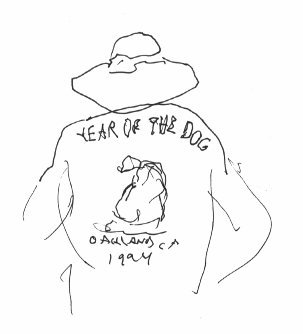
2 July 25
Uncommon Landscapes
 On my twice-daily walks I always carry a small camera in case I spot something worth photographing. But my walks don’t vary much, and lately I feel like I’ve run out of photographic subjects. Or have I?
Not long ago I watched a You Tube video about the photography of Stephen Shore. The video was by an artist named Tatiana Hopper who produces interesting content about the history of photography and filmmaking. It was good to be reminded about the work of Stephen Shore. He was one of the participants in the influential New Topographics exhibition in 1975 which presented photographs of ordinary human-dominated landscapes across the United States, with subjects like industrial parks, gas stations, and housing developments. Shore was the only participant who photographed in color, and he is one of the pioneers of artistic color photography. The photo of his at right was taken in 1974, and was published in his major photo book from 1982, Uncommon Places. It is quite typical of his work: a muted color palette, a strong formal composition, with a sense of detachment from the landscape.
I am clearly quite attracted to this aesthetic, and wonder if it provides a template for photographing the ordinary landscape of this college town. But does an artistic movement from the 1970s still have relevance in 2025, in an age when hundreds of billions of photos have been posted to Instagram? Interestingly enough, between 2014 and 2024 Stephen Shore posted every day on Instagram before deciding after 10 years it was time to move on from the practice. As a general principle, Stephen Shore’s Instagram Photos Are Better Than Yours. There is something about spending decades arranging photos on the ground glass viewfinder of an 8” × 10” view camera that inexorably leads to a heightened sense of composition. Photography is very much a matter of looking closely.
28 June 25
The Jasper Tax
 Our neighbor who shares the duplex with us likes to put out peanuts early in the morning for our local scrub jay, whom she’s named Jasper. When she goes off on a trip I have the assignment of placing four peanuts out on the glass table in the front yard. Here is Jasper collecting his first peanut this morning.
24 June 25
Daily Sketch - Hollyhocks
 Our neighbor has a veritable tunnel of hollyhocks by the sidewalk in front of her yard, and I think at one point seeds from those plants dispersed over into our backyard. Here is my sketch of the day of one of the pink hollyhocks in our yard.
12 June 25
Fostering the Neighborhood
We live in a wonderful location where we can walk to almost everywhere we need: the grocery store is two blocks to the east, downtown begins two blocks to the south, and so forth. And the neighborhood is pretty old by Central California standards: many of the houses date back to the 1930s. This evening we traveled next door to attend the annual meeting of the local neighborhood association. It is very wholesome in a way. Getting to know one’s neighbors is a good activity. We didn’t discuss the grand issues of our epoch, but things that matter at a local scale: which streets need stop signs or crossing warning lights, what the plans are for nearby developments, etc. Significantly, our city councilperson showed up at the meeting. She learned some things, shared some things she knew. As I often do in our town, I appreciate the accessibility of our local elected officials.
4 June 25
Daily Sketch - Plants Edition
 As of this week I am semi-retired, though the degree of semi-ness is something that I will be working out for a while. It does mark a good occasion to return to blogging, so here I am.
I have been keeping a daily sketchbook for about 7 years now. The sketchbooks have been in a variety of formats and styles. Within this practice I have a subpractice of doing more extended sketches in the field on weekends. I did a series of these on local buildings, but after running out of interesting buildings in Davis I’ve lately switched to weekend tree sketches.
Trees call for a portrait format sketchbook, which means I’m always searching for portrait format subjects on non-tree days. Plants and flowers are filling a lot of the other pages of the sketchbook. So here is today’s sketch. This is a Matilija poppy (Romneya coutleri) from the alleyway by a neighbor’s yard.
7 January 23
Weather Watching
I think we’re in the middle of the fourth storm here in 2023 already, and we have so far gotten 3.09” of rain in January. This has meant paying a lot of attention to what the weather is going to be doing in the next hours or days. Today for instance I wanted to know if I’d be able to cycle out to fetch take-out burritos sometime between 12:30 and 1 PM without getting rained on. It’s about a 4 mile round trip bike ride. So I studied my weather apps scrupulously. No precipitation was predicted to fall before 2 PM, so out I went.
There are two apps I’m finding especially useful. The first is Windy, which is available equivalently as a webapp or as a iOS or Android app. It provides many different weather visualizations, including reported temperatures and wind speeds, and radar and weather satellite views. Here is a view of radar imagery from Windy, showing a precipitation cell about 3 minutes away from reaching Davis.

The scientist in me particularly likes how Windy give you several different major forecast models to choose from, at various different spatial extents. For instance it lets you animate the ECMWF global weather model over the next 11 days, good for predicting how long this rainy pattern will last. But Windy also has visualizations of the HRRR (High Resolution Rapid Refresh) model for North America, which is at a 3 kilometer resolution and is updated every hour. Here is a view of predicted precipitation from the HRRR model over a 15 minute period, the image being straight from the HRRR website.

I also just discovered the wX app, available solely for Android. It is basically a repackaging of many different National Weather Service products, allowing you to avoid wading through lots of different NWS website page. From the app’s starting page you can just scroll down to see the NWS text forecasts for your location, and you can also click on an icon to get to a comprehensive suite of different weather radar products e.g. storm relative mean velocity, or reflectivity at various different radar tilt angles.
3 January 23
Storm A'Coming

This is a magnificent view from the GOES 17 geostationary weather satellite of the storm that is about to impact Northern and Central California. This is coming not long after Saturday’s big storm, and yesterday’s forecast discussion from the Bay Area office of the National Weather Service did not mince words:
“To put it simply, this will likely be one of the most impactful systems on a widespread scale that this meteorologist has seen in
a long while. The impacts will include widespread flooding, roads washing out, hillside collapsing, trees down (potentially full groves), widespread power outages, immediate disruption to commerce, and the worst of all, likely loss of human life. This is truly a brutal system that we are looking at and needs to be taken seriously.”
The storm will arrive around daybreak tomorrow and last into Thursday morning. And there are at least two and perhaps more storms following this one.
Time for hunkering.
16 November 14
A Day On The Rift Zone
Walked down Shoreline Highway in Point Reyes Station yesterday in search of lunch. I was quite happy with the burrito I eventually found at a Whale of a Deli, but feeding myself cheaply was otherwise going to be a challenge. Pica spent the day at the 2014 Fibershed Wool Symposium, and I tagged along to wander along the San Andreas Fault for a bit, hiking along the Rift Trail and visiting a few cows.
Point Reyes Station is an odd place. Marin is one of the very richest counties in the United States, and on weekends the town is a gateway for recreational and culinary tourism. Cyclists meander in over the hills from towns on the San Francisco Bay side of the county, stop to browse at the Bovine Bakery. The food here is pricey, emphasizing the local and organic — if I hadn’t found my burrito, I was going to settle for a $8.95 mac-and-cheese. West Marin is quite stably rural though — most of the land is in agricultural easements, mainly for dairy ranching. It made perfect sense for Pica’s symposium on locally-sourced fiber production to be held in this town.
 At left is a view from Point Reyes Station, looking west towards the ridge of the Pt. Reyes Peninsula.
21 May 14
A Trip to the Southland
In 1996 I moved west from Cambridge, Massachusetts, to be with Numenius while he finished his PhD at UC Santa Barbara. In the manner of these things it took longer than the year we were both expecting, and we moved up the mountain after the first year to live in a cabin porous to weather (it was a ferocious El Niño year) and vermin, mammalian and insect. (We didn’t consider the canyon wren, whom we named Marcel, to be vermin, but we did discourage him from building a nest in the light fixture of the entryway.)
We left this idyllic setting to move to Davis in 1999. We’ve been back a couple of times since, but this past weekend was to help a friend celebrate his 25th anniversary of ordination as a Paulist priest. Catholic gatherings are often large, chaotic and sloppy, and I enjoyed spending a quiet couple of hours on the beach with Frs. Ed and Ruben, and Jeff and his family, ahead of the big celebration before meeting Numenius on the train from Burbank.
I did sneak in a quick trip to Solvang, home of Village Spinning and Weaving, in the morning. I wasn’t spinning yet when we lived in Santa Barbara and it was a delight to drive up past the Trout Club, yuccas all abloom, and over the pass into the Santa Ynez Valley. (I used to climb that hill on my bike! I could hardly believe it.) The following morning, after a walk around Lake Los Carneros and submitting our entries to the final International Flower Report, Numenius and I took Cathedral Oaks Road into town, seeing old haunts and reciting street names as they unfolded through the windshield.
Memory is a strange phenomenon, treacherous and fickle, much poked at by the likes of a different Marcel. It’s triggered by externals we can’t control, befuddled by others (driving through the UCSB campus was an exercise in complete disorientation). How we crave stability, control. How futile that is. How very futile. Best to enjoy the ride, like the bright young things on the beach in Isla Vista, surfing through the weekend…
11 May 14
Whole Earth Festival 2014
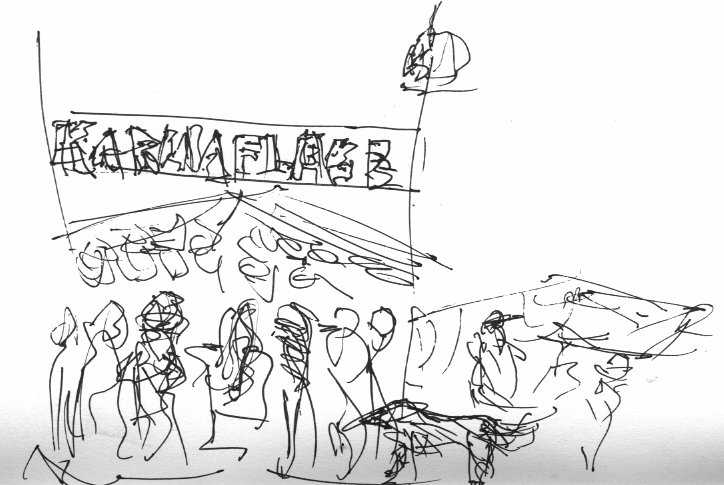 The hippies returned to UC Davis this weekend for the 45th year in a row, as it was the 2014 edition of the Whole Earth Festival, held on the main campus quad over Mother’s Day weekend rather to the annoyance of the university powers-that-be. It is my favorite event in the annual cycle of Davis community activities, and love its direct connection to the early flourishing of the culture of sustainability in the 1970s. Pica held down the fort at the booth of the Davis Spinner’s Guild, while the highlights for me included 1) local science fiction author Kim Stanley Robinson having a panel discussion with his friend Michael Blumlein, another sci-fi author and a UCSF physician. They talked about the future in the face of climate change and resource limitations, economics, and epigenetics. Thomas Piketty was mentioned often. 2) learning about the Third Space Art Collective, an recently founded group that since August has occupied physical studio space in a third of a warehouse just the other side of the freeway and 3) doing lots of sketching, filling up a small sketchbook over two days. Despite the abundance of tie-dye color, I stuck with monochrome pen, sketching rapidly with a black Gelly Roll or a brown UniBall Signo pen. Here are several of my many sketches.