
12 March 07
Mushrooms In The Straw
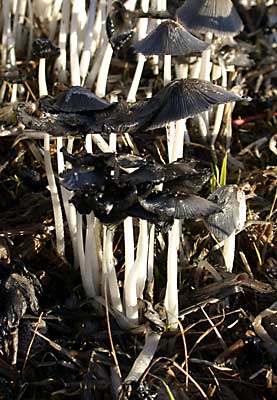 Not to be confused with straw mushrooms. We’ve had a straw bale sitting outside the vegetable garden since last summer, and once it got wet this winter, these mushrooms came up and covered the straw bale. We’ve had a heat spell these past few days, and the fruiting bodies have died back, but if we ever get more rain this year, I think we’ll see the mushrooms again. I have no idea what they might be.
11 March 07
Nearly Four Years
Four years ago this month we were housesitting for a friend in Village Homes. While I worked on removing the huge numbers of weeds that had built up over the rainy season, Numenius put Feathers of Hope together.
Since that time a lot of blogging friends have come and gone. It’s a shifting culture. Many people start out not knowing whether they’ll have enough to say; then it turns out they have plenty; then they think they’ve said all they can and stop.
One of these has, I’m really pleased to find out (better late than never), decided to come back. Rana writes about the natural world better than many. What she finds to say about the natural world at her doorstep is so evocative I can smell the wet earth. I can see the small black cat’s pipe-cleaner tail. I can hear the screaming blue jays.
—-
Today the first of the rough-winged swallows were back. The only one I haven’t seen in Davis yet this spring is the barn swallow, but they should be back any day. On our bike ride into town we had the show of white-throated swifts diving over and under the freeway, chattering madly. I have dirt under my fingernails. The first assassin bug showed up, oddly enough, on Diego’s coat. The insects have started emerging just in time for the swallows. We have leapt almost into summer, here, and it’s only March…
10 March 07
Semantic Magpies
Spring has come along (high in the 70s F today), and I’m back to surveying our grid square for the Solano County Breeding Bird Atlas project. My goal now is to start confirming breeding in species on the grid square that I’ve already observed there. One of today’s targets was the yellow-billed magpie; heading past a ranch house I observed one flying and disappearing into a nest I think carrying an insect. Does that count as a confirmed instance of breeding? Or is it not quite enough evidence?
Meanwhile, several colleagues of mine working on our semantic web project have gotten interested in ‘semantic eco-blogging’, the idea being to supplement blogged nature observations with data that can be interpreted by machines. Their testbed blog for this is FieldMarking. The file here is an example of the data format we’re testing; it describes the magpie observation above.
8 March 07
Treasure Under The Basement
 The 1930s was an era when labor was quite available and many public projects got started that called for a lot of handwork. This held true in the field of natural resource management as well as at large. In California, a forester named Albert E. Wieslander began a U.S. Forest Service project to map the vegetation of California. Many teams of botanists hiked ridgeline to ridgeline, pausing to gaze out over the landscape and mark in colored pencil on 30’ USGS quadrangle maps the vegetation patterns they saw. Only a few of these vegetation maps were ever published, and the set of well over a hundred hand-drawn maps of about 40% of the state lay forgotten.
The set of maps was nearly thrown out on two different occasions, when in the 1980s they were rescued by a professor at UC Berkeley and started to be curated and put to use. They are incredibly valuable from the point of view of historical ecology, giving a view of the vegetation of the state 75 years ago. A number of people have been working on the project of digitizing the Wieslander data, including my officemate Jim Thorne who is leading the effort to create GIS data from scans of the original maps.
The Wieslander map set was complete for the Sierra Nevada mountain range except for the Lake Tahoe basin area, where the hand-drawn maps had gone missing for a decade or more. These maps resurfaced Saturday.
Jim had been in touch with an emeritus professor at UC Berkeley by the name of Paul Zinke, who was one of the botanists employed by Wieslander, and was well in his 80s. Jim hoped that the oral history program at Berkeley would interview him, but sadly he died last year before the interview could take place. Jim then got in contact with Zinke’s son Michael, and after a while arranged with him to browse through some of Zinke’s papers. Last weekend, in a crawl space under the basement floor, they struck paydirt. The missing maps were there.
Above is a photo of the happy discoverers — Michael, Sarah, and Jim left to right.
27 February 07
Methuselah the Date Sapling
Two years ago Dr. Elaine Soloway germinated a 2000-year date seed found at Masada in Israel. This was the oldest seed ever to germinate. The seedling survived, and now Dr. Soloway is planning to transplant it. If the sapling, named Methuselah, continues to flourish and is female, in several years time we may find what the dates of Judea tasted like — according to Pliny the Elder they were renowned for their succulence and sweetness.
16 February 07
Snow Day
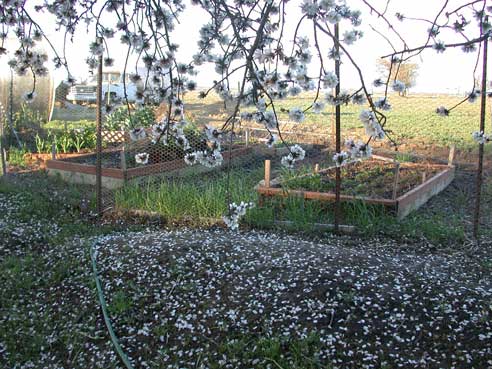 Dedicated to all my friends and family in chilly, snowy climes: hang in there, spring’s on its way!
Also check out the launch of the new Madrid wiki, Madripedia. (via Puerta del Sol Blog )
10 February 07
Now Indexing The Universe
No longer content to gulp all this world’s textual materials into its maw, Google is turning its eyes heavenward and partnering with 16 universities to build the Large Synoptic Survey Telescope. The 8.4 meter aperture LSST features a 3 gigapixel camera and will make a complete scan of the sky over Cerro Pachón, Chile, every three nights. Soon we’ll be able to read blogs from Epsilon Eridani b.
7 February 07
Five Years, 135 Blocks
We at the Yolo Audubon Society are planning to start a breeding bird atlas project for Yolo County, commencing in 2008. A breeding bird atlas is a set of maps that show the distribution of where every bird species nests, in this case in a set of grid cells across a single county. A breeding bird atlas project takes place over several years, often five — the idea is to confirm the breeding status of each species across the entire time period. A standard grid cell size is 5 × 5 kilometers, which works out to about 135 grid cells across the county. At about 15-20 hours of effort per grid cell, we will have our work cut out for us!
6 February 07
Valley Oak Potting Party
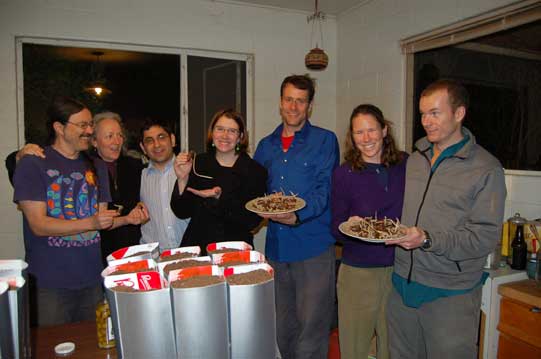 Jim (pictured at left) says that even though it’s an El Niño year, it was a very bad year for acorns. He had to go beyond Lake Berryessa to find a stand of oaks with a lot of acorns. But once he did, he collected about 1,000.
He delivered about 250 to Tree Woodland; another 250 to the Audubon Farms program. That has left him with about 500 to plant. Oaks put out fearsome taproots that require a lot of length in a pot. Gallon milk cartons are ideal. Jim collects these from the cafes all over town, gets donations of compost.
Today we were transplanting the germinated oaks into their milk carton+compost homes. Jim’s kitchen is now a nursery. But this rate of success is high: about 5% loss at each stage. Better, though, by far, than just plonking acorns in the ground and hoping they grow (about 5% survival rate, there).
4 February 07
Davis Flyby
It’s not an event that can be predicted to the precision of a lunar occultation, but sometime between 1:52 and 2:20 PM on February 20 the cyclists racing Stage 2 of the Amgen Tour of California will be entering Davis on the way to the finish in Sacramento. This 115-mile stage starts out in Santa Rosa and makes a couple of difficult climbs across the Coast Range mountains before descending into the Central Valley for the 45-mile flat run to the state capitol building in Sacramento. Some of the world’s top teams are in this year’s race — Credit Agricole, CSC, Rabobank, T-Mobile, Discovery, Quick Step — all passing within several hundred yards of where I work. I just better not blink!