
7 April 07
Botanic Garden
 We met Ron and Joe at the Botanic Garden in Tilden Regional Park in Berkeley on a drizzly morning today. The Botanic Garden is exclusively devoted to California native plants. I realized as we went through the collections that I don’t think I’ve been there since I took my classes on California plants in 1992 back in grad school at UC Santa Barbara. The plant species seem to be a lot more familiar than when I was there last.
Ron and Joe related that this garden led to the origin of the California Native Plant Society, which is the most important organization for the conservation of the California flora. The garden dates to 1940; in the early 1960s there was a plan to expand the 9-hole golf course across the road over the garden. Local citizens objected, and the organization that grew out of this eventually became the CNPS.
Above is a sketch of Trillium angustipetalum, a plant collected from Humboldt County. It is in the lily family, but as Chris Clarke relates , who knows what that means any more.
5 April 07
Blogger Bioblitz
Jeremy Bruno of The Voltage Gate has come up with an excellent way to participate in the National Wildlife Federation’s National Wildlife Week. He has announced the First Annual Blogger Bioblitz, “where bloggers from across the world will choose a wild or not-so-wild area and find how many of each different species – plant, animal, fungi and anything in between – live in a certain area within a certain time.”
This is not meant as a hard scientific project, rather it’s a fun way to “highlight little pockets of biodiversity across the world.” This event runs from April 21 – April 29. For the first couple days of that period we’ll be on a birding trip far too fast-paced to serve as a bioblitz, but after that I should be able to find some nearby nook to survey.
30 March 07
Kingbirds Are Back
Today was a holiday and I had lots of pottering opportunities. I went into town for a bit and then late in the afternoon I was out near the garden tinkering with the radio setup. I heard in flight and then later confirmed by sight two western kingbirds, the first I’ve seen this spring. They are very cheery sorts — always singing ‘dah-DEE-didi-dah’.
26 March 07
Three Year Oaks
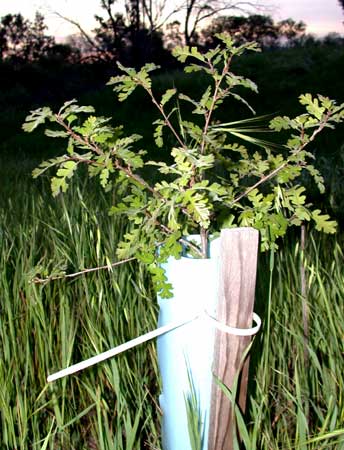 This evening I walked down to the creek to check on a few of the valley oaks my neighbor Jim planted as part of a restoration effort. Some are doing well, like the one at left; others didn’t make it.
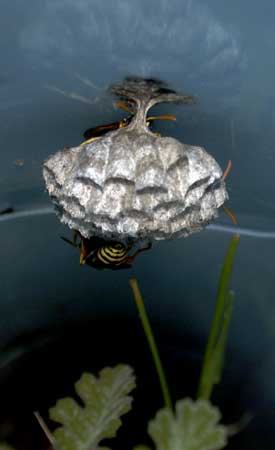 Meanwhile, some wasps have taken up residence in one of the planting tubes. The oak here hasn’t flourished but is still hanging in there.
23 March 07
Mustering Of The Orclets
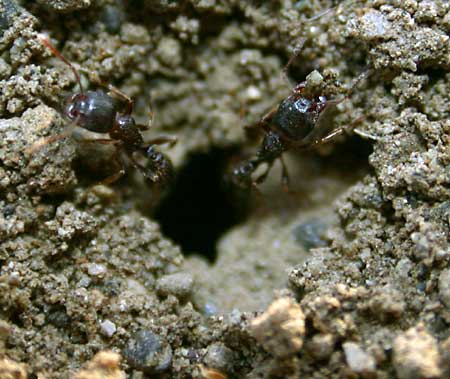 We were having a reprieve from the kitchen invasion of Argentine ants ( Linepithema humile ) but they may be on the rise again. They seem to head into the house in large numbers when it is either very wet outside or it is hot. The weather has been beautiful these past several days but it may start getting very warm soon. Not so good for us ant-wise.
At left two of the ants are mobilizing for the next moves on chez Magpienest.
22 March 07
Fighting for Treetops
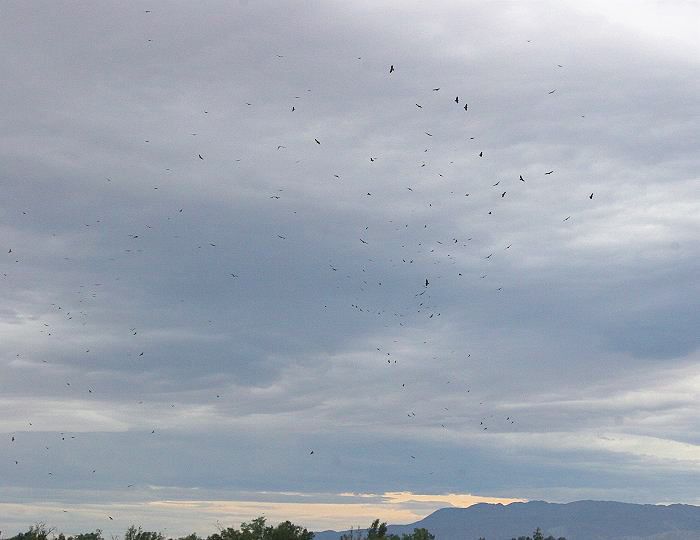 As Numenius said, the Swainson’s hawks have been coming in — over the next few weeks they’ll be nestbuilding all over Northern California. (There were reports yesterday morning of a record-breaking migration over the Anza Borrego desert in Southern California, about 1,300 birds.) As I left the house this morning, there was a gal by the driveway with a clipboard, watching the Swainson’s that was perched in a walnut tree.
The white-tailed kites have been nesting for nearly a month, now, outside my office. I watched them courting; the male then started his solitary courtship flights, toes extended, a barely perceptible hovering glide showing his striking wings to best advantage, around the pine tree where the female was presumably incubating, returning often with rodents; and now, he has taken up attacking any bird larger than a starling that comes near the tree.
Yesterday, it was a Swainson’s. There are fewer and fewer trees in this part of the world that are tall enough and with enough cover for these larger buteos. This one seems taken. The kite, a third of the size but far more agile, went after it again and again until the Swainson’s got so high it was barely visible from the ground. Is it worth expending this much energy? The kite obviously thinks so.
Postscript, Friday, 23 March: I’m adding a photo of the Borrego hawks, taken by Grace Clark. They counted 1365 hawks that all roosted overnight and left between 0900 and 0945 on Wednesday… Paul Jorgensen says in an email “it was one of the greatest natural spectacles I have ever witnessed.”
20 March 07
Fiddleneck
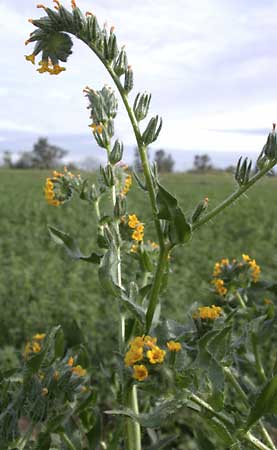 These fiddlenecks ( Amsinkia menziesii var. intermedia) are now in bloom on the south side of the alfalfa field by our house. They are a native flower found often in disturbed areas at lower elevations in California. This past Sunday we went to a picnic at a friend’s place on the top of a hill west of Winters, in the eastern foothills of the Coast Range. The fiddlenecks there are much further along and are starting to go to seed. Many of the other wildflowers there seem to blooming early this year as well.
19 March 07
Return Of The Swainson's Hawks
Yesterday we thought we heard and saw one, but today it was clear — the Swainson’s hawks have returned to the vicinity. At noon time there were two birds circling fairly high overhead and calling, and then late in the afternoon we saw two Swainson’s flying at a fairly low height calling and chasing a red-tailed hawk. The dynamics between the two species are interesting. The redtails are down on the Sacramento Valley floor where we are during the wintertime. In the mornings we’ve regularly seen one perched on the power pole 100 meters southwest of the house. Once the Swainson’s hawks show up, the redtails get displaced, presumably moving up to the foothills.
16 March 07
Ghost Owl
We walked this evening up from the house to Pica’s office and immediately heard the click-click-click-click of a barn owl, and saw it flying low over the house. A little further along, we heard another barn owl to the north over the alfalfa field, perhaps hunting along the newly plowed edge of the field. Near Pica’s office, we saw another barn owl — we believe there are two nesting pairs along the half-mile stretch between home and office.
A particularly well-travelled birding friend of ours thinks Davis may be the most reliable place in the country to find barn owls. There are several nest boxes over parking lots downtown, and certainly a number of pairs down this way. It’s either feast or famine with barn owls — they’re a hard bird to find in Massachusetts.
Many folks believe they are the origins of ghost myths. Cosmopolitan birds, all white underneath, making creepy-scary noises at night.
14 March 07
Snap Cress Weed
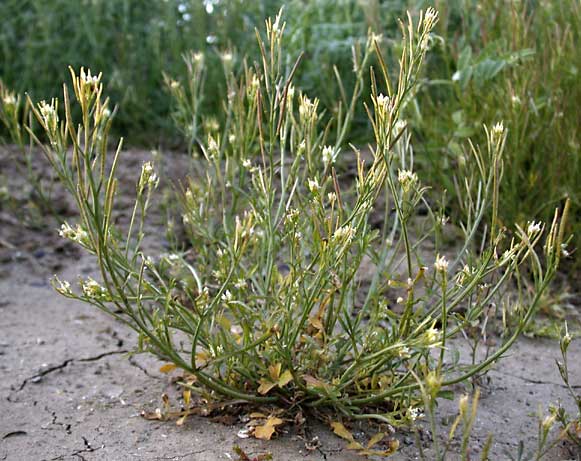 Just south of the vegetable garden there is a patch of these weedy crucifers that we don’t believe were here last year. This morning when we stepped through the patch the seed pods were going snap-snap-snap and tiny seeds were flying everywhere. I keyed the plant out in the Jepson Manual today and think it is hairy bittercress, Cardamine hirsuta. This would be interesting because the Jepson treatment of this introduced annual says it’s known to occur in the Klamath Region but not in points south. Hence this occurrence could be a range extension. The reference I’d really like to check is the new Weeds of California and Other Western States. There are many copies of this in the campus bookstore but it is shrinkwrapped in two volumes and I wasn’t peeking.