
12 September 07
Remembering Alex
By now it has been widely reported that Alex, the gifted African Grey parrot from whom we learned so much about avian cognition and communication, died suddenly a week ago at the age of 31. He was the friend and research subject of comparative psychologist Dr. Irene Pepperberg, who started working with him in 1977. Using a novel technique that emphasized social aspects of learning, Pepperberg was able to teach him categorization, shapes, colors, small numbers, the names of 50 different objects and express all this in English speech. One of my deep beliefs is that there is a great deal going on in the thoughts and feelings of our vertebrate friends; Alex was a fine teacher to all of us in that regard.
9 September 07
Paths Marked In Green
I rode into town via campus this afternoon, eventually headed to Community Park to see the San Francisco Mime Troupe perform here on their annual visit to Davis (especially noteworthy this time were the portrayals of Dick Cheney and Condelezza Rice), and saw markings on the campus paths that were definitely not here on Friday. A green stripe, the words “Davis Bike Loop”, and another green stripe. I didn’t follow them — I am too immersed in a book on Faerie to trust where such signposts might lead.
2 September 07
Rock-Flip Bust
A visit from Numenius’ sister and her boyfriend was wonderful — we unloaded about a kilo of beans, two butternut squashes, a slew of tomatoes, and untold herbs, not to mention what we fed them at lunch — and got in a showing of Ratatouille up in Woodland. None of which took us anywhere near a rock to turn over. Sorry Dave.
The evening was complicated by finding a black kitten under a car which refused, quite sensibly, to come out and wound itself around the wheel of a Mercedes. I’m going to try and trap it tomorrow — we don’t need any more cats in the Arboretum.
29 August 07
Eclipse
I need to find a good astronomical event RSS feed and stop relying upon my officemate to give me notice of such things — what if I were to miss an intragalactic supernova (the last such one was in 1604) or something like that? He did however let me know about yesterday morning’s total lunar eclipse, and thanks to Charlie-cat wanting his breakfast as usual at 3:10 in the morning, we were able to see it. Pica and I went out on the tarmac in front and had a brief gaze; I reminded her that the last lunar eclipse we saw was on October 27, 2004, the night the Red Sox won the World Series.
It looks like the next exciting astronomical event will be the Aurigid meteor shower, coming up on September 1st. This is predicted to be an especially strong outburst, due to the Earth passing right through the dust cloud of the long-period comet C/1911 N1 (Kiess). It is estimated that the peak of the shower will occur at 11:36 UTC plus or minus 20 minutes (this is 4:36 AM PDT).
28 August 07
Fossil-free Big Year
No sooner had I determined to spend less in the way of fossil fuels chasing birds than I hear about a wonderful project: a big year by bicycle. Malkolm, Ken, and Wendy Boothroyd started from Whitehorse in the Yukon and are heading to Florida via California and Texas. On their bikes. They’re in Crescent City, now, heading south, trying to pick up a hermit warbler on the way…
They are raising money for several important environmental causes and, more important, awareness. The home page is here; the blog is here.
The family is also encouraging all birders to plan a fossil-free birding day in 2008, and would love to hear from you if you participate! Raise money for local causes, or for theirs.
Great idea, great project. Tailwinds, dear Boothroyds…
20 August 07
Glacial Ramble
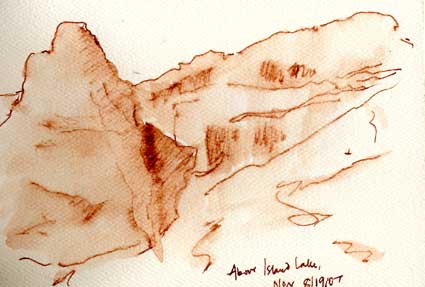 Our time in Colorado in April put us in closer contact with a landscape shaped by glaciers than usual. This weekend I renewed my acquaintance with tarns, deep scars left on rocks by the grinding of ice and boulders, and with the high-elevation plants and animals that now call this landscape home.
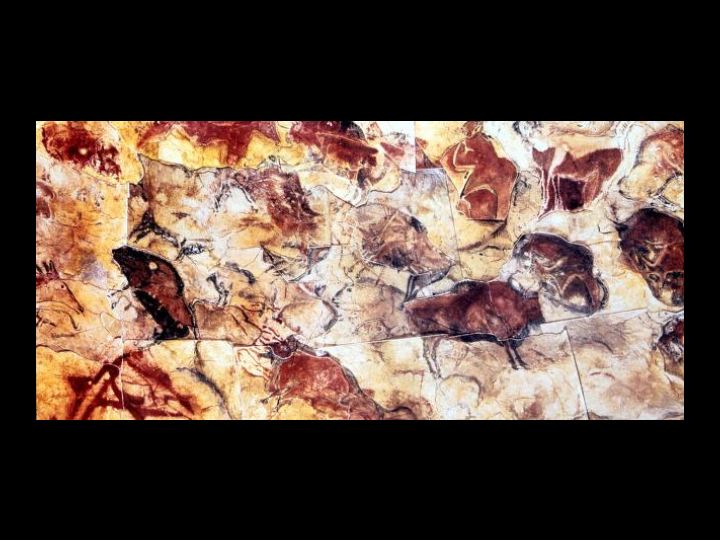
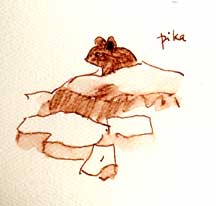
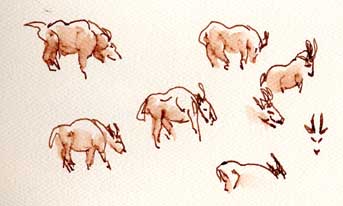 As a child when we visited the caves in Altamira (now closed to try and preserve the paleolithic paintings from human traffic and exhalations) I found myself imagining what it would have been like to have been an eight-year-old girl living in a cave so many thousands of years ago. The paintings are works of art in the most visceral sense I can think of, and though I had no idea about the shamanic (assumed) power of the paintings, the musculature of the animals (bison, deer, goats) was real and skilfully portrayed, even to an untutored eye. What was it like to draw like that? I found myself pondering those caves again on Saturday, as I watched mountain goat family groups pick their way easily across the scree slopes that would have sent me to the hospital, as I tried inexpertly to draw them.
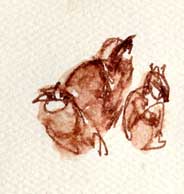 We were in the Ruby Mountains of eastern Nevada to see a bird, a bird that doesn’t belong in North America. It’s a hard bird to see (and, I gather, to hunt, for which reason it was introduced here from the Himalayas in the early 1960s). It took two attempts of a two-mile hike at 10,000 feet and a lot of hours before we finally saw it on Sunday morning, just before we were going to have to head downhill and drive all the way back to Davis. But spending a day surrounded by mountain bluebirds and pikas (whose alarm call is very similar to a red-breasted nuthatch’s), golden-mantled ground squirrels and Brewer’s sparrows, in the high glacial meadow with no sound except the wind and the occasional “hey, there’s a badger!” makes me feel the tug of the mountains again.
 Reading Butuki’s account of his trek across the Alps has great resonance for me just now. I’m not a strong hiker and I blister easily but it’s worth it… I’m hoping to convince Numenius to come with me to the mountains more. Promising the sight of introduced birds won’t do it, but Numenius is a mountain goat at heart…
[See Richard’s account of this trip here ]
17 August 07
Mr. Ibis
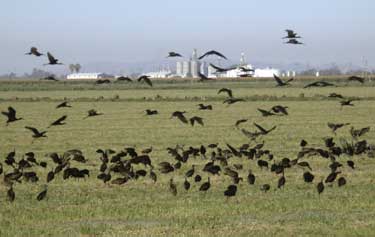 The reference in the title is to a character in Neil Gaiman’s excellent book American Gods, which I finished last night. It’s the season when we are seeing lots of white-faced ibis flying about in long, lazy vee formations. They head out from roosts in the wetlands such as the Yolo Bypass to forage in fields in the agricultural landscape. Two days ago the alfalfa field just south of our house was flooded for irrigation, and in came the ibis.

16 August 07
Wireless For Frogs And Mice
On Monday I heard a presentation about Quail Ridge Reserve, one of the University of California natural reserves that is administered by UC Davis. Quail Ridge sticks out as a peninsula into Lake Berryessa, about 40 kilometers west of here. Quail Ridge Reserve has gone hi-tech. In a collaboration with the computer science department, the reserve managers have set up towers and repeaters to create a wireless mesh network covering much of the reserve. The technology used is the standard wireless found in many a laptop, but the environment and scale of the network is of a degree to make the project interesting to computer scientists.
Putting a natural reserve on the Internet leads to some neat possibilities. One researcher, who left UC Davis for a position at the University of Michigan, can continue to monitor the calling of frogs he was studying in real time. Webcams have been set up that can be reoriented over the net, looking for foxes, mountain lions, and snakes. And plans are afoot to set up a triangulation network that will enable tracking of critters such as radio-collared mice down to accuracies of less than a meter. The only other such triangulation network is at Barro Colorado Island in Panama, with much less favorable topography.
14 August 07
Shake Your Tail
 A study at UC Davis shows that California ground squirrels generate measurable heat when waving their tails around rattlesnakes, which apparently helps deter the snakes from attacking them. (Adults are resistant and even immune to rattlesnake venom; the snakes go after the younger squirrels, which don’t have enough blood to make them safe.)
I have occasion to watch this tail-wagging, though there aren’t really any rattlesnakes on the valley floor, here. The adults chase each other around outside my window at work all day long, tails thrashing, in a kind of come-hither routine that involves lots of running, lots of thrashing, lots of sniffing, and very, very rarely, a copulation. They do seem to use their tails in communication as well….
14 August 07
Leaving Town
The swarm of bees that left the hive in the nectarine tree to camp in the almond tree have moved on. Pica returned home for lunch to find the drive leading out back clouded with thousands of flying bees and the almond tree empty. It all makes me think of colonists in a game of Freeciv moving one square off from the city before heading out into the wilderness in the next turn.