
7 June 08
Escape to Alcatraz
Tomorrow we’ll be going to Alcatraz Island. I think the last time I was there I was four; I got my picture in the paper. There were still inmates, then. (My mother tells me that was San Quentin. I have never been to Alcatraz before.)
We’ll be participating in PRBO’s International Migratory Bird Day Festivities. But it’s also International Drawing Day, so I’m hoping to get some sketches of gulls and other nesting seabirds while we’re on the island…
3 June 08
Land Of Olives
There are fledgling efforts in this state to promote agri-tourism. Yolo County, which leads the country in direct sales of agricultural products to customers, seems a good place to start. Perhaps surprisingly, Yolo County has become a center for artisanal olive oil production. This directory lists 13 olive oil producers in Yolo County, including Yolo Press, home of the only working olive mill in Yolo and Solano counties, UC Davis, who got into the olive oil production business a couple years ago when their grounds crew came up with a creative way to deal with the hazard fallen olives would create on bike paths, and others such as Frate Sole Olive Company, Hillstone Olive Oil, and the Story Olive Oil Company.
23 May 08
Acorns in the Laundry
For the past few years my officemate Jim has been raising valley oak seedlings from acorns in any place he has been able to find, including his own laundry room. The campus student paper the California Aggie reported today on his considerable efforts at native oak restoration.
14 May 08
Here Comes The Heat
An unseasonably strong high pressure ridge sitting over the Eastern Pacific is resulting in a heat wave here in Northern California. The high temperature for the next three days is expected to reach 102° F. Today it wasn’t that hot; some high cloudiness circulating in from the north moderated it.
This Saturday we will be providing radio support for the Davis Double Century, the 200-mile bicycle event that starts in Davis and circles through five counties. They are not going to have an easy time of it in this heat.
28 April 08
Not Just Birds
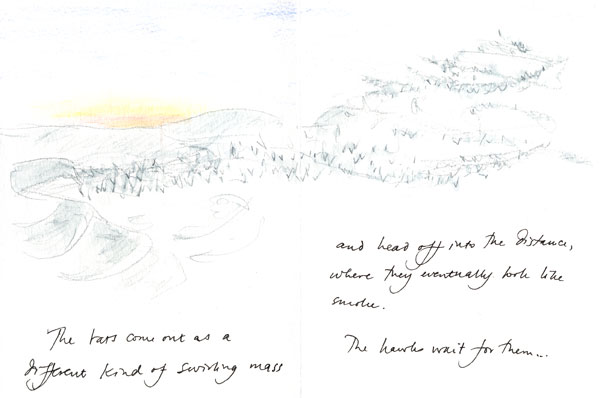
We saw lots of birds in Texas. I sketched a good number of them; some of those sketches will be appearing on Bird by Bird.
There were other critters out and about, though, including javelinas, deer, coyotes, and bats. Millions and millions of Brazilian free-tailed bats that emerged from the mouth of a cave mere feet below us, at a rate of about 500 per second, for ages and ages. They swirled up into the air to be picked off at random by awaiting red-tailed and Swainson’s hawks (and be summarily eaten mid-air) yet drifted off toward Austin unfazed, eventually looking like smoke.
There are some sights that defy description, verbal or pictorial. This is one of them. I offer my meager attempts knowing that nothing at all can compare with being there. Certainly nothing at all can convey the ammonia stink of twenty million bats emerging from their sleeping quarters…
28 April 08
West Texas Tidbits
This morning we were having side-by-side views of Brewer’s and clay-colored sparrow in the scrublands northwest of Uvalde, Texas. We arrived back this afternoon from our trip to the Texas hill country, Big Bend, and the Davis Mountains and quickly saw our familiar crows and yellow-billed magpies again — quite a change of avifauna!
Best bird of the trip: the Colima warbler. In the United States this birds is only to be found in the Chisos Mountains in Big Bend National Park, and it takes a long hike to get to the zone where it was found. We had a long 12-and-a-half hour hike that day, but after much effort and careful listening, we caught up with the bird. This was Pica’s 700th species of bird seen in the ABA region.
Most obliging life bird ever: on the Colima hike, a Mexican jay caught up with us hoping to procure some trail mix. He followed us up a few hundred meters, and often got within several feet of us. This was my first Mexican jay ever — I wish all life birds were so accomodating!
Most amazing astronomical sight: since the Big Bend area and the Davis Mountains have the darkest skies of anywhere in the continental United States, I figured on doing some good stargazing. I saw the zodiacal light for the first time ever, but what was incredibly cool was seeing the intersection of the band formed by the zodiacal light with the Milky Way. The former follows the ecliptic, that is to say the plane of our solar system. The latter marks the plane of our galaxy. Incredible to see this intersection in the real sky rather than just on a star chart.
16 April 08
700?
We’re off to Texas tomorrow. We’ll be looking at birds. (We won’t be on our bikes.) If we see the golden-cheeked warbler, black-capped vireo, and Colima warbler, that will put me at 700 bird species seen in North America.
My first big birding trip was also to Texas, in February 1990, also with Bill Drummond. I was recovering from a divorce and found the focused energy a wonderful outlet. I was mesmerized by pauraques and cranes, grackles and kiskadees.
I do not intend to stop birding, but I think this may be my last big trip that involves getting on a plane to see birds…
Lots of sketches ahead; I’ll post some when we get back.
15 April 08
Citizen Science Is My Life
We’re off on a birding trip to Texas in a couple of days, and we’ve been frantically trying to pull things together before then. One of which is getting the Yolo County Breeding Bird Atlas project underway. This will be a five-year project to inventory the birds breeding in Yolo County to a five-kilometer grid cell resolution. Somehow I’ve ended up being the volunteer data manager for the project, the biggest chore of late being producing a set of maps for the grid cells we’re surveying this year (the maps are available at the link above).
On clear evenings I’m still hard at work making variable star observations. I am not very quick at the process yet and seem to manage only two stars or so per session, but I presume I will get more efficient over time. It is fun the morning after to enter the data, since they get posted immediately on the AAVSO website. It’s great to be able to look at a graph of the change of a star’s brightness and see your own observations pooled together with everybody else’s. Here is an example of the light curve graph for the star R Canis Minoris. My own observations are the three points at right on the graph highlighted in a purple box.
27 March 08
Lights Out Earth Hour
On March 29th at 8 PM local time the World Wildlife Fund is inviting everyone to turn off their lights for an hour, an Earth Hour to make a statement about energy use and climate change. What to do then? March 29th also marks the start of the 6th annual National Dark-Sky Week Celebration organized by the International Dark-Sky Association. It’s a great chance to get out and do some stargazing!
26 March 08
Variable Nights
I got clouded out this evening. T Tauri and Z Ursae Majoris will have to wait until another time.
With my Messier survey well under way, I have been getting started at what seems to be my next astronomical adventure. This is being a variable star observer. A variable star is, simply put, a star that varies in brightness over a period of time, whether from minutes to decades. There has been a long tradition of amateur astronomers recording data about the brightnesses of variable star — the largest organization coordinating such activities, the American Association of Variable Star Observers, dates back to 1911.
I did some variable star observing almost 10 years ago, when we were living up the mountain in Santa Barbara, and am now back into it. I enjoy looking at faint fuzzy galaxies under dark skies as much as the next observer, but in the bright skies I live under, the faint fuzzies are either a) invisible or b) dim, washed out, and completely lacking in drama. Variable star observing is quite a different path to take. It’s a lot of fun. First, there are lots of stars to follow, no matter how bright the skies are or how modest your optical equipment is. Second, I love looking at star charts, and estimating things — the standard procedure in making visual observations is to interpolate the brightness of the variable star from precise measurements of the brightness of comparison stars as printed on the star chart. Third, it’s fun to climb the skill ladder as an observer. Finally, there is lots of interesting science to learn about in the process. Even a basic question like “what are the different types of stars” is now of immediate concern.
Tomorrow night is expected to be cloudy again. Dang.