
12 September 07
Remembering Alex
By now it has been widely reported that Alex, the gifted African Grey parrot from whom we learned so much about avian cognition and communication, died suddenly a week ago at the age of 31. He was the friend and research subject of comparative psychologist Dr. Irene Pepperberg, who started working with him in 1977. Using a novel technique that emphasized social aspects of learning, Pepperberg was able to teach him categorization, shapes, colors, small numbers, the names of 50 different objects and express all this in English speech. One of my deep beliefs is that there is a great deal going on in the thoughts and feelings of our vertebrate friends; Alex was a fine teacher to all of us in that regard.
25 August 07
Introducing Bird by Bird
Approaching 700 birds seen in the ABA area (North America including Canada and Alaska, excluding Hawaii) has me at a crossroads. It’s expensive and environmentally irresponsible to gad about the country adding birds to my list. (I have neither unlimited time nor unlimited funds for this kind of activity, and at this point the price per bird goes way up.)
Some birders at this point in their list settle into county listing, or state listing (easier if you live in a small state). Others start photographing birds, building their list back up with a photo of each species they had previously seen. (Some keep on going, chasing 750 and even 775; I will never be one of them.)
Me, I’m going to start sketching. A bird a day. Bird by bird, like Annie Lamott says.
 Sketching birds makes you look at the bird hard. If you look hard enough, it makes the bird part of your psyche. This takes your head to a different place, one that is unfettered by obligations. I’m not particularly good, but I hope to get better. You do it enough, it gets easier. You see more.
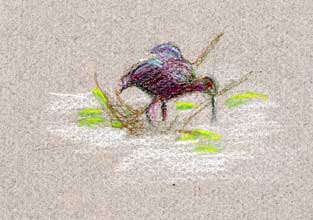 Today’s bird is a white-faced ibis, sketched at the Yolo Bypass. It was getting hot. There were birders around because a glossy ibis — an eastern vagrant — had been reported that morning. I found myself smiling that I was content to study the white-faced ibises rather than worry that I couldn’t see the glossy. This is my introduction to a new quest: not a new bird, each time, but a sketch. The bird in front of me, not the one that got away…
 I hope to produce one of these for my new blog, Bird by Bird every day, though they won’t always be new birds. We are seeing a lot of the turkeys from our kitchen window, for example. But my efforts are now shifting away from chasing to recording…

16 August 07
Daft Caper
So I’m creeping up on 700 North American birds on my list. It stands at 696, to be precise, the last one being the Philadelphia vireo near Rangeley in Maine.
I’m heading off tomorrow with some friends to the Ruby Mountains of Nevada to look for the Himalayan snowcock. No, it doesn’t really belong there. But according to American Birding Association rules, it’s countable. The black rosy-finch that hangs around up there ought to be more satisfying…. Numenius is sensibly staying put. See you when I get back.
5 July 07
Nestling Break
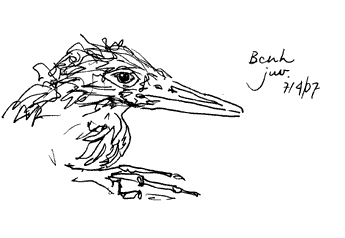 The gals were working on some black-crowned night-heron babies whose nest had failed. It was hot today — 105 degrees — and the babies got samples taken in the air conditioning. They’re going back this evening.
29 June 07
Back from Monterey
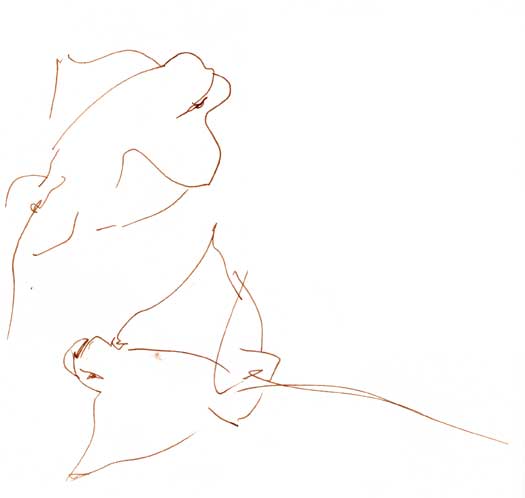 I now know what organs are most affected in Japanese quail by Napthalene (kidneys); that until very recently the Norwegian response to oiled wildlife was to shoot it; that shade cloth makes a better covering for bird-drying pens than either sheets or blankets if you want to have better air flow (which you do, because it cuts down the incidence of lethal fungi like aspergillus in birds that are being rehabilitated); that bat rays will suck on your fingers if you try to feed them shrimp; that the application and subsequent magnetic removal of iron powder to oiled feathers removes more oil than detergent washing alone.
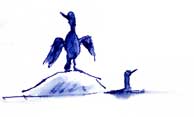
 I also now know the best spot in the world for breakfast if you want it in the company of a horned puffin, three sea-otters, and a constant stream of pelagic cormorants…

14 June 07
What I did today
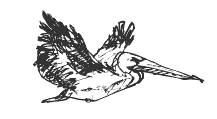
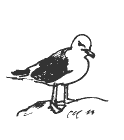
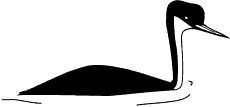
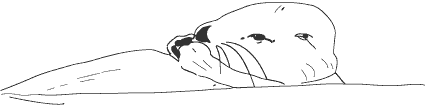
The Effects of Oil on Wildlife conference is coming up soon! I was working on the program today. I’ve also been doing some work on cetacean necropsy protocols and have been looking for reference material on where the heart is in relation to the scapula in the California gray whale.
Marine animals are fun to draw because they are so often monochrome, even starkly black and white.
Oh. Speaking of monochrome: today was also the graduate commencement ceremony. I helped out for oh, about an hour or two, then wandered home instead of sweating it out till ten. It was chaotic, hot, and fun.
26 April 07
Dappled Things
There was a snake under the peach tree yesterday — a gopher snake. It was trying to get a little sun. It had a fat bulge in its belly, undoubtedly the gopher that had been shaking through the Mexican primroses earlier this week.
I went out this evening to try and find it again; it was in the same spot, lazily flicking its tongue, checking us out.
Snakes have a hard time in ag lands. I wanted to tell it to invite its friends, to have lots of babies. I have no shortage of work for snakes… including the inflatable rattler at work that needs to be brought home so it can guard my lettuces.
13 February 07
Imped
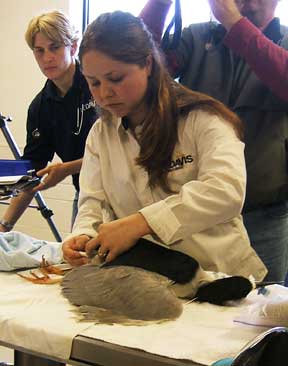 Yesterday for work I was present at a surgical procedure on a bird. A black-crowned night-heron had gotten snagged in some fishing line and was found in December, dangling from a tree, with its left wing flight feathers severely damaged.
Feathers grow back, but you have to wait for a new moult, which can take months, always to be avoided with wildlife. So the vets decided to undertake an “imping” on the bird, a transplant where donor feathers are grafted onto the trimmed existing shafts using bamboo skewers and five-minute epoxy glue. No blood involved: this is all dead tissue.
This night-heron had nine feathers imped yesterday.
Wondering where the term came from (the vet who did the surgery didn’t know, but he knew it was a very old falconry technique), I asked Language Hat. Right person:
“You’ve come to the right place! The Oxford English Dictionary says it’s from a (rare) Old English verb impian, which is related to various other Germanic verbs (like German impfen) but its earlier history is obscure, though it’s presumably ultimately derived from Greek emphuteuein ‘to implant, engraft.’ Its earliest meaning was ‘to (en)graft,’ which goes back to around the year 1000; what you want is definition 4:
4. Falconry. To engraft feathers in the wing of a bird, so as to make good losses or deficiencies, and thus restore or improve the powers of flight; hence, allusively, with reference to ‘taking higher flights’, enlarging one’s powers, and the like. In various constructions: a. To imp feathers into or in a wing, etc. Obs. 1477 Paston Lett. III. No. 794. 185 Like as the fawcon Which is alofte, tellith scorne to loke a down On hym that wont was her feders to pyke and ympe. 1580 LYLY Euphues (Arb.) 249 Ymping a fether to make me flye, when thou oughtest rather to cut my wing for feare f soaring. 1589 NASHE Pasquil & Marf. 11 Such an Eccho, as ultiplies euery word..and ympes so many feathers vnto euery tale, that it flyes with all speede into euery corner of the Realme. 1641 ROME Joviall Crew II. Wks. 1873 III. 374 To see a swallow..with a hite feather imp’d in her tail. 1706 PHILLIPS, To Imp a Feather in a awk’s Wing (among Falconers), to add a new piece from an old roken stump.”
etc.
The bird was expected to stay in an aviary for a week or two while it strengthened its flight muscles. By nightfall yesterday, though, it was was flying around and generally freaking out. It was released this morning after a band had been put on its leg; flew up into a tree where it stayed for 20 minutes, and then headed off into the Suisun Marsh.
7 February 07
Five Years, 135 Blocks
We at the Yolo Audubon Society are planning to start a breeding bird atlas project for Yolo County, commencing in 2008. A breeding bird atlas is a set of maps that show the distribution of where every bird species nests, in this case in a set of grid cells across a single county. A breeding bird atlas project takes place over several years, often five — the idea is to confirm the breeding status of each species across the entire time period. A standard grid cell size is 5 × 5 kilometers, which works out to about 135 grid cells across the county. At about 15-20 hours of effort per grid cell, we will have our work cut out for us!
30 December 06
Freezers in the Loo
I’ve written here before about the fact that a freezer containing cheetah and island fox samples sits in the women’s room at work. Today Numenius and I stopped by to pick up some newspapers I’d been soaking for a compost layer and I heard beeping. The freezer had gone from its normal -79°C to -25°C and was alarmed! alarmed! We lost power on Thursday night and I assumed this was somehow related.
This is a long weekend, New Year’s Eve weekend. I tried five numbers before I reached a person, who said he’d get his wife to call me back on her cell. More logistics. She asked me to look into the other freezers, one a -80° freezer and two -40°s. They were all full of pelican and elk bits; no room for spare fox carcasses, alas….
Eventually the professor in charge of the island fox project was reached; eventually she cleared out a bunch of other samples from some coolers, and eventually I met her and a student at the Wildlife Health Center to transfer this critical material to a separate place where it can be kept frozen.
Revco. The freezer company. It turns out there are hundreds of these stories, of freezers going on the fritz over holiday weekends. There are two kinds of freezers, apparently: the ones that have failed and the ones that are going to fail. (ALWAYS on a holiday weekend.)
Good thing I was looking in on the compost. By Tuesday, that freezer would have been stinking and the loo would have been flooded with fetid canid bodily fluids.