
30 May 26
Radical Cartography
One of my habits is stopping by the public library briefly and seeing what is on their new book shelf. This past Tuesday I found a copy of William Rankin’s new book Radical Cartography: How Changing Our Maps Can Change Our World and didn’t hesitate to check it out. Bill Rankin is a historian of technology and the geographical sciences at Yale University. He has been experimenting with cartographic techniques for a couple of decades now and has kept up a library of his projects at the site radicalcartography.net.
To Rankin radical cartography is not so much about the politics of the theme, but rather getting away from the conventions of mainstream cartography with its emphasis on neutrality, deference to data, and aspirations towards a single interpretation. Instead he proposes fostering the values of uncertainty, subjectivity, and multiplicity.
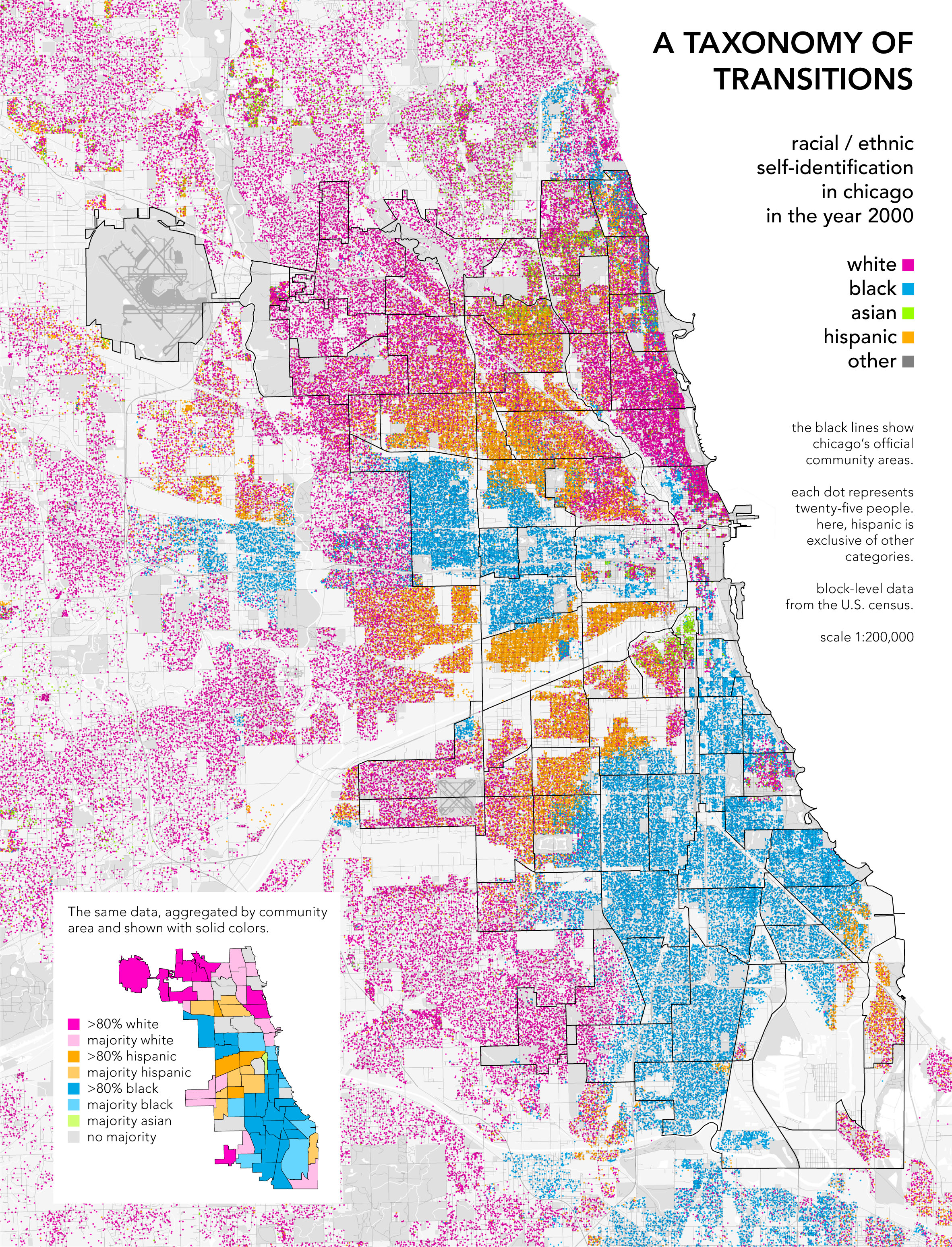
An example of this is Rankin’s work on mapping ethnic self-identification in Chicago. There is a long history of mapping ethnic neighborhoods in Chicago dating back to the 1920s. The maps of these patterns got reified into community areas which became the way Chicago understands its own geography. Rankin’s map illustrates that the transitions between many of these community areas are a lot more gradual than the “jigsaw puzzle” mapping of the areas would suggest. His technique in this map is to do fine-scale dot mapping: each colored dot represents 25 people of a particular ethnicity. This contrasts with shading the entirety of the community area with a color representing the majority ethnicity.
The book is organized by seven different elements of cartography: boundaries, layers, people, projections, color, scale, and time. As somebody who has done a fair amount of cartography professionally, I learned interesting concepts in all seven of the sections. Some of Rankin’s approaches run against my instincts, but that is part of his message, and there are techniques I’d like to experiment with. I’d definitely recommend the book for map lovers and geography students.
Previous: Craft Fair Next: Russell and A