
26 March 26
A New Short Row Technique
 Short rows in knitting are used when you want a different amount of fabric in one section of a row than another without adding length at the end of the row. Typical uses include knitting a sock heel to make the L-shape of a foot, adding length to the back or front of a sweater (this can be extreme to accommodate a dowager’s hump or slumping shoulders or a large bust), or to shape a sleeve knit horizontally, as I’m doing with my Fort Amherst sweater.
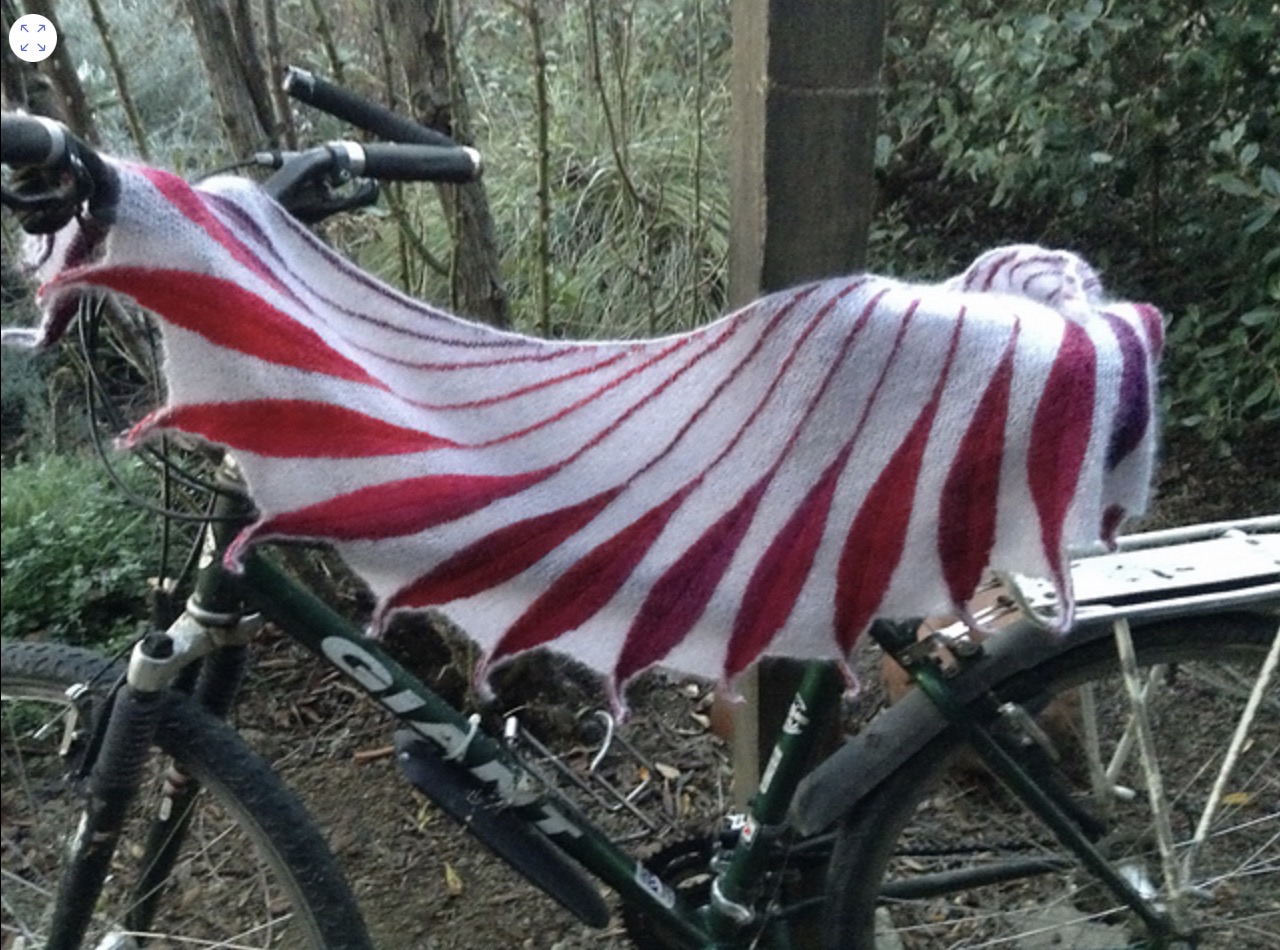
For years the only short row turn I knew was the wrap-and-turn, where you knit to the desired stitch, yarn forward, slip next stitch, yarn back, turn work (in the middle of a row). It’s clunky and inelegant except in garter stitch, where the bulk of the knitting hides a multitude of sins… With the internationalization of knitting I learned, and much preferred, the “German” short row, where the stitch is yanked hard over the needle making a “double-stitch” which you then knit as one on the next row. This has been invaluable in the swing-knitting technique where short rows are flung around with abandon to make some very interesting effects (I’ve knit the Dreambird shawl several times using this technique, pictured at right draped over my late-lamented bicycle which got stolen a couple of years ago).
The Fort Amherst project has introduced me to a third method, the Japanese short row (though designer Jennifer Beale calls this “Sunday short rows” in her pattern). Here, a removable stitch marker is placed over the working yarn, the return row is knit, but on the way back, you pick up the yarn held by the stitch marker and knit it together with the following stitch, removing the stitch marker. It is all but invisible! It might become my go-to method.
Previous: Duplicate Stitchery Next: The Case of the Missing Buttons