
15 March 26
Impressive In Every Telescope
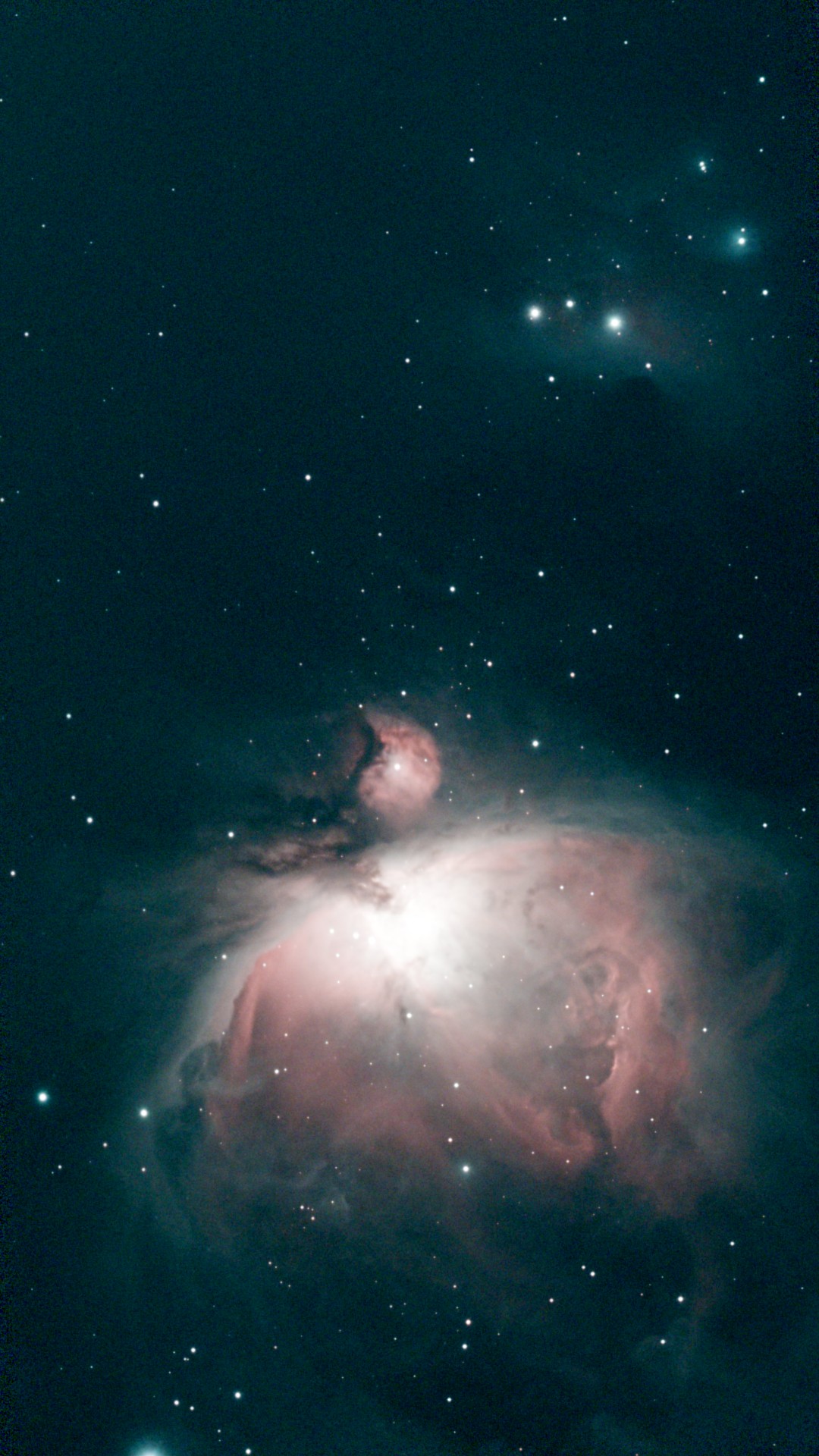 That is how Erich Karkoschka’s book Observer’s Sky Atlas describes the Orion Nebula, and I can verify this. I imaged it last night with my Seestar S50, and here it is after 13.5 minutes of imaging. The smaller reflection nebula in the upper part of the image is NGC 1975.
3 March 26
Eclipse At 3:10 AM
I was aware enough there was a lunar eclipse happening early this morning that I checked the time, got out of bed, threw on some clothes and stumbled into the backyard to look at the moon. It was well to the west and pretty red, though the bottom of it had a bright edge. This made me wonder if it was actually at totality or maybe I had gotten the time wrong and missed it already. I didn’t review the timing of it the night before. Pica woke up and had a brief look outside at the moon too.
I did have the time right, and stayed outside another 15 minutes, enjoying the now-darkened sky and the red moon. Back to bed then only to get up at 6:30 for the early morning Tuesday grocery shopping. I dozed later in the morning with Winston the cat by my side. It was a good morning.
27 February 26
The Destruction of the Night Sky
There are two proposals before the U.S. Federal Communications Commission right now that would do horrifying things to the night sky. Both are currently open to public comment through March 6 and 9, and I’m gearing up to submit a couple of comments. The FCC is the federal agency that regulates satellite launches in the United States, and they are now in the practice of rubber stamping an awful lot of these.
The first proposal is from a company called Reflect Solar that wants to put giant mirrors in space for the purpose of turning night into day for selected localities, in particular solar farms. They plan to start with an test satellite in 2026 with an 18 meter mirror, and then by 2030 have 4000 satellites in orbit at an altitude of 625 km. Eventually they imagine orbiting 250,000 satellites. The math for the amount of solar energy one can obtain this way absolutely does not work out, but even the 4000-satellite plan would be catastrophic for both professional and amateur astronomy. Visual astronomy would become an extremely risky activity, since accidentally glimpsing the reflected light in a telescope or binoculars could cause permanent eye damage.
Not to be outdone, everybody’s favorite archvillain Elon Musk is wanting to orbit up to 1,000,000 satellites for spaceborne AI data centers. There are presently 14,000 active satellites in space and low earth orbit is already getting crowded. One risk is Kessler syndrome — that is, collisions from space debris causing the generation of more debris in a chain reaction, rendering the entire orbital zone unusable. Another is impacts on atmospheric chemistry as tens of thousands of satellites burning up when they reenter may contribute to ozone depletion and climate change. Advocates of space data centers also tend to neglect the laws of physics. It is a lot harder to cool down a data center in space than on Earth, since due to the vacuum of space the only mechanism for heat transfer is radiation, not conduction or convection. (This is why vacuum thermoses keep their contents hot or cold.)
Both these proposals are now getting mainstream media coverage, such as in the New York Times and the Washington Post. The organization DarkSky International has a web page on how to comment on the proposals.
27 May 24
Back to the Stars
 A couple weeks ago, on 10 May 2024, we in Northern California were treated to an almost unheard of sight at our latitude, an aurora. That evening there was a lot of chatter about it happening, but I had no idea if I’d be able to see anything from our backyard in the center of town. Once it got dark, I went outside but couldn’t tell if the pink in the sky I was seeing was from city glow or from an aurora. But maybe my camera would help me see something my eye couldn’t. So I got my camera from inside and shot some stills and video through an ultrawide lens. Success! The photo above is an eight second time exposure, and I could see motion on the video (taken with half-second exposures).
This encounter has gotten me excited about astronomy again, and in particular electronically-assisted astronomy (often abbreviated EAA). Cameras have the ability to see much fainter objects than the human eye can detect, especially through taking long time exposures. I have almost all the right equipment to dive into EAA, the one exception is that my equatorial mount, which is needed to get those long time exposures, is currently broken. I am hoping to get it repaired soon.
Meanwhile, we are being alerted to look out for the once-in-a-lifetime eruption of the recurrent nova T Coronae Borealis. This may happen sometime between tomorrow and the next couple of years, but most likely in the next several months.It is currently 10th magnitude, but the last time it erupted in 1946 it got up to 2nd magnitude in brightness.
5 April 15
The Perils Of Color In The Digital Age
Last fall we bought a digital DSLR, and this has led me to dabble in a bit of astrophotography, even buying a good equatorial mount to facilitate this. Astrophotography is an interesting hobby. Practiced at its upper echelons (which I have no aspirations towards), it calls for extremes of technique, patience, and expensive gear. The aesthetic which many astrophotographers aim for is a quite colorful image showing many subtleties in the details of a nebula or other deep-sky object.
The use of color in this manner is in most ways an illusion, at least from the point of view of human visual perception. Cones, the anatomical structures in the retina that respond to color, are not sensitive to light at low levels, so looking through even a very large telescope at the nebula one will not discern the color brought out in the photograph. The color in the image may be useful in terms of scientific visualization, for instance illustrating different emission spectra, but it’s not what the eye can see.
Astrophotography is perhaps an extreme example, but I’m philosophically confounded by the question of representation of color in the digital age. Consider what might be the modal life of a digital photo shared with others. A snapshot taken with one’s smartphone, then posted to the web via Facebook or Instagram. The issue is of calibration. How does one ensure that the color intended by the photographer is what is seen by the recipient? Without both the creator’s and recipient’s monitors calibrated to a common standard, one cannot. These standards exist, but 99.99% of the time both parties are not so calibrated. Even enthusiastic photographers tend to spring for new lenses in lieu of color calibration equipment. One can adjust color curves in image software to one’s heart’s content, but without calibration both sides, one’s artistic intent in terms of color cannot be reliably shared.
And what if the intent is simply to record the colors one sees? The problem persists and is refracted twicefold. First, how faithfully do the levels of color recorded by the digital sensor represent the spectra of light being reflected by the object? Second, what are the colors being displayed by one’s monitor?
A solution I often adopt is to directly record the color in watercolor paint. With sufficient practice in color mixing, this can work reasonably well. Soil scientists have a more scientific answer to this problem — they go to the field armed with Munsell color swatch books to match and note the color of a soil unit. And the astrophotographer in me wishes there was a market for black-and-white consumer digital cameras: these problems go away, and cameras without RGB filters are more sensitive to light.
It’s also not clear where octarine fits in any color calibration system I know of.
[Image below is one of my attempts at astrophotography, being of the Orion Nebula.]

11 April 13
Sidereal Birthdays
I had a milestone birthday today — the earth has orbited around the sun 50 times since I was born. Unpacking that statement a bit, I puzzle over what point exactly marks that milestone? The usual notion I suppose would be to say that since I was born way back when at 4:04 PM on 11 April, therefore that time this year would be the milestone point. But that however is with reference to the Gregorian calendar, which keeps the date of the equinoxes more-or-less in the same point in the calendar by inserting leap days every four years except on centuries not divisible by four. Obviously, leap days are discrete insertions into the calendar, which is why the actual date of the vernal equinox varies between the 19th and the 21st of March depending upon the year.
Defining one’s calendar with reference to the equinoxes still isn’t exactly the same thing as the earth being in the same position in its orbit. The year with reference to the equinoxes is called the tropical year, and is 365.242190 days long. The year with reference to the fixed stars is the sidereal year, and is 365.256363 days in length. The latter seems to be what I’m interested in identifying in my milestone, so how do we determine this?
What it seems we want to do is calculate things in heliocentric coordinates, that is, with reference to an observer standing at the middle of the sun. To figure this out, I reached for a venerable piece of astronomy software, XEphem, and did some calculations. The heliocentric longitude of the earth from the sun at the time of my birth was 201:23:09 (degrees-minutes-seconds). Changing the date in the program to April 2013, I then stepped its clock forward and back until the heliocentric longitude was 201:23:09 again. This I find occurred at 7:50 PM on April 10th. Not today at all. Hmm.
All of which is a good reminder that time is a lot more subtle of a concept than many people realize.
22 March 13
A Universe of One
Yesterday I noticed on Twitter that #Planck was trending. I knew by that time what this was about, but was still surprised to see the name of the great early-twentieth century physicist having moments of social media fame. What had happened yesterday was that there was a press conference announcing the release of data from the Planck satellite mission to map the cosmic microwave background (CMB) radiation with ultrahigh precision. Universe is a teeny bit older than thought reads this story on Science News. Cosmologists have much to tackle ahead of them with this new data, so a few folks will be kept busy for years here.
Here’s the bit that most intrigued me from the Science News story: “Planck also found several features that surprised scientists. Most notably, it reaffirms a quirky WMAP finding that one half of the sky seems to have more fluctuations than the other. Theory predicts the universe should look the same in all directions. “ (WMAP was an earlier space mission, the second one, to produce a map of the CMB.) So this portrait of the universe at an early age is not random in all directions. Anyway, I am bothered by a statistical puzzle. We have a sample size of one — just one universe to look at here. There’s no population against which we can make a statistical test. So how can we possibly distinguish between this anisotropy being the remnant of some oddball random fluctuation during the early inflation of the universe, or the case where there’s undiscovered physics going on here?
Not that I know much at all about cosmology! At any rate I’m in one of my phases where I’m extremely interested in astronomy. I think this all started a couple months ago when Pica was knitting herself a Celestarium shawl.
2 September 11
Catching A Supernova
I saw the second supernova in my life last night. This would be SN 2011fe, which was discovered on August 24 by an automated sky survey at the Palomar Observatory. It is in the galaxy M101 (the Pinwheel Galaxy), which about 21 million light years distant, Two things are unusual about it. First, I believe it is the nearest supernova to occur since SN 1987A (a mere 168,000 light years away, back in 1987). Second, thanks to the automated observing network, it is the youngest type IA supernova ever observed, caught within 12 hours of the explosion. The supernova is destined to be one of the most studied such events for this generation of astronomers
I first heard about the supernova last Friday or Saturday, planned to look for it on Saturday, but was foiled by the presence of haze and smoke from a brush fire 20 miles distant. I have only seen one supernova in a telescope before, back in 1998 — I think was SN 1998bu in the galaxy M96, which got to about magnitude 11.8 in brightness. We were living halfway up the mountain behind Santa Barbara, a place with much darker skies than where we are now — I have great trouble seeing 12th magnitude stars in my 7” telescope here. So I looked on Sunday, and had no luck, cursing the bright skies here.
So I looked again last night, it being important to look before the moon gets too bright in the evening sky in the next several days. First looking through the eyepiece I thought it would go well. It did. When I had hopped to the correct star field there was a suspicious object. Was it the supernova? Or perhaps it was the 11.7 magnitude comparison star on my star chart? Comparing the geometry of the stars with those on the star chart it looked more like the former, but it wasn’t until I found a pair of stars at the upper part of the field pointing at the supernova on the chart did I confirm it. The supernova was now not at all difficult to see with direct, rather than averted, vision. A look at this light curve shows what has happened: between Sunday and Thursday the supernova brightened from about magnitude 12 to around magnitude 10.7. Wow. No wonder it was now pretty easy to see. I’ll be following it over the next several weeks, though the moon will make this difficult for a couple weeks
And now to look for a comet! I just heard about Comet Garradd today: it sounds like it is pretty easy to find.
10 February 11
Sunspots!
When I was cycling to work through campus this morning past the grassy landscaped hillocks just east of one of the engineering buildings, I saw a small refractor telescope pointing southeast set up on a tripod on the grass with a person hovering nearby. I realized that it was being aimed at the sun, which means only one thing: there are sunspots to look at! Any radio geek knows the significance of that: lots of sunspots means higher levels of ionization in the upper atmosphere which means better conditions for shortwave communications. Indeed, when I got into the office and looked at the little Firefox add-on in the lower right corner of the browser, it said that the solar flux index was up to 91, not very high in historical terms, but definitely a sign that the laggardly Solar Cycle 24 now is getting off the ground. Look for good radio DXing possibilities in the days and months ahead.
13 June 08
I Jinxed The Sun
The sun is being awfully slow to come out of solar minimum, as reported here and here. This may be good for those who are keeping satellites alive in orbit but it is terrible for those trying to make radio contacts on shortwave. In fact, we have been at solar minimum ever since I got my license to transmit on HF, back in January 2007. This is surely not a coincidence. Maybe we’re entering another period like that of the Maunder Minimum.
The poor state of the ionosphere not withstanding, I managed two contacts this evening on HF, one into Washington state, another to Santa Fe, New Mexico.