
6 April 26
Zeus Backwards Spells Suez
This is to say I believe that the epic fury of the gods is turning the Iran war into the United States’ Suez Crisis. Our power on a global scale is diminishing day by day.
I’m reading a lot about the Vietnam War right now. I just finished The Best and the Brightest, David Halberstam’s 1972 account of the technocrats in the Kennedy-Johnson administrations who led us into that war. I’ve now started Fire in the Lake by Francis FitzGerald also from 1972, a much-lauded account of how Americans failed to understand the history and culture of Vietnam when they went to war there.
Given the complexity of alliances that are under strain right now maybe I should be reading Barbara Tuchman’s The Guns of August too. It’s quite the escalatory mess.
28 March 26
No Kings, Again
 This morning we went to Winters to attend a No Kings rally. We knew it would be small and easy to get to compared to the much larger march from West Sacramento to the Capitol. Winters was very accommodating of people with mobility problems and featured a lot of sing-along music.
In the afternoon Numenius also went to a family-friendly gathering here in Davis (this photo is his and features local celebrity Whymcycler Peter Wagner).
From all accounts the turnout at today’s rallies set a record. The trick will be to have a massive turnout of voters in the mid-terms. Assuming they don’t get cancelled… at this point anything seems possible.
8 March 26
Graphic Reportage
 In Making Nonfiction Comics, Eleri Harris and Shay Mirk talk about the power of reporting on events using comics. There are advantages: a loose sketch of someone is a screen to hide behind in case they fear investigation. But it also humanizes the whole process, and I’m glad I took a pen and brush along to yesterday’s gathering in Woodland.
There are so many things to make us upset and even despair about this administration’s recklessness in all areas of public life here and in disrupting the world, but doing something, anything, to stand up to it feels helpful.
7 March 26
No Forever Wars
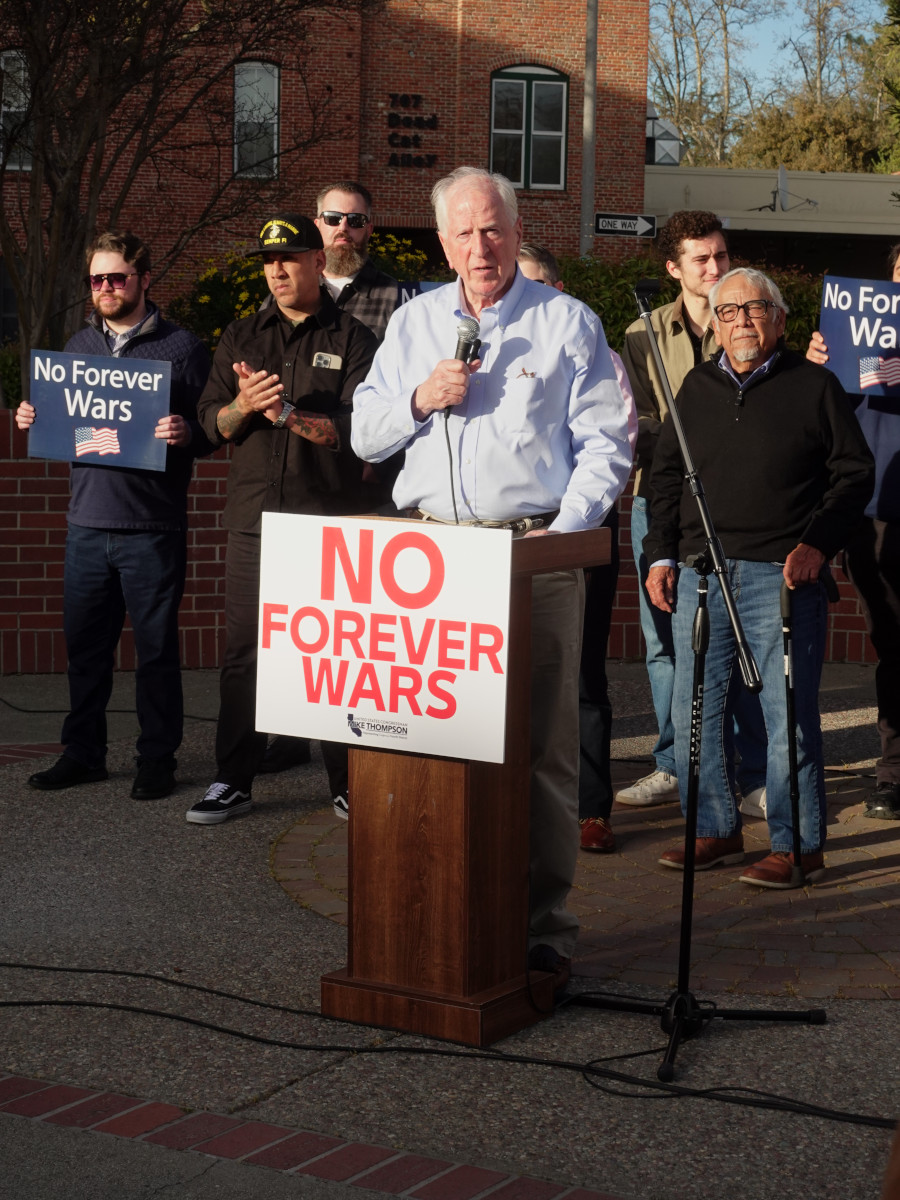 We went to an antiwar protest this afternoon up in Woodland that I believe was organized by our congressman, Mike Thompson. He is the individual speaking at the podium in the photo. Congressman Thompson served in Vietnam with the 173rd Airborne Brigade and was wounded there. Speaking with him today were four other veterans, one from the Vietnam War and three from the Iraq-Afghanistan wars. All of them saw wars that lasted over twenty years and do not want us entering another period like that. I am glad we got the chance to hear Congressman Thompson speak and that he is out in front on this issue, dreadful as it is.
Faine Greenwood on Bluesky yesterday expressed one reason why extricating ourselves will be hard:
“MAGA’s fundamental shared quality is a total lack of theory of mind for other people” is a theory that keeps getting validated by reality – look at almost every decision they’ve made in the war with Iran, and how they seem constantly surprised by the unanticipated actions of other parties. Strategy is fundamentally all about developing a sophisticated theory of the mind of one’s opponent. With MAGA’s Iran Adventure, guess we’re going to see what a modern war almost totally devoid of anything we’d call “strategy” looks like.
2 March 26
Listening to Language
I’ve been coordinating the Advanced German Conversation group for International House Davis since the death of our beloved instructor Paul a couple of years ago. This takes place every week on Zoom, though we also meet in person once per month, at least those of us who are local.
Last week I showed this Easy German video. It’s a podcast with an American guest (from Mississippi) whose German accent is so good that she is often mistaken for a German. She has studied German for a long time and now lives in Germany, which obviously helps, but she had to focus hard on improving what she assumed was an adequate accent and her efforts have definitely been worth it.
She did have some good tips about how to improve your accent in a foreign language. (It’s not necessarily fair, but native speakers will think your language skills are much higher than they actually are if you speak with a good accent rather than a bad one, even when your grammar is faultless.) Apart from learning what your tongue ought to be doing in your mouth and practicing sounds in front of a mirror, she recommended listening to a LOT of content in the target language. (I think this is a good practice for lots of other reasons, especially for the purpose of normalizing constructions that are awkward in our own language; German verb placement and cases with specific prepositions are two obvious examples.)
I’ve been trying to watch videos on subjects that interest me like spinning and birds following this advice. Today the algorithm served up an interview with a woman in her 90s on her experiences living (and moving around in) Germany during WWII. War inflicts trauma on everyone who lives through it with the possible exception of those who cause it…
14 February 26
Blurred Borders
I’ve been watching the Olympics sporadically on Spanish television with the help of a VPN. What has become clear is that there is an awful lot of nationality-switching. A Norwegian snowboarder couldn’t compete because his Finnish nationality hadn’t cleared yet. Of the four Spanish ice-dancers to reach the final, none was actually born in Spain, and none spoke Spanish with a convincing Spanish accent.
I’m all for this — nation-states are an imperial fiction, after all — but it does seem like events like the Olympic Games are predicated on perpetuating the fiction, with flags, processions, national anthems, and what not. Scooching yourself two countries over in order to have a better chance at a podium place does smack of cheating, however.
27 January 26
Young In Iran: A Comics Fundraiser
I am thrilled to report that the Sequential Artists Workshop opened a Kickstarter for young Iranian artists to tell the story of what it’s like to be young in Iran these days. It got fully funded in 3 days! They are now upping the goal to be able to print more copies and, if funds permit, to be able to pay the editors.
From the fundraising blurb:
WHY SWALLOWS?
“Why swallows?” you might ask.
When we asked our students to speak about their experience of being Iranian, we knew their works would end up being very different from one another. In fact, we had a kind of patchwork quilt in mind, one that could reflect the diversity of Iranian identity.
Yet, unexpectedly, a recurring theme kept appearing in the works: migration.
Even the students whose pieces were not directly about migration were, in different ways, still grappling with the concept.
Swallows in Iran are known for being migrants, for their freedom to travel across all lands.
Unlike us Iranians, swallows don’t need visas or security checks to make their journeys. They don’t have to struggle with travel bans.
This anthology is meant to travel, reaching different parts of the world. It is going to fly free!
That is why we chose the swallow: in its own way, this book, too, is a migrant.
Note from a birder: barn swallows, the species pictured in the book, are circumpolar, meaning they occur in all continents apart from Antarctica. They are famous long-distance migrants.
20 January 26
Pondering Greenland
 I am not able to read the article, but the Wall Street Journal has an opinion piece today headlined “Greenland is Trump’s White Whale”. This seems like a succinct way to describe Trump’s derangement. Beyond that, the neo-royalist lens that I’ve discussed earlier is the best framework I that have found to make sense of what Trump is up to. There is no strategic or economic advantage for the United States in seizing Greenland; rather it is all about status-seeking and being able to provide lucre to billionaires in his clique. A takeover of Greenland will quite plausibly cause the economic ruination of the United States, as Europe starts to disentangle itself from trade with us. The prime minister of Canada Mark Carney gave an excellent speech at the Davos conference about how middle powers such as Canada are going to start routing around the United States as hegemon.
Everything I know about American history says that the Greenlanders will suffer tremendously under American rule.
There is far more going on than we are aware of. As the aphorism from the Tao Te Ching says — “those who know don’t tell, those who tell don’t know.” And military adventurists should always heed the quote from the title character in the movie “Elizabeth” — “I do not like wars. They have uncertain outcomes.”
The photo at left was taken somewhere over the eastern coast of Greenland in September 2017 on our return flight from Iceland.
19 January 26
Resistance Through Knitting
 Numenius drew my attention this morning to a thread on Blue Sky about the Melt the Ice Hat, a knitting pattern released a few days ago to emulate a hat worn (and subsequently banned) in Norway to protest the Nazi occupation. The pattern notes contain this narrative:
In the 1940’s, Norwegians made and wore red pointed hats with a tassel as a form of visual protest against Nazi occupation of their country. Within two years, the Nazis made these protest hats illegal and punishable by law to wear, make, or distribute. As purveyors of traditional craft, we felt it appropriate to revisit this design.
Norwegians are ingenious people and this story gives an account of how the resistance moved to creating Christmas cards that echoed the sentiment as a way of getting around the ban.
I have no red yarn in my stash, at least yarn that isn’t particularly scratchy, so I ordered some online today. I already have requests for four hats, and I’m going to knit them two at a time — not like the double-knit socks in War and Peace, which is really a party trick, but using the magic loop method.
The outrages of ICE in Minneapolis are being well documented. We have GOT to stand up to this thuggery.
10 January 26
Memorial In Central Park
 We went to the memorial held in the afternoon in Central Park here in Davis for Renee Good who was murdered earlier this week by ICE in Minneapolis. There was a good turnout of several hundred people, some of them wandering over from the tail end of the Farmers Market, and the memorial was marred only by a disruption by our town’s Moms for Liberty loon (Lady, I’d like to hear what the pastor is saying, thank you, I thought).
On YouTube later I watched a bit of a conversation between historians Heather Cox Richardson and Joanne Freeman about this moment. A fragment from this:
(HCR) “And you know, I quite frankly never wanted to live through historic times. I just got to lay that out there.” (JF) “And I wanted to sit in archives and read dead people’s mail. Like that was our job.”