
24 January 10
Crows Overhead, Skies Are Gray
Today was the second annual UC Davis winter bird count; we did a sector of campus centered around the Wildlife Health Center where Pica works. The best birds were a bufflehead and a sharp-shinned hawk: Pica has a full list on Bird By Bird. It was overcast all morning with occasional sprinkles.
It’s been a good week for weather-watching, with a nice series of storms hitting California. We’ve logged 4.35 inches of rain here since Monday. I’m glad I bought a new pair of rain pants last weekend. I’ve been reading up on my meteorology, and found a great educational website yesterday for learning all about operational forecasting. This is the MetEd site (Meteorology Education and Training) site which is run by the University Corporation for Atmospheric Research. I spent several hours today working through their educational module on Skew-T diagrams, which are the graphs made to illustrate the data collected from weather balloon soundings.
17 January 10
River Otters In The Arb
We’re expecting three weeks or so of solid rain so we decided to go for a walk this morning out to the UC Davis Arboretum before the deluge hit. We saw a few new birds for the year (green heron, orange-crowned warbler…) but the big excitement was seeing a couple of river otters in the Arboretum waterway! Pica had heard that they were around several weeks ago but received no subsequent news about them. The waterway is a closed body of water so the mystery is how did they disperse into it — probably taking a sneaky path from Putah Creek following any number of culverts. We saw the otters working their way along the north side of the waterway: they were mostly underwater but we could spot their wake and air bubbles. The best view was after they had ducked into one of the storm culverts on the side of the waterway. One of them poked their head forward, and we had a clear view of his muzzle and whiskers! There is plenty of carp for them to eat, so we hope they stick around.
12 January 10
Geese Flying IFR
We had rain today, both a shower in the early morning and another in the afternoon. This is a change in weather pattern from this past week, where we’ve had dense and low fog (tule fogs) in the morning lifting to about 1000 feet by midday. The wetlands of the Sacramento Valley have lots of water by now, and frequently I will hear the calls of geese flying above well in the fog. As a pilot would put it, they are flying under IFR (Instrument Flight Rules) conditions. It’s easy to imagine that they are calling frequently so as to stay in touch with other members of their flock, but how are they managing to navigate? How do they know when to set down in their favorite flooded field? It’s a mystery. To me that is, but not to the geese.
26 November 09
Thanksgiving Mix
Having taken care of all of our familial Thanksgiving duties a week-and-a-half ago, we were free to do what we much prefer for the holiday, to have a mellow day on our own. These past several years we’ve had a little tradition on Thanksgiving to go on a walk up Mix Canyon Road, which is a steep road that goes right up to the crest of the Vaca Mountains about 25 miles west of here. We never make it into a big hike, rather we just enjoy being in the canyon in late fall with the chestnut-colored buckeyes rolling down on the ground and the bigleaf maples in color. Alas Pica didn’t make it a hike at all today: she slightly wrenched her knee looking at a Nuttall’s woodpecker within 50 yards of the car, so she stayed put and drew while I walked up the canyon a ways where I was lucky to see a couple of pileated woodpeckers.
We wanted to have the traditional Thanksgiving meal of going out for Chinese food — I was especially craving hot-and-sour soup — but none of the Chinese places we looked at in Davis were open. Happily, the Nepali restaurant Kathmandu downtown on G Street was open so we now have a new tradition of having palak paneer and saag chana masala thali plates on this day.
11 November 09
World's Best Place Wiki
That would be our very own Davis Wiki. Michael Andersen writing last week" for the Nieman Journalism Lab at Harvard comes up with “Six lessons from the world’s best local wiki”, discussing how the quirky origins of the Davis Wiki — developed by a couple of students in their spare time, seeded with 500 pages of good original content on the town — has led to such a large and massively useful site (it has 14,000 pages of content and gets 10,000 hits a day). He suggests that corporations for the most part have been really, really bad at managing sites with content for a locality coming from its denizens, and that folks getting into that business had best have a look at the Davis Wiki!
8 November 09
Sitting in the Sun, Sketching
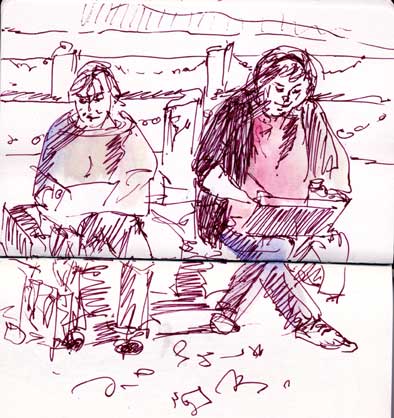 Regular readers of Feathers of Hope and Bird by Bird know I do this a lot. Today, though, I did it with my mother and sister. We drove out to Booth Bay Harbor for lunch. It was so warm we sat outside to eat, enjoying a Vietnamese lunch in a place that fronts as a bakery (the donuts are very popular with the locals).
We sketched, we ate, we drove down inlets, we popped into Halcyon Yarns in Bath (a dream palace and unexpected as their website says they’re closed on Sundays).
It’s a simple pleasure, picking up a pen and sketching a common eider or a lobster boat or the blue bay with conifers edging down to the water, red barns, oaks past their peak.
I live very far away. I wish I didn’t…
24 October 09
Roadkill On The Information Superhighway
No, this is not a reference to watching one’s unbacked-up data vanish forever off into the ether…
Rather, it’s to highlight a citizen science website some colleagues of mine have put together. This is the California Roadkill Observation System which allows you to enter observations of road-killed animals in California so that we can better understand what factors contribute to roadkill and then try to reduce these.
I tested out the system this morning and logged a poor jackrabbit that had been hit on the road I take to work. It’s straightforward to use, and has a helpful Google Maps interface for inputting the location.
15 October 09
October Storm
The first big storm of the season was yesterday, unusually early in the fall. Davis got 2.94 inches of rain, mainly in the daytime. There was a new record low pressure set in Sacramento for the month of October — 29.39 inches. I rode off to work into my first downpour in a while and promptly crashed my bike. Not so fun. Are we due for a big El Niño year this time around? Stay tuned.
19 September 09
Apostasy
Before I visited the new Getty Museum in Los Angeles I happened across a New Yorker article on the landscape design for the museum, the famous altercations between architect Richard Meier and the landscape architect Robert Irwin. (Architects can have really big egos, exacerbated to infinity by open purses.) It described cascading gardens that filled hillsides, that echoed and mimicked the chaparral landscape on top of which this great white city (“Oh, it’s just like Jerusalem”) had been plonked, glowering above the 405.
When I got there, eager to see this vast transformation (desecration) of the landscape, I asked a guard how to get to the rest of it. Oh, this is it, he said. It? It seemed tiny compared with what I’d been expecting. No expense had been spared for sure, but it seemed way overwritten. It also seemed way out of scale with the rest of the structures. (To be fair to Irwin, it seems that the number of edifices multiplied over time, while he’d been given an initial set of plans to work from, so it was never going to be to scale.)
Disappointment. Arrgh.*
Most of my friends in Davis rave, rave, rave about the Davis Farmers Market. It was sold to me repeatedly when we were planning to move here. Best in the country, best in the state, biggest, best, best, best. I remember thinking when I first got here well, this is nice, but where’s the rest of it?
It’s probably unfair to compare any farmers market in the U.S. with what I grew up around in Spain and France. The “smelly markets” that made us wrinkle our noses (brats from JFK-era sanitized California supermarkets) filled large warehouses, overflowed from them. Fish, driven in that morning from the coast. Meats. Stalls numbering in the dozens all selling fresh vegetables and fruit, artfully stacked and arranged. They were vast, overwhelming, gorgeous. We took them for granted.
Farmers markets here are a 70s resurgence, a protest, the anti-supermarket. If the Davis one is the biggest and best, I’m not well encouraged to visit others. (Numenius tells me the one in Bloomington he visited in in September was excellent, but that was probably because many of the sellers were Amish, and they never were shopping in supermarkets in the first place.)
So, a typical experience of shopping at the DFM: I look around. I try and fit what I see into an ensemble that will work for lunch or dinner. (We only eat organic veggies and my choices here are limited to about 3 or 4 stalls, so the comparison is even more unfair, but still.) I can never quite find what I’d envisaged. I buy things anyway. They go into my bike basket and I have just spent $30 on stuff I didn’t plan on buying, without finding what I needed, so I bike over to the Coop to get the rest. Invariably. Every time.
The Davis Food Coop happens to sell produce from the three local organic growers who show up on Wednesdays and Saturdays at the Farmers Market. It also sells produce from about 8 other local organic growers. And about 12 other not-so-local ones. I never leave there unable to find what I went in for. Sure, it’s really a supermarket. But it’s also a community in which I’m invested.
This morning I will go to the Farmers Market, hauling along Sweet Caroline my new spinning wheel for Spin in Public day. (Not on my bike, but when a bag arrives next week for my wheel, this will not be out of the question.) I will run into, probably, 25 people I know (more if they come in more than one at a time). I will joke and laugh and revel in the community that convenes in the Central Park area of Davis every Saturday and Wednesday. I may buy lunch. I may even buy flowers. But I will probably not, apostate that I am, buy produce. They may revoke my citizen of Davis card…
* Happy Talk Like a Pirate Day.15 September 09
Signs of Fall
We had some rain this weekend, the first rain of the season, especially last night when we got about a quarter of an inch, enough to soak into the ground a bit. I had a meeting today up in Sonoma Valley, near the town of Glen Ellen. It smelled wonderful up there along the creek.
Maybe I’ll remember to set up the rain gauge this rainy season.