
14 July 25
Weekend Tree Sketching - Palm
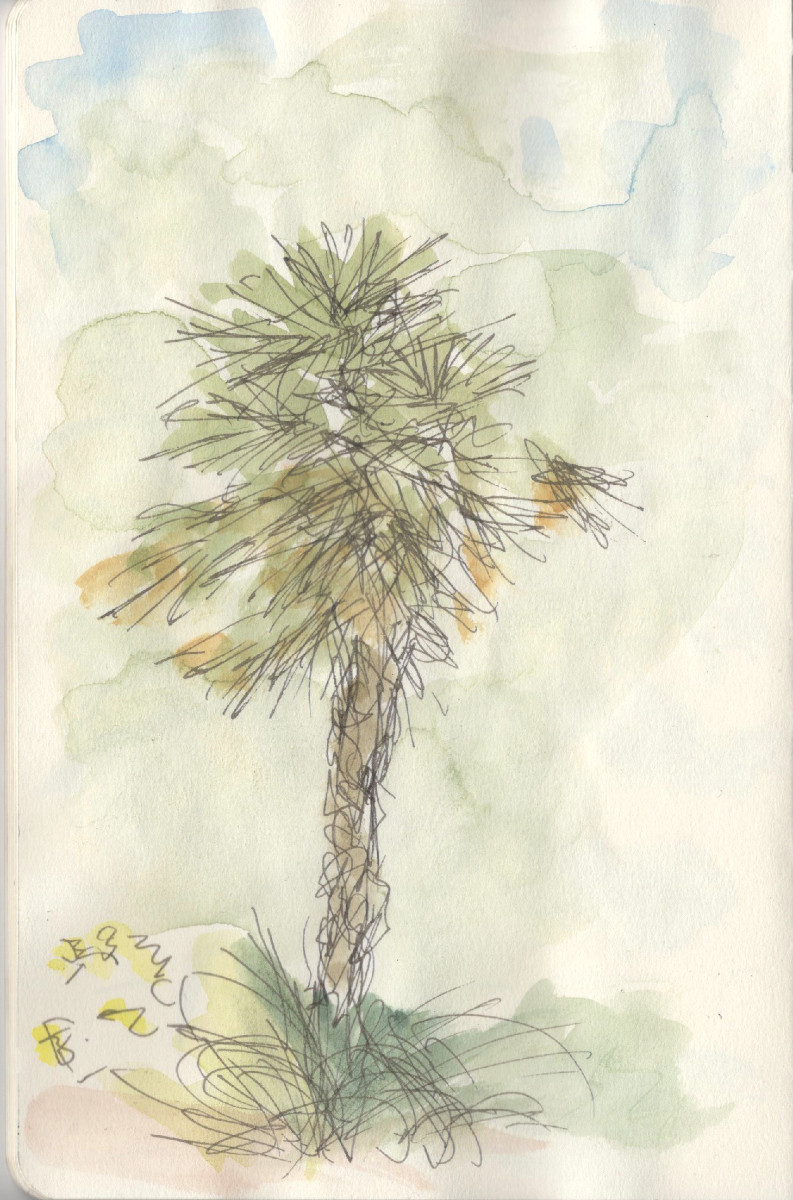 This sketch is from yesterday’s outing to Central Park in Davis. I took my Schmincke pan set of watercolors and appreciated having the cobalt blue handy.
12 July 25
The Profile Selection Project
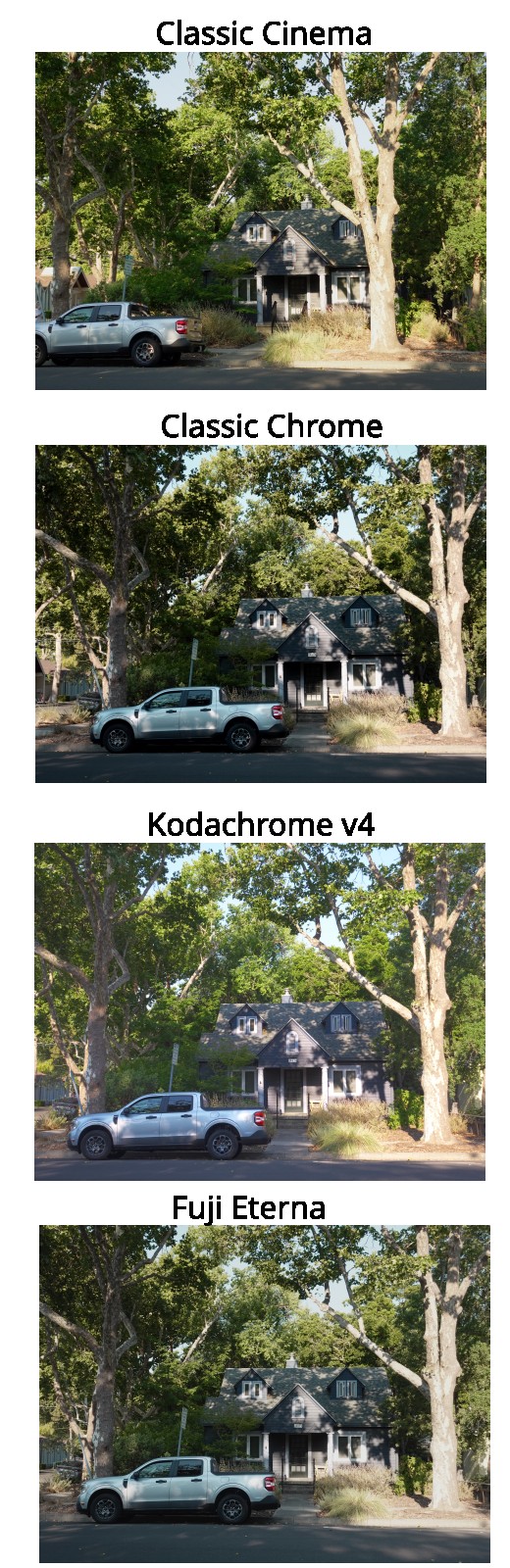 I am now deep into the project of figuring out which film simulation profiles to select for my little Sony ZV-1. As previously described, there are about 85 profiles in the recipe book, and the camera has slots for 10 of them at a time. I’ll need to pick and choose. Basically I want to cover a range of styles. Of the 10 slots, I will reserve one for scratch, and two of them will be monochrome styles: one low-contrast, and the other high-contrast. This leaves seven for color profiles. The way to figure which to choose is to do lots of testing. So now when I go for my morning and late-afternoon walks I load up the camera with a new profile and take some pictures using it.
At right is an example comparing four different color profiles. The photos were taken one after another.
10 July 25
Weekend Tree Sketching - Cypress
 On weekends nowadays I head out to find a tree to draw as my daily sketch. Here is my sketch from this past Sunday of a cypress that is in front of a nearby church. When I sketched it I realized that the watercolors I wanted to paint it with were in my Schmincke pan color set back at home, so I finished it off there. The paints I used were raw umber for the trunk and perylene green and yellow ochre for the foliage.
8 July 25
Palettes For Photography
 My main point-and-shoot camera these days is a Sony ZV-1, which I’ve had since 2021. It is compact, easy to carry about, has a wonderful sharp and fast lens, but I have not been happy with the jpegs I’ve gotten out of the camera. Recently I used it to take a reference photo of a tree I had been sketching, but was quite dismayed that the skies in the photograph had turned cyan, even though the camera was on standard settings. I usually shoot jpeg plus raw, wanting to keep a raw file around in case I need its latitude for additional processing. Looking at the raw file, it was clear what happened in the jpeg in the camera: the image was not overexposed, but the blues were clipping when the sensor data were transformed into the jpeg. This got me to start researching ways to get better jpegs out of Sony cameras.
All of which lead me down the rabbithole of Sony film simulations. It turns out there’s a deeply-buried feature in the Sony interface called “picture profiles”. As designed by Sony, these are set up mainly to help videographers film in consistent low contrast for subsequent color grading in production. But they provide a quite powerful way to change the look of stills or video imagery. A photographer and cinematographer named Veres Deni Alex figured out that picture profiles provide a route to introduce film simulations into Sony cameras. Film simulations are a well-appreciated feature of Fujifilm digital cameras — the company drawing upon their long experience with analog film — but Sony cameras don’t have anything comparable. Alex put in the trial-and-error work to adjust the 25 or so parameters in a picture profile so as to get it to render like a particular film stock. Over the past several years he has built up a library of about 85 different film simulation profiles. I was intrigued and bought a copy of his recipe book.
The above straight-out-of-camera photo of a dog sculpture downtown in Davis on G Street is an example of the output of one of these profiles. The name of the profile is Classic Chrome, and Alex based it on the Fujifilm simulation of the same name. Fujifilm in turn designed their simulation to allude to documentary-style photos printed in magazines often shot with Kodachrome or Ektachrome. After one outing with it, I like the profile a good bit, and it seems well-suited for urban landscapes.
I would use a different profile if I were going on a photo walk through the local arboretum. I’d first look for one that is good at rendering greens and responds well to bright flower colors. (I’m not sure which one yet — I have lots of experimentation ahead of me). Essentially, loading profiles into one’s camera and working this way is akin to choosing a palette in plein air painting. The question to ask while setting out is what is the mood, sense of light, and story one is trying to capture in the photo outing? The choice of the photographic palette will vary accordingly.
It also seems important that this workflow emphasizes getting the look of the photo right in camera, rather than much later in post-processing. This again resembles sketching or painting in the field — the immediacy of the moment lets one emphasize the elements of light and form that are important in the scene. Otherwise one risks forgetting in the studio what the photo was about.
3 July 25
The Hated Red Pen, Revisited
 I’ve been thinking about the pen that I hate and I decided to give it another try. I’ve been watching some of Marc Kompanayets’ videos about pen and ink drawing and thought I’d try with this pen, which has a slightly flexible nib. (Marc is a fanatic about super-flexible nibs, which allow for maximum line variability.)
Hatching, and especially crosshatching, is a skill that takes some time to master. I’d love to be really good at it. Marc’s 10 Essential Cross-hatching Techniques is excellent but he’s particularly adamant about keeping the gauge consistent. You can vary the line length, direction, line strength, and even whether if curved or straight, but if the width between the lines is inconsistent, the effect quickly gets messy. The idea is not to draw attention to the hatching unless this is your goal. His prime example of a brilliant hatcher (in pen and etching) is Rembrandt.
The pen is still fighting me a bit but I’m sure it’s much better for sketching/drawing than writing for me, so I’m going to persevere.
Below is a Rembrandt self-portrait. It’s messy, it’s all over the place, and it’s brilliant. If I could only ever be an eighth as good as this, I’d be so happy.

2 July 25
Uncommon Landscapes
 On my twice-daily walks I always carry a small camera in case I spot something worth photographing. But my walks don’t vary much, and lately I feel like I’ve run out of photographic subjects. Or have I?
Not long ago I watched a You Tube video about the photography of Stephen Shore. The video was by an artist named Tatiana Hopper who produces interesting content about the history of photography and filmmaking. It was good to be reminded about the work of Stephen Shore. He was one of the participants in the influential New Topographics exhibition in 1975 which presented photographs of ordinary human-dominated landscapes across the United States, with subjects like industrial parks, gas stations, and housing developments. Shore was the only participant who photographed in color, and he is one of the pioneers of artistic color photography. The photo of his at right was taken in 1974, and was published in his major photo book from 1982, Uncommon Places. It is quite typical of his work: a muted color palette, a strong formal composition, with a sense of detachment from the landscape.
I am clearly quite attracted to this aesthetic, and wonder if it provides a template for photographing the ordinary landscape of this college town. But does an artistic movement from the 1970s still have relevance in 2025, in an age when hundreds of billions of photos have been posted to Instagram? Interestingly enough, between 2014 and 2024 Stephen Shore posted every day on Instagram before deciding after 10 years it was time to move on from the practice. As a general principle, Stephen Shore’s Instagram Photos Are Better Than Yours. There is something about spending decades arranging photos on the ground glass viewfinder of an 8” × 10” view camera that inexorably leads to a heightened sense of composition. Photography is very much a matter of looking closely.
30 June 25
Daily Sketch - Nightshade
 This is a pen and wash sketch of some sort of shrubby nightshade that is growing on the north side of our backyard.
24 June 25
Daily Sketch - Hollyhocks
 Our neighbor has a veritable tunnel of hollyhocks by the sidewalk in front of her yard, and I think at one point seeds from those plants dispersed over into our backyard. Here is my sketch of the day of one of the pink hollyhocks in our yard.
6 June 25
Sheep on the Quad
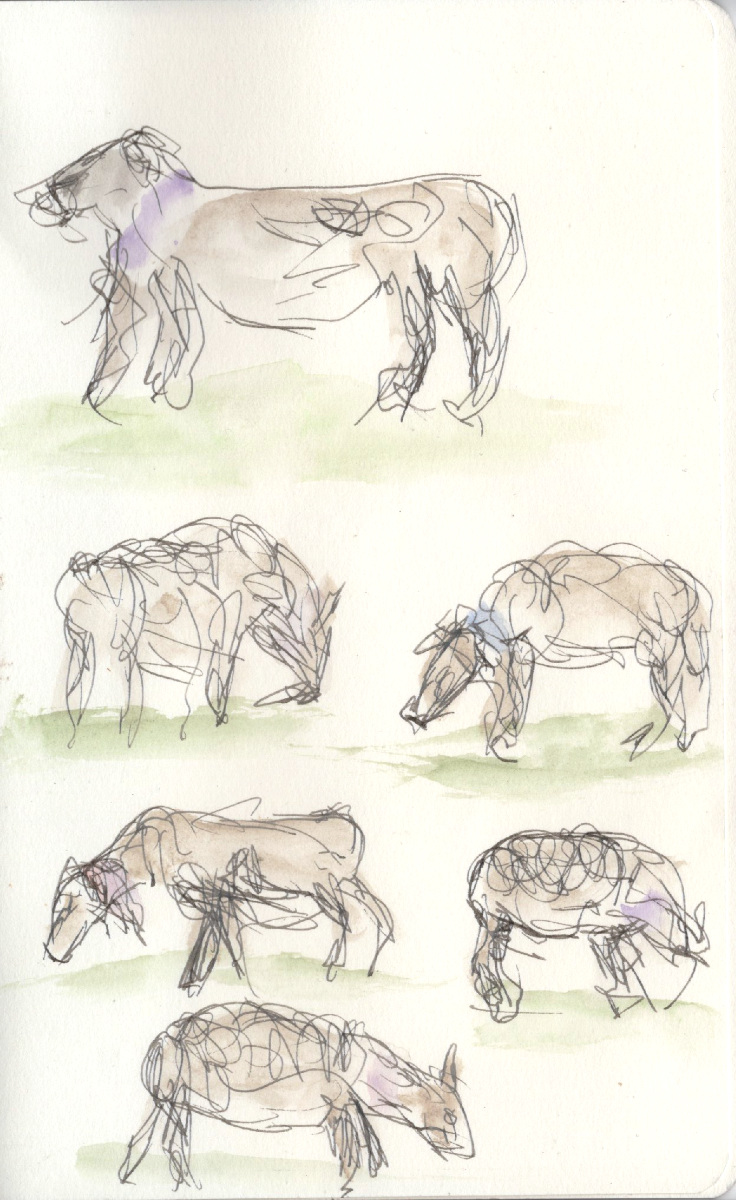 At UC Davis a landscape architecture professor, Haven Kiers, has an ongoing project to bring sheep to the heart of campus in springtime to mow the lawns and to educate people about the benefits of this form of landscape management.. This project is called the UC Davis Sheepmowers, and has been underway since 2021.
These past three days the sheep have been in an enclosure on the main campus quad. They are always well-received by the student and campus community. I went on a walk this morning to do a few sheep sketches, as seen at left.
5 June 25
Knitting Socks for Summer
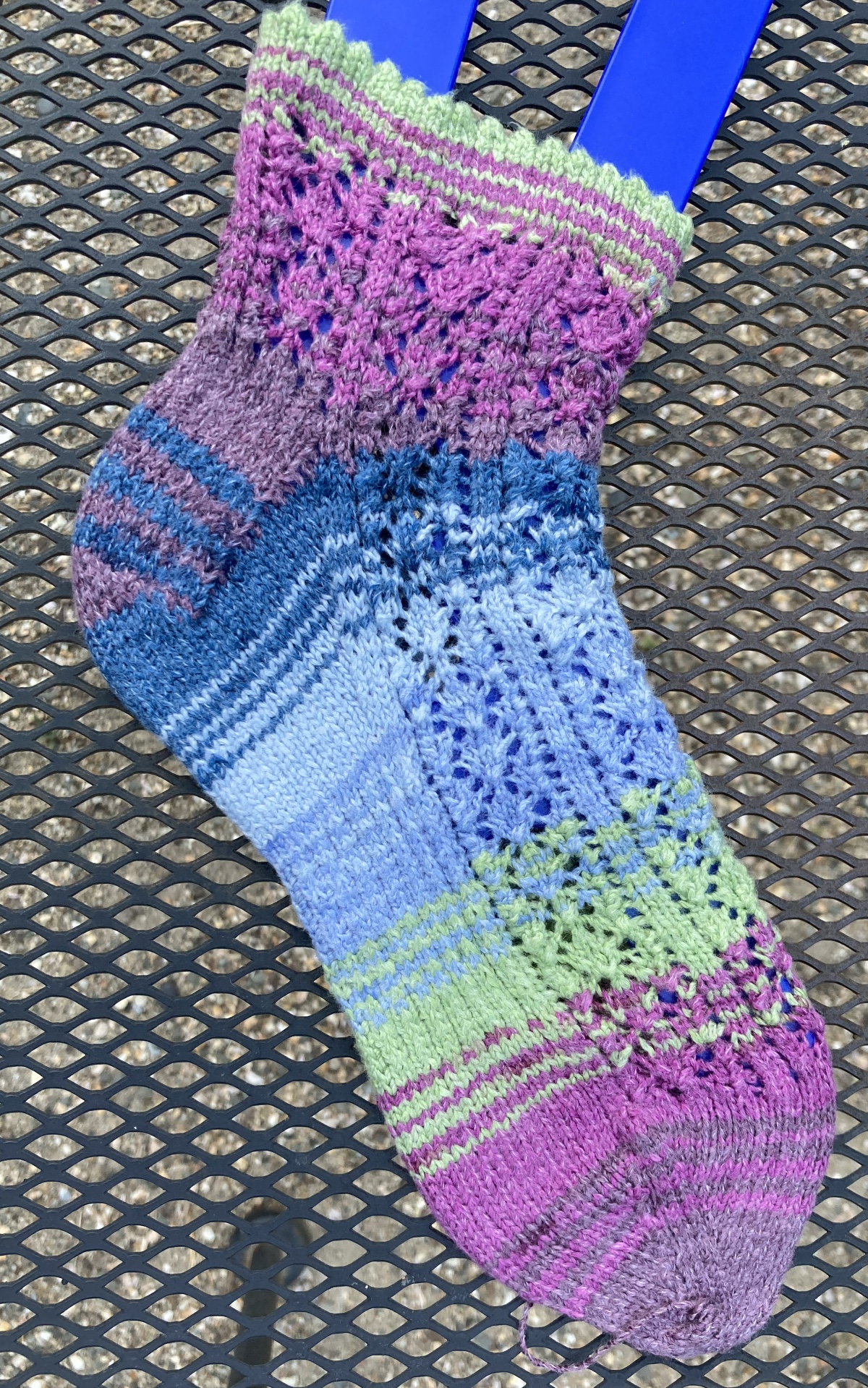 My knitworthy sister is the happy recipient of handknit winter socks for her birthday which falls in November: she lives in a cold place and nothing is better for keeping your feet cosy than wool socks. Our feet look very different than they did when we were in our 20s, and I’ve been able to modify her socks to fit perfectly without constricting the toes but also without bagging.
On a recent trip she informed me that she had plenty of wool socks, but was wondering if I could knit some cotton lace ones for summer like we used to buy in Spain? I found a bamboo/cotton blend yarn and have been working on a prototype for her. I’m going to send this single sock to her. If it fits I’l just match the second one; if it doesn’t, more work’s required.
I’ve never published a pattern before but if this is successful I might offer it to others.
Details: picot turned cuff, openwork lace, slip stitch short-row heel, slip stitch instep, roomy toe.