
7 February 26
Dutton Hall
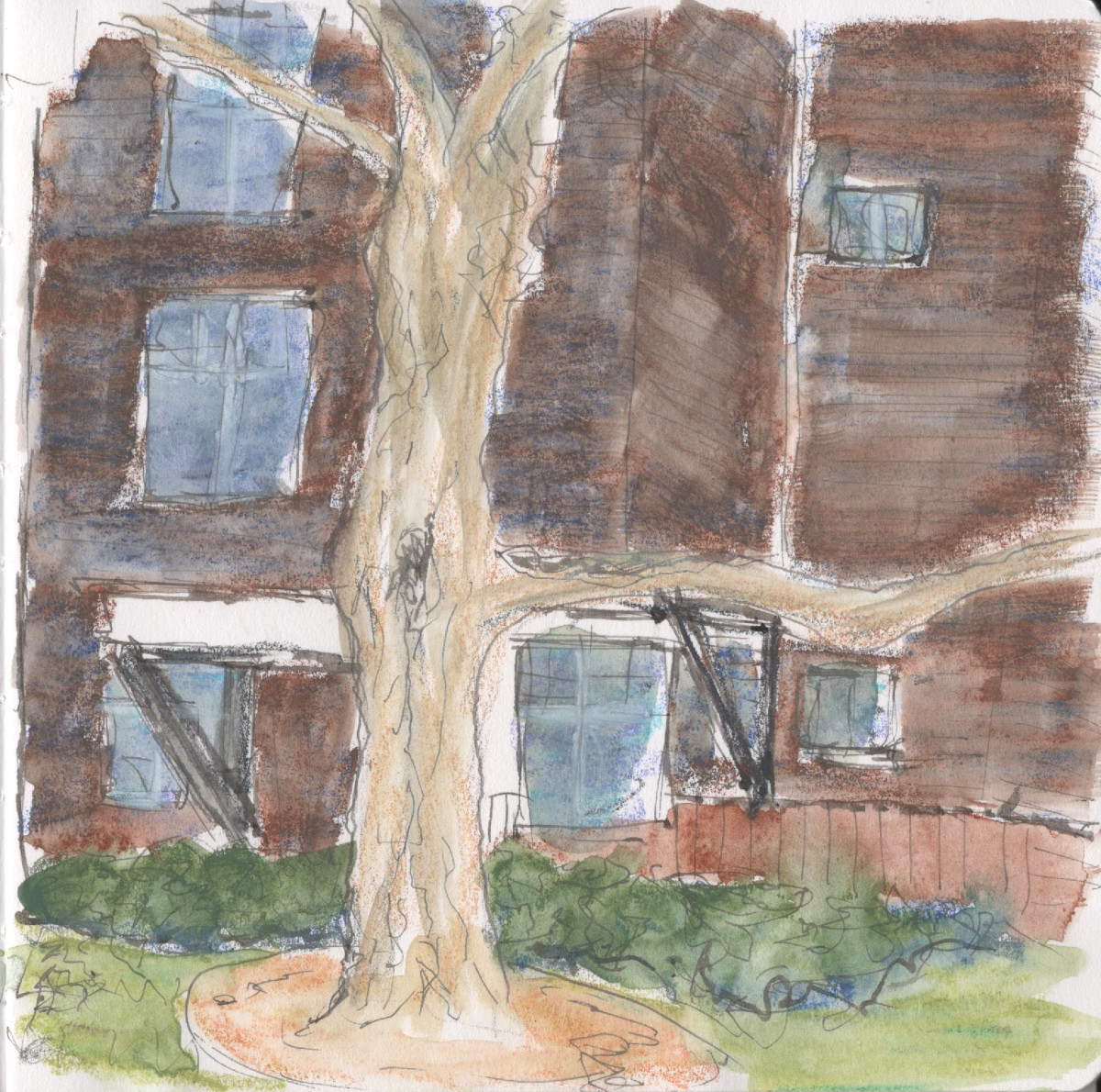 For my urban sketch today I walked over to campus this afternoon and settled in to sketch a tree and the north side of Dutton Hall. I colored the ink sketch at home with Neocolor II aquarelle crayons.
3 February 26
Quince With Bee
 I snapped this on my early afternoon walk today. The quinces in our neighborhood are flowering and one bush six blocks from here had many honeybees active on it.
18 January 26
West Campus Outing
 We went on a little outing this afternoon to the Putah Creek Riparian Reserve in UC Davis’s West Campus. Pica settled in and sketched a very difficult tree, and I focused on drawing the row of olive trees running north alongside Hopkins Road. I sketched these with my Derwent Graphitint pencils, except for the little bit of blue in the sky.
14 January 26
Francis At The Feeder
 As Pica has noted, we enjoy watching hummingbirds. We have set up two hummingbird feeders in our yard, one on the east and the other on the south side of the house which we refill the feeders with syrup twice a week. Anna’s hummingbirds are the most common species and are present year-round; we’ve named the individual males of this species Francis. These hummingbirds are highly territorial and will chase each other off from the feeder frequently. Here is a photo I took today with my long telephoto lens of a male Anna’s on the feeder outside the kitchen window.
8 January 26
Perils of Public Natural History
 I have begun my historical research explorations with some research into a topic in California historical ecology: how did California grasslands come to be dominated by non-native annual grasses? The story I learned as a student was that prior to European settlement California grasslands were mainly dominated by perennial bunchgrasses, but the introduction of grazing livestock led to their replacement by the non-native grasses. This is what Davis botanist Glen Holstein called the “Bunchgrass Dominance Paradigm” in a paper in the journal Madroño in the year 2001. The first sentence of the sign in the photo (“Purple needlegrass (Stipa pulchra) once covered the Central Valley floor and surrounding foothills”) from the UC Davis Arboretum sums up this paradigm pretty well.
The sign clearly dates from no earlier than 2004, and the trouble is is that the paradigm was already falling out of favor in historical ecology by that date, due to the research of Holstein and others. (A more minor point is that Stipa pulchra had been renamed Nassella pulchra with the publication of The Jepson Manual (a comprehensive flora of California) in 1993.) I have used the phrase “public natural history” in the title to this post in an analogy to the field of public history, the professional discipline of interpretation of history for the general public, for example in writing the text for museum displays. Public history is a challenging discipline — how does one know which stories to tell to what publics? From this example from our Arboretum, it seems like there are similar challenges in presenting natural history — the science is always changing.
7 January 26
Drawing Trees
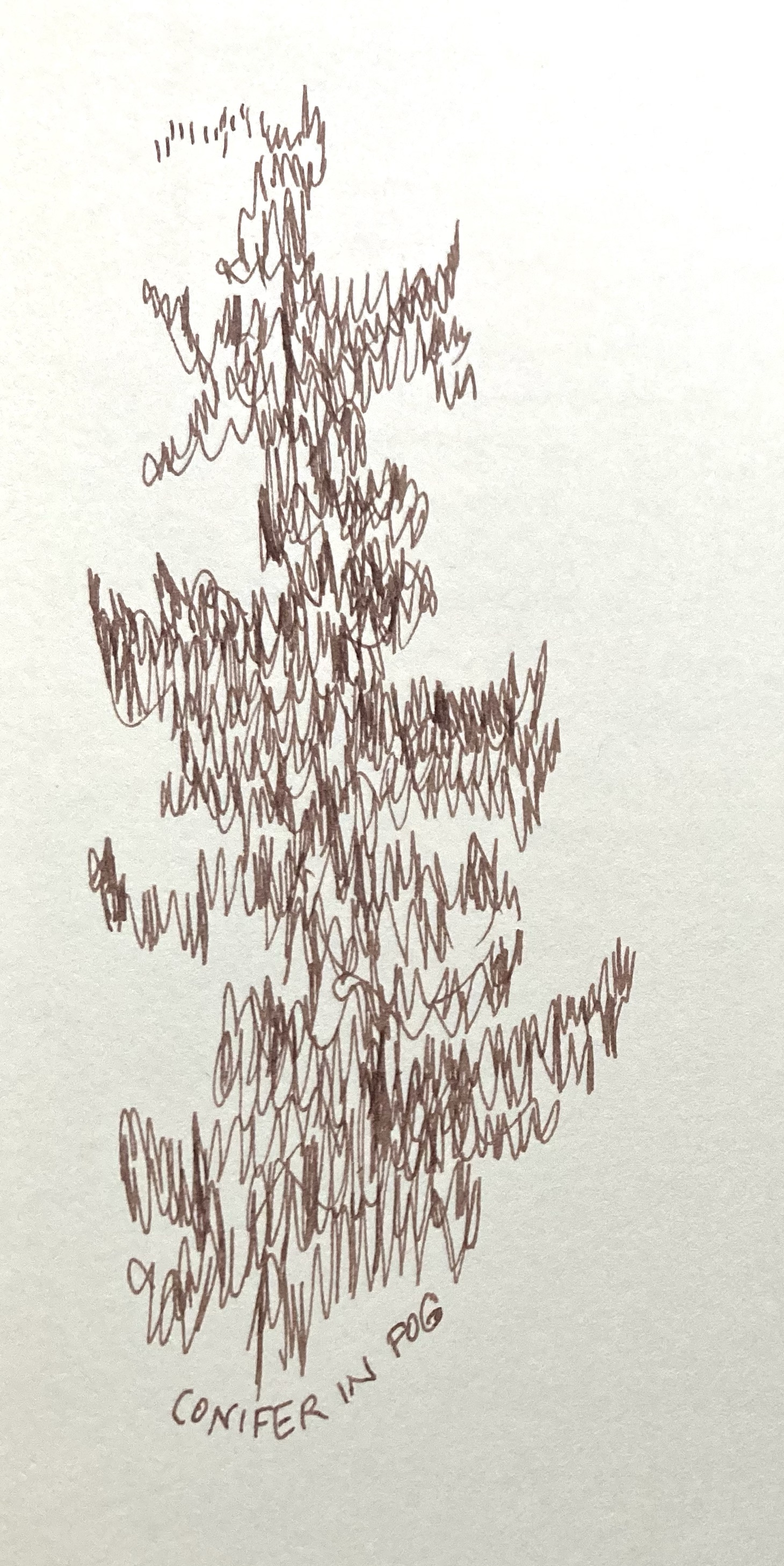 I have, among other things, set as an intention this year to get better at drawing trees. My plan is to draw a tree a day. I feel like I’ve chosen a bad medium — pen is less versatile than pencil, for trees — but I’m going to keep going.
This tree was drawn a couple of days ago in the early morning fog. Here, the pen wasn’t a hindrance. I’ll be posting more as I go.
And I’m writing about drawing because the events in the world are almost too much to bear.
2 January 26
Davis Bird Count
It’s raining again this evening, but fortunately there was a break in the weather pattern earlier and we woke up to partly cloudy skies for our local bird count. This was the Woodland-Davis Christmas Bird Count. This is a relatively new Christmas Bird Count which started in 2022. In prior years we would do the Putah Creek Christmas Bird Count which is centered west of Winters, but lacking a car we prefer doing a count closer to home.
We were assigned to bird the Wildhorse Golf Course which is on the northeast edge of Davis. Despite having lived in Davis 27 years we’ve never birded around that area before, since golf courses aren’t our thing. But it was surprisingly birdy there. In part this is because the course is bordered by a naturally vegetated open space buffer at the edge of the agricultural lands to the north. We walked the perimeter of the golf course, a two-and-a-half mile route, and saw forty species in total. Our most abundant bird species was the red-winged blackbird. Our favorite sighting was an overflight of 17 tundra swans.
Once home (we got home in time to feed the cats their expected meal at 11 AM) I tallied up our counts and entered them into eBird to share with the count compilers. I thereupon noticed that I made exactly one entry in eBird in 2025 — maybe I can improve on that this year?
23 December 25
Mentalité and the Annenberg Bridge
Under construction right now in Ventura County, California is the Wallis Annenberg Wildlife Crossing. Once this is completed (expected Fall of 2026) this will be the largest wildlife crossing in the world, 200 feet long, 165 feet wide, and fully vegetated. It crosses the 10 lane freeway Highway 101 near Agoura Hills. Its function will be to connect the Santa Monica Mountains with open space to the north of the freeway, especially to provide passage for mountain lions, but also to benefit bobcats, coyotes, badgers, bears, and other animals. The project is costing about $90 million, with about 60% of the funding coming from private donors.
I am thrilled that this project is taking place, and hope it inspires the construction of other large-scale wildlife crossings in California and beyond. But I am struck by how such a project would not even be dreamed of fifty or so years ago, let alone funded at such a level. In other words, there has been a shift in mentalité over the past decades such that the movements of large animals across urbanized wildlands have entered public consciousness.
What is mentalité? Here’s a scholarly definition, from Daniel Little.
A mentalité is thought to be a shared way of looking at the world and reacting to happenings and actions by others, distinctive from other groups and reasonably similar across a specific group.1
This is a concept from French historiography, and it seems like an important way to understand the world. But what is a methodology for recognizing change in mentalités over time? That is a great challenge.
A long time ago I picked up a compilation of poetry, News of the Universe, edited by Robert Bly. The poetry in this book has been selected to illustrate a shift since the 18th century towards the awareness of consciousness in nature. Following this example, perhaps looking for changes in artistic expression is a methodological way forward.
1 Little, Daniel. New Contributions to the Philosophy of History. 1st ed. Vol. 6. Methodos Series. Springer Netherlands, 2010. https://doi.org/10.1007/978-90-481-9410-0. Page 196.
17 December 25
Record Salmon Run
Before we moved into the middle of town in November 2020, we lived four hundred meters from Putah Creek, a stream that flows eastward just south of Davis draining from the Coast Ranges into the Sacramento Delta. In the 1950s Monticello Dam was built at the outlet of the stream from the mountains to create Lake Berryessa, but the downstream flows below the dam were quite intermittent. This started to change in 2000 with the creation of the Putah Creek Accord following an environmental lawsuit which ensured adequate water flows and initiated a program of riparian restoration.
In 2013 the first chinook salmon were spotted swimming up the creek and fall salmon runs became a regular event. (We used to stand on the bridge over the creek on Old Davis Road and look for swimming salmon, but never spotted any.) In 2021 researchers established that at least some salmon were being born in the creek and returning to spawn several years later. Yesterday there was an exciting news announcement that this year there has been a record salmon run on the creek: 2,150 chinook salmon returned this fall to spawn in the creek. Putah Creek has become a hopeful story of environmental restoration.
11 December 25
Unyielding Fog
 There has been unremitting fog over Davis and the rest of the Central Valley for about 18 days or so, ever since the 22nd of November. We had one half-day of sunshine on the 3rd of December but aside from that the temperature has stayed in the mid-40s Fahrenheit this entire period. It’s dreary and doesn’t make me inclined to sketch outside. Here is an account of this tule fog from NASA, complete with an satellite image animation. This is an unusual pattern and with climate change there have been fewer and fewer persistent tule fogs in the fall and winter in the Central Valley.
The natural color image at right is from the GOES-West satellite taken at 3:11 PM PST today (11 December).