
13 December 06
Everydot
Everydot shows one person’s quest to photograph all the dots on the map in his neck of the woods around Minnesota and North Dakota, even sleepy crossroads like Henderson Station, Minnesota.
2 December 06
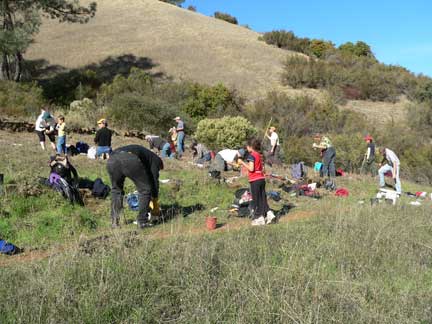 Our morning was spent once again in Cold Canyon. This time we met up with about forty people, at least ten of them under ten (go Girl Scout Troop 1952) to plant native grasses at the homestead, a nice hike in to the canyon of about 1-1/2 miles.
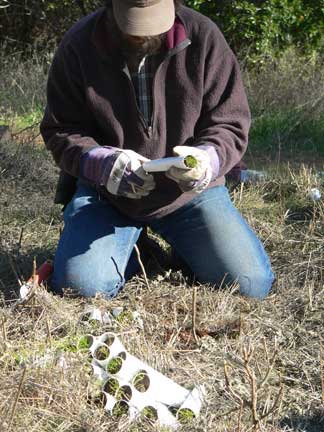 There were 600 grass seedlings to plant as well as quite a few native shrubs and trees (toyon, lotus, gray pine). With 40 people, though, the time passed quickly. Numenius has so far avoided messing about too much in the garden but he was well into it today. We were joined by about 5,000 hatching ladybugs. It was an excellent party.
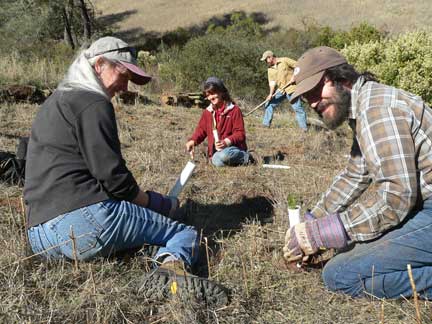 One of the great pleasures of the day was running into three separate friends. Andrea, in the middle here at left, had some wonderful news to share with us. She’s a lurker on this blog so I won’t embarrass her but hey, gal, congratulations to you and Steve. It was great to see you.
19 November 06
Home Ground
I haven’t seen this new book yet but it’s on my to read list: Home Ground: Language for an American Landscape, edited by Barry Lopez and Debra Gwartney.
From the publisher’s blurb for it on the book’s website:
Home Ground: Language for an American Landscape brings together forty-five poets and writers to create more than 850 original definitions for words that describe our lands and waters—terms like flatiron, bayou, monadnock, kiss tank, meander bar, and everglade. The writers, including Barbara Kingsolver, Luis Alberto Urrea, Jon Krakauer, Charles Frazier, Antonya Nelson, and Samantha Chang, draw from careful research as well as on their own distinctive stylistic, personal, and regional diversity to portray in bright, precise prose the striking complexity of the landscapes we inhabit, from Missouri’s woody draws to Virginia’s runs, from the desire paths of cities to the rondes of Midwestern farmlands, from California’s bajadas to Alaska’s pingos and Hawai`i’s shield volcanoes. An advisory board has ensured the scientific accuracy of the prose. Included are one hundred black-and-white drawings by Molly O’Halloran and an introductory essay by Barry Lopez.
Not that I ever listen to All Things Considered but they did a piece on the book a couple of days ago — on that page there are also some excerpted definitions from the book.
16 November 06
Cloud Appreciation
I recently read The Cloudspotter’s Guide, by Gavin Pretor-Pinney, who is the founder of The Cloud Appreciation Society. The book is a humble exhortation to look up every now and then.
The cloud phenomenon of this month for the Society is anti-crepuscular rays. If crepuscular rays are described as “God’s fingers”, perhaps these are Satan’s shadows. They are much rarer, and I don’t recall ever seeing them.
John Ruskin is an honorary member of the Society, having once written —
It is a strange thing how little in general people know about the sky. It is the part of all creation in which nature has done more for the sake of pleasing man, more, for the sole and evident purpose of talking to him and teaching him, than in any other of her works, and it is just the part in which we least attend to her…The sky is for all; bright as it is, it is not “too bright, nor good, for human nature’s daily food,” it is fitted in all its functions for the perpetual comfort and exalting of the heart, for the soothing it and purifying it from its dross and dust.
11 November 06
Astronomy Break
Usually there is not much reason to take a break in the middle of the workday for an astronomical observation. It is, after all, daytime. This past Wednesday was different because in the afternoon there was a transit of Mercury, which is when the innermost planet crosses the disk of the sun. This is a fairly rare event, only occurring 13 or 14 times a century. The next one is on 9 May 2016.
The weather cooperated for us in Davis, and despite the unsettled conditions this week, it was sunny throughout the event. Elsewhere in North America, observers weren’t so fortunate. After lunch, I went to the roof of the physics building where the UC Davis Astronomy Club had set up a telescope with a solar filter. Thanks to them, I saw the speck of a planet, sunspot-sized but perfectly round, against the face of the sun.
In 6 more years (5 June 2012) is a transit of Venus. This is a much rarer event, not to be missed — the next one occurs in 2117.
2 November 06
First Rain
The first rain of the season was today. We got nearly an inch—0.88” over the day, plus a little bit last night. I didn’t dig out the slot in the ground where we place the rain gauge until this morning, so I don’t know the total from last night.
Rain of course means getting wet in ways you don’t quite want. I dressed lightly for the way into work, just my yellow windbreaker and jeans—only to find out that it was drizzling quite handily once I started cycling in. I also have to find some dry nook to store my outdoors clogs. Ploosh!—stepping with my socks on into the cold, wet linings of these when I went out this evening to the garden to fetch vegetables for the pasta sauce wasn’t that much fun.
But it was wonderful to see the drips and drops forming up on the concrete overhang outside my window at work. Yes! A window. From which I can watch the rain.
23 October 06
Stink
October’s the month where we get infested with beetles that fly, crash into the light, and then emit a stench which is like concentrated smelly feet squared.
They’re small beetles, small and long. They look like a shortened earwig without the pincers, innocuous really.
They live in leaf litter and make all efforts to get indoors, where they then hide under anything there is to hide under. If they’re disturbed, they freeze, then scuttle in all directions. Like miniature cockroaches that smell.
Efforts to come up with an ID have so far met with failure. It’s in the Carabidae, is all we know for now. We may scan one for all you carabid experts out there…
22 October 06
Puncturevine
Yesterday I finally fixed the flat in the rear tire of my road bike. Feeling down the inner surface of the tire, I noticed two tiny embedded thorns, each capable of producing a leak in the tire. I gently worked these out of the tire and installed the new tube.
On page one of today’s Davis Enterprise, the paper ran a story on the bane of cyclists that gave me the flat, puncturevine. According to one bike mechanic, most of the flats in the Davis area are now due to this plant. The lentil-sized seeds of this weed have hard stout spines for dispersal, whether via fur or tires. The common names for the weed are somewhat ominous—caltrop, tackweed, goathead, Texas sandbur—and its scientific name is the alliterative Tribulus terrestris. But I never seem to see the actual plant, instead just finding the seeds in unfortunate places.
21 October 06
A Very Warm Saturday
This morning I joined twelve or so people in our first guide training at Cold Canyon. It was hot by eleven, the kind of hot that makes you sweat in a T-shirt walking slowly up a slight incline. We saw blooming California fuchsias and the Anna’s hummingbirds that guarded them ferociously; I learned to tell the difference between poison oak and skunk bush (really really important); we divvied up our mini-presentations (I’m doing mine next week). It was a good day to be out in the sunshine.
This evening was a chili cookoff with bluegrass by Chicken Tractor (a friend and neighbor plays mandolin in this band). It was punctuated by checkins of the first World Series game. (Cards were winning 7-1 when we left.)
A normal, sort of, Saturday.
But when (I’m a when not if person) the flu pandemic hits, we won’t be doing any of this. No doing out, no mingling, no shopping, not any of it.
Maybe a lot more gardening?
14 October 06
Turkeys 1, Coyote 0
This morning as I was digging outside (I’m considering digging for a morning activity even when there’s no good reason to do it, so much time to ponder plus you get to say hello to so many earthworms) I heard a soft cluck, cluck. The turkey flock was moving south across the alfalfa field that got mowed three days ago, pecking and scratching as they went.
Out of frisbee range; I went back to my digging.
Alarm clucks raised my head again: a coyote was approaching the flock. But with no alfalfa he had no chance at a surprise attack. Two turkeys flew, laboring, into the top of the osage orange, to be scolded by crows; the coyote couldn’t decide which way to look, and eventually slunk off, presumably to wait for a better chance.
We’re off to Numenius’ 25th High School Reunion (his idea, don’t faint folks). The Tigers just won the American League pennant, and we’ll catch the Mets-Cardinals game in the car.