
23 March 07
Mustering Of The Orclets
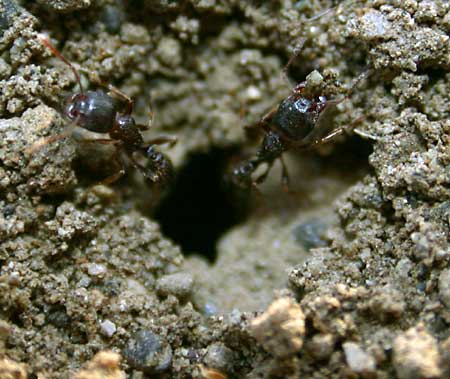 We were having a reprieve from the kitchen invasion of Argentine ants ( Linepithema humile ) but they may be on the rise again. They seem to head into the house in large numbers when it is either very wet outside or it is hot. The weather has been beautiful these past several days but it may start getting very warm soon. Not so good for us ant-wise.
At left two of the ants are mobilizing for the next moves on chez Magpienest.
22 March 07
Fighting for Treetops
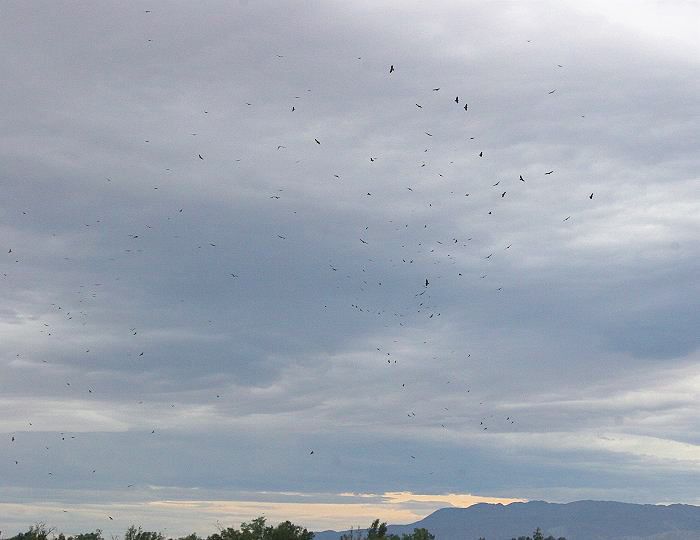 As Numenius said, the Swainson’s hawks have been coming in — over the next few weeks they’ll be nestbuilding all over Northern California. (There were reports yesterday morning of a record-breaking migration over the Anza Borrego desert in Southern California, about 1,300 birds.) As I left the house this morning, there was a gal by the driveway with a clipboard, watching the Swainson’s that was perched in a walnut tree.
The white-tailed kites have been nesting for nearly a month, now, outside my office. I watched them courting; the male then started his solitary courtship flights, toes extended, a barely perceptible hovering glide showing his striking wings to best advantage, around the pine tree where the female was presumably incubating, returning often with rodents; and now, he has taken up attacking any bird larger than a starling that comes near the tree.
Yesterday, it was a Swainson’s. There are fewer and fewer trees in this part of the world that are tall enough and with enough cover for these larger buteos. This one seems taken. The kite, a third of the size but far more agile, went after it again and again until the Swainson’s got so high it was barely visible from the ground. Is it worth expending this much energy? The kite obviously thinks so.
Postscript, Friday, 23 March: I’m adding a photo of the Borrego hawks, taken by Grace Clark. They counted 1365 hawks that all roosted overnight and left between 0900 and 0945 on Wednesday… Paul Jorgensen says in an email “it was one of the greatest natural spectacles I have ever witnessed.”
20 March 07
Fiddleneck
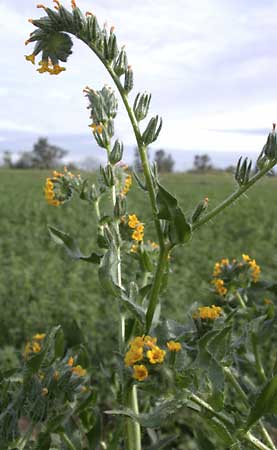 These fiddlenecks ( Amsinkia menziesii var. intermedia) are now in bloom on the south side of the alfalfa field by our house. They are a native flower found often in disturbed areas at lower elevations in California. This past Sunday we went to a picnic at a friend’s place on the top of a hill west of Winters, in the eastern foothills of the Coast Range. The fiddlenecks there are much further along and are starting to go to seed. Many of the other wildflowers there seem to blooming early this year as well.
18 March 07
Return Of The Swainson's Hawks
Yesterday we thought we heard and saw one, but today it was clear — the Swainson’s hawks have returned to the vicinity. At noon time there were two birds circling fairly high overhead and calling, and then late in the afternoon we saw two Swainson’s flying at a fairly low height calling and chasing a red-tailed hawk. The dynamics between the two species are interesting. The redtails are down on the Sacramento Valley floor where we are during the wintertime. In the mornings we’ve regularly seen one perched on the power pole 100 meters southwest of the house. Once the Swainson’s hawks show up, the redtails get displaced, presumably moving up to the foothills.
16 March 07
Ghost Owl
We walked this evening up from the house to Pica’s office and immediately heard the click-click-click-click of a barn owl, and saw it flying low over the house. A little further along, we heard another barn owl to the north over the alfalfa field, perhaps hunting along the newly plowed edge of the field. Near Pica’s office, we saw another barn owl — we believe there are two nesting pairs along the half-mile stretch between home and office.
A particularly well-travelled birding friend of ours thinks Davis may be the most reliable place in the country to find barn owls. There are several nest boxes over parking lots downtown, and certainly a number of pairs down this way. It’s either feast or famine with barn owls — they’re a hard bird to find in Massachusetts.
Many folks believe they are the origins of ghost myths. Cosmopolitan birds, all white underneath, making creepy-scary noises at night.
14 March 07
Snap Cress Weed
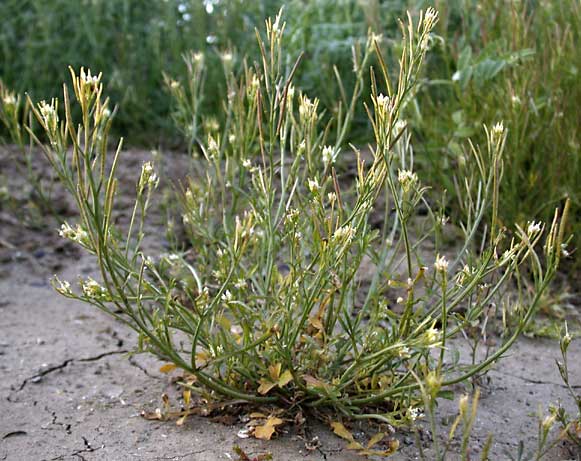 Just south of the vegetable garden there is a patch of these weedy crucifers that we don’t believe were here last year. This morning when we stepped through the patch the seed pods were going snap-snap-snap and tiny seeds were flying everywhere. I keyed the plant out in the Jepson Manual today and think it is hairy bittercress, Cardamine hirsuta. This would be interesting because the Jepson treatment of this introduced annual says it’s known to occur in the Klamath Region but not in points south. Hence this occurrence could be a range extension. The reference I’d really like to check is the new Weeds of California and Other Western States. There are many copies of this in the campus bookstore but it is shrinkwrapped in two volumes and I wasn’t peeking.
12 March 07
Mushrooms In The Straw
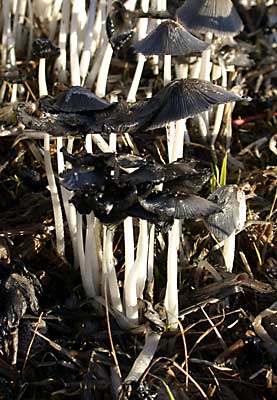 Not to be confused with straw mushrooms. We’ve had a straw bale sitting outside the vegetable garden since last summer, and once it got wet this winter, these mushrooms came up and covered the straw bale. We’ve had a heat spell these past few days, and the fruiting bodies have died back, but if we ever get more rain this year, I think we’ll see the mushrooms again. I have no idea what they might be.
11 March 07
Nearly Four Years
Four years ago this month we were housesitting for a friend in Village Homes. While I worked on removing the huge numbers of weeds that had built up over the rainy season, Numenius put Feathers of Hope together.
Since that time a lot of blogging friends have come and gone. It’s a shifting culture. Many people start out not knowing whether they’ll have enough to say; then it turns out they have plenty; then they think they’ve said all they can and stop.
One of these has, I’m really pleased to find out (better late than never), decided to come back. Rana writes about the natural world better than many. What she finds to say about the natural world at her doorstep is so evocative I can smell the wet earth. I can see the small black cat’s pipe-cleaner tail. I can hear the screaming blue jays.
—-
Today the first of the rough-winged swallows were back. The only one I haven’t seen in Davis yet this spring is the barn swallow, but they should be back any day. On our bike ride into town we had the show of white-throated swifts diving over and under the freeway, chattering madly. I have dirt under my fingernails. The first assassin bug showed up, oddly enough, on Diego’s coat. The insects have started emerging just in time for the swallows. We have leapt almost into summer, here, and it’s only March…
10 March 07
Semantic Magpies
Spring has come along (high in the 70s F today), and I’m back to surveying our grid square for the Solano County Breeding Bird Atlas project. My goal now is to start confirming breeding in species on the grid square that I’ve already observed there. One of today’s targets was the yellow-billed magpie; heading past a ranch house I observed one flying and disappearing into a nest I think carrying an insect. Does that count as a confirmed instance of breeding? Or is it not quite enough evidence?
Meanwhile, several colleagues of mine working on our semantic web project have gotten interested in ‘semantic eco-blogging’, the idea being to supplement blogged nature observations with data that can be interpreted by machines. Their testbed blog for this is FieldMarking. The file here is an example of the data format we’re testing; it describes the magpie observation above.
8 March 07
Treasure Under The Basement
 The 1930s was an era when labor was quite available and many public projects got started that called for a lot of handwork. This held true in the field of natural resource management as well as at large. In California, a forester named Albert E. Wieslander began a U.S. Forest Service project to map the vegetation of California. Many teams of botanists hiked ridgeline to ridgeline, pausing to gaze out over the landscape and mark in colored pencil on 30’ USGS quadrangle maps the vegetation patterns they saw. Only a few of these vegetation maps were ever published, and the set of well over a hundred hand-drawn maps of about 40% of the state lay forgotten.
The set of maps was nearly thrown out on two different occasions, when in the 1980s they were rescued by a professor at UC Berkeley and started to be curated and put to use. They are incredibly valuable from the point of view of historical ecology, giving a view of the vegetation of the state 75 years ago. A number of people have been working on the project of digitizing the Wieslander data, including my officemate Jim Thorne who is leading the effort to create GIS data from scans of the original maps.
The Wieslander map set was complete for the Sierra Nevada mountain range except for the Lake Tahoe basin area, where the hand-drawn maps had gone missing for a decade or more. These maps resurfaced Saturday.
Jim had been in touch with an emeritus professor at UC Berkeley by the name of Paul Zinke, who was one of the botanists employed by Wieslander, and was well in his 80s. Jim hoped that the oral history program at Berkeley would interview him, but sadly he died last year before the interview could take place. Jim then got in contact with Zinke’s son Michael, and after a while arranged with him to browse through some of Zinke’s papers. Last weekend, in a crawl space under the basement floor, they struck paydirt. The missing maps were there.
Above is a photo of the happy discoverers — Michael, Sarah, and Jim left to right.