
28 August 07
Fossil-free Big Year
No sooner had I determined to spend less in the way of fossil fuels chasing birds than I hear about a wonderful project: a big year by bicycle. Malkolm, Ken, and Wendy Boothroyd started from Whitehorse in the Yukon and are heading to Florida via California and Texas. On their bikes. They’re in Crescent City, now, heading south, trying to pick up a hermit warbler on the way…
They are raising money for several important environmental causes and, more important, awareness. The home page is here; the blog is here.
The family is also encouraging all birders to plan a fossil-free birding day in 2008, and would love to hear from you if you participate! Raise money for local causes, or for theirs.
Great idea, great project. Tailwinds, dear Boothroyds…
20 August 07
Glacial Ramble
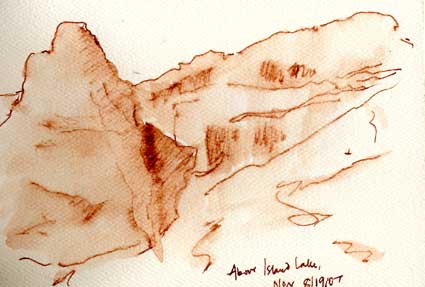 Our time in Colorado in April put us in closer contact with a landscape shaped by glaciers than usual. This weekend I renewed my acquaintance with tarns, deep scars left on rocks by the grinding of ice and boulders, and with the high-elevation plants and animals that now call this landscape home.
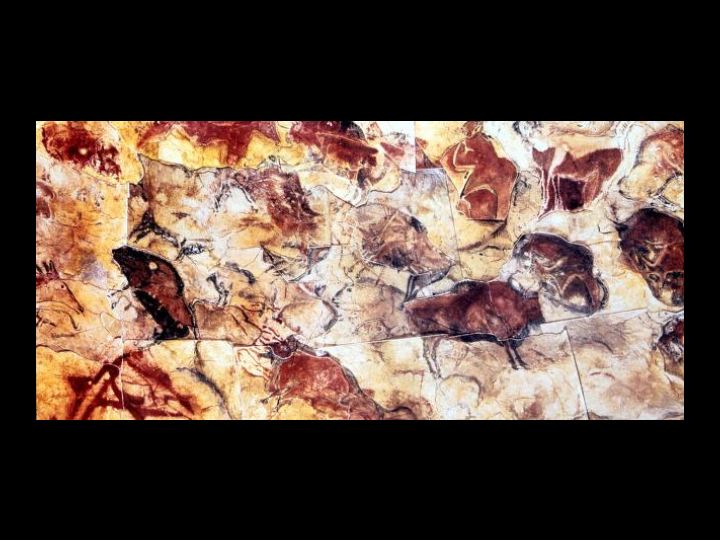
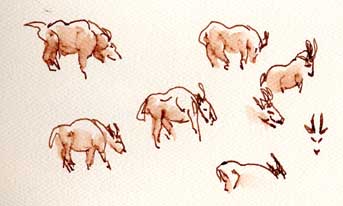 As a child when we visited the caves in Altamira (now closed to try and preserve the paleolithic paintings from human traffic and exhalations) I found myself imagining what it would have been like to have been an eight-year-old girl living in a cave so many thousands of years ago. The paintings are works of art in the most visceral sense I can think of, and though I had no idea about the shamanic (assumed) power of the paintings, the musculature of the animals (bison, deer, goats) was real and skilfully portrayed, even to an untutored eye. What was it like to draw like that? I found myself pondering those caves again on Saturday, as I watched mountain goat family groups pick their way easily across the scree slopes that would have sent me to the hospital, as I tried inexpertly to draw them.
 We were in the Ruby Mountains of eastern Nevada to see a bird, a bird that doesn’t belong in North America. It’s a hard bird to see (and, I gather, to hunt, for which reason it was introduced here from the Himalayas in the early 1960s). It took two attempts of a two-mile hike at 10,000 feet and a lot of hours before we finally saw it on Sunday morning, just before we were going to have to head downhill and drive all the way back to Davis. But spending a day surrounded by mountain bluebirds and pikas (whose alarm call is very similar to a red-breasted nuthatch’s), golden-mantled ground squirrels and Brewer’s sparrows, in the high glacial meadow with no sound except the wind and the occasional “hey, there’s a badger!” makes me feel the tug of the mountains again.
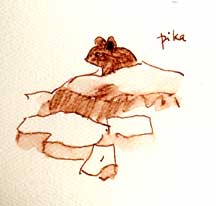 Reading Butuki’s account of his trek across the Alps has great resonance for me just now. I’m not a strong hiker and I blister easily but it’s worth it… I’m hoping to convince Numenius to come with me to the mountains more. Promising the sight of introduced birds won’t do it, but Numenius is a mountain goat at heart…
[See Richard’s account of this trip here ]
17 August 07
Mr. Ibis
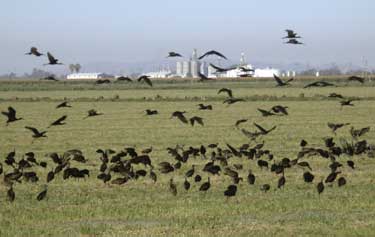 The reference in the title is to a character in Neil Gaiman’s excellent book American Gods, which I finished last night. It’s the season when we are seeing lots of white-faced ibis flying about in long, lazy vee formations. They head out from roosts in the wetlands such as the Yolo Bypass to forage in fields in the agricultural landscape. Two days ago the alfalfa field just south of our house was flooded for irrigation, and in came the ibis.

16 August 07
Wireless For Frogs And Mice
On Monday I heard a presentation about Quail Ridge Reserve, one of the University of California natural reserves that is administered by UC Davis. Quail Ridge sticks out as a peninsula into Lake Berryessa, about 40 kilometers west of here. Quail Ridge Reserve has gone hi-tech. In a collaboration with the computer science department, the reserve managers have set up towers and repeaters to create a wireless mesh network covering much of the reserve. The technology used is the standard wireless found in many a laptop, but the environment and scale of the network is of a degree to make the project interesting to computer scientists.
Putting a natural reserve on the Internet leads to some neat possibilities. One researcher, who left UC Davis for a position at the University of Michigan, can continue to monitor the calling of frogs he was studying in real time. Webcams have been set up that can be reoriented over the net, looking for foxes, mountain lions, and snakes. And plans are afoot to set up a triangulation network that will enable tracking of critters such as radio-collared mice down to accuracies of less than a meter. The only other such triangulation network is at Barro Colorado Island in Panama, with much less favorable topography.
14 August 07
Shake Your Tail
 A study at UC Davis shows that California ground squirrels generate measurable heat when waving their tails around rattlesnakes, which apparently helps deter the snakes from attacking them. (Adults are resistant and even immune to rattlesnake venom; the snakes go after the younger squirrels, which don’t have enough blood to make them safe.)
I have occasion to watch this tail-wagging, though there aren’t really any rattlesnakes on the valley floor, here. The adults chase each other around outside my window at work all day long, tails thrashing, in a kind of come-hither routine that involves lots of running, lots of thrashing, lots of sniffing, and very, very rarely, a copulation. They do seem to use their tails in communication as well….
14 August 07
Leaving Town
The swarm of bees that left the hive in the nectarine tree to camp in the almond tree have moved on. Pica returned home for lunch to find the drive leading out back clouded with thousands of flying bees and the almond tree empty. It all makes me think of colonists in a game of Freeciv moving one square off from the city before heading out into the wilderness in the next turn.
9 August 07
Secession
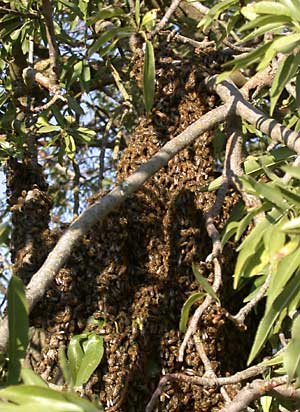 There is now a bee swarm in the almond tree, and the hive in the nectarine tree is looking a bit depopulated. We wonder what honey bee affairs of state lead to half the hive heading off to a new tree fifty feet from the old hive. Perhaps a second queen leaving the premises? At any rate this afternoon there were definitely some confused bees flying about — which tree do I fly to now?
24 July 07
Landing Gear
I’ve been home for two days, having finished the new Harry Potter book on the way home. (I only know one other person who’s finished it and am biting my tongue.) The okra’s continuing to be devastated by pocket gophers; I’ve harvested most of it to make a bindi masala tomorrow in the solar cooker. We won’t get much more, I don’t think.
I’m acutely aware of how far away the rest of my family is. Mostly I don’t pay attention. But these kids are growing fast, and seeing them once a year, briefly, doesn’t really work. I had a lump in my throat embracing my sister, my mother, my niece…
Flying over beautiful blue Lake Tahoe (at least until the first rains of the fall turn the fireswept mountainsides into mudsloshes), and into the parched Central Valley, I was reminded how much I like to see green, yet how quickly it becomes oppressive, too much. Perhaps it’s what you’re used to. My palette is still ochre/sienna/ultramarine…
18 July 07
Grousing
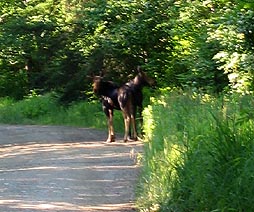 Philadelphia vireo? Yes. No spruce grouse, though, despite many hours of looking and six moose and about eight snowshoe hares. Many species of warbler I haven’t heard for over ten years and whose songs came back to me in a blinding flash. My buddy Linda joined my mother and I in the spruce caper.
I’m now in Brunswick again having collected my brother in Boston this morning. We’re heading back to Norway, Maine, tomorrow; the Harry Potter festival is in Portland on Friday.
It’s raining. It’s heaven. Numenius tells me there was the unheard-of rainshower this morning in Davis; I’m sorry to have missed it!
6 July 07
Why Chilis Are Hot
Coturnix sums up the evolutionary reasons for this here. Short version — this is a mechanism by chili peppers to deter mammal herbivory in favor of bird herbivory, since seeds that pass through avian digestive tracts are fertile, but seeds that pass through mammalian digestive tracts are not. It turns out birds lack nerve receptors for capsaicin, the chemical that makes peppers hot.