
18 February 08
Great Backyard Bird Count
It’s not too late to participate in the Great Backyard Bird Count! This citizen science project has been happening this weekend and ends Monday February 18. Basically you count all the birds you see at a single location over a period of time of at least 15 minutes and report this online. Between the two of us we did three counts today: one from our backyard, one over by Putah Creek, and one in the Arboretum.
15 February 08
Signs Of Spring
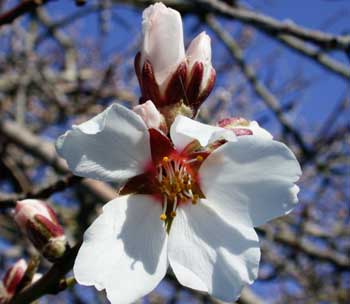 The first almond blossoms on our tree have opened.
13 February 08
Five Owl Night
Yesterday evening following a tip from one of the bird lists we bicycled out to Road 28H several miles northeast of Davis to go look for short-eared owls. The day before about 10 of these owls had been seen flying at dusk low over fields west of their presumed roost site. We arrived well after sunset, and were immediately joined by our fellow Bigbyer Steve, also on bike. We were successful and saw the short-ears, about a half-dozen all told, hunting languidly over the fields.
More owls on the way back — also on Road 28H we spotted one of the resident burrowing owls, and then riding through Davis and campus we heard several barn owls and a great horned owl.
At that point I figured I could make it a five owl evening by hunting down the Owl Nebula (M97) in Ursa Major. It was not a great night for doing this, with a waxing moon in the sky and high thin clouds, but I managed to see the nebula through my 7” Dob. Not a great view of the nebula, but it wasn’t at the threshold of visibility either.
10 February 08
Astronomical Big Year
Having the fun that I am with our Bigby birding year, the idea came to me this morning that maybe I should do an astronomical equivalent. More precisely, I would attempt to see all the 110 Messier objects by the end of the year. The Messier objects are the most famous set of deep-sky objects in astronomy. They were catalogued in 1774 by French comet hunter Charles Messier, who wanted to have a list of fuzzy objects that could possibly be confused with comets.
I’ve never actually seen all these objects; I’ve gotten to about 80 or so back when I was more active in astronomy. Before moving to Davis, we lived halfway up the mountains behind Santa Barbara and had great dark skies there. Living at 45 feet elevation in the middle of the Central Valley there is a lot of light pollution and the skies are much hazier, both of which discourage my astronomizing. The Messier objects however are relatively easy to see, and I think all of them are within reach from our house with my 7” Dob. For now the rules of this venture are the same as for the Bigby — observations only count if I get to the observation site under my own power.
Tonight I got started by looking at Orion, seeing M42, M43, and then M78, followed by the Pleiades (M45), and then the open cluster M41 in Canis Major. A good start.
9 February 08
Better Luck Second Time
Last time we went to Lake Solano we rode into a storm and got wet, frozen, and skunked. Today we tried almost the same route and did a lot better.
Ten new birds for me today, including the gorgeous Barrow’s goldeneye, Western grebe, Bewick’s wren. We heard California quail and Hutton’s vireo; missed pileated woodpecker and osprey along with the “easy” phainopeplas. We never did catch up with a lark sparrow for Numenius.
Our favorite bird of the day: sharp-shinned hawk that flew in at eye-level and stared at us, gorgeous in new moult. We don’t see them often enough.
8 February 08
Clear Night
The weather has been very good this past week, and inspired by seeing an announcement that the campus astronomy club was having a stargazing session tonight, I got out my 7” Dobsonian telescope and had a gander at the sky this evening. Mars is small now as it retreats from its biannual closest approach to the Earth, but was still showing some detail. The Orion Nebula was beautiful as always — one of those objects that is remarkable to see no matter what size of optics you are using.
Coming up at the end of the month (from February 25 to March 8) there is an educational citizen science project called GLOBE at Night that is about light pollution. Basically sometime during this period you estimate the darkness of the sky using a set of star magnitude charts and report that along your exact location. These magnitude values will then get mapped — last year they got data from 60 countries.
25 January 08
Vaca Dusting
We looked west this morning and saw several thin tracings of snow on top of the Vaca Mountains, which get up to about 2800’ in elevation, and a bit on the Blue Ridge to the north of the Berryessa Gap. It’s always lovely to see snow on the Coast Range mountains. Californians simply like snow — all the population in the state is down at low elevations and never get into any without a bit of travel.
The road up Mix Canyon that we want to climb for our Bigby would get us up into the snow, but it’s a little far to ride at our present level of fitness!
21 January 08
Lake Solano In The Rain
We stuck to our plan for the weekend to go on a Bigby ride out to Lake Solano, having just taken our tandem in for a major tuneup. Our target birds included hooded mergansers, Barrow’s goldeneyes, sapsuckers, and pileated woodpeckers. Our friend Barbara, taking a look at the forecast of a 40% chance of rain and showing more sense than we had, decided at the last minute not to tag along, but we still planned to meet Vance at his office on Putah Creek Road about two-thirds of the way out. Vance works for California Audubon with their landowner stewardship program and is a serious cyclist and sometime bike racer. When we arrived at his office there was a bit of drizzle but after checking the weather radar we thought it would let up soon so we carried on. I put on my raincoat at that point and was definitely happier.
We rode to the south side of the lake by which point it was definitely not letting up. Scanning from there we saw lots of common mergansers, a few hooded mergansers, double-crested cormorants, and Vance saw his first Wilson’s snipe of his Bigby. We pulled in at the boy scout camp at the southwest corner of the lake, where there had been a report earlier of a white-throated sparrow. We walked around there a bit, heard our first acorn woodpecker, and saw a couple of fox sparrows. No white-throated, and by this time it was not letting up even more.
We got back on the road, headed west to circle around the lake and stop in at the campground by the Lake Solano dam where pileated woodpeckers have been seen. No pileateds there. By this point we were wet, chilly, and 22 miles from home, so we took a bit of shelter under the eaves of a campground building while eating lunch of half a peanut butter sandwich and a mandarin orange. We then headed off on the five-mile run to the town of Winters for a chai latte and a hot chocolate at Steady Eddie’s. It actually let up by that point.
Thus warmed we headed east on Putah Creek road home. It wasn’t raining much at all by then, and we were moving at a good clip, but soon the fact we hadn’t ridden that far in quite a while caught up with us, and we limped our way into Davis, laughing our way through the final downpour the last mile. We got in the door at 3 PM after riding about 43.75 miles, and immediately headed for the hot shower.
New Bigby species for me included:
Hooded merganser
Oak titmouse
Wild turkey
Hermit thrush
Fox sparrow
Spotted towhee
Pacific-slope flycatcher
Acorn woodpecker
13 January 08
The Journey Is Half The Fun
The tandem went in for a tune-up today. This Bigbying means we have many miles to cover!
Birding is often not an activity that gets you lots of exercise. Frequently the pattern is to drive for a couple hours, and then only walk several hundred yards away from the car to see the birds. Doing a Bigby reverses that pattern. If we actually manage to get a mountain quail on our Bigby, we will have had to have ridden at least 50 miles round trip and then either cycle or hike up towards the top of the Vaca Mountains. Bird or no, it makes for quite an enjoyable trek.
5 January 08
A Three-Falcon Day
A three-falcon day:
Kestrel, peregrine, merlins
Taking on the storms