
16 November 08
Round The Gyre
In the early 1970s Davis was a happening place environmentally. The city was a pioneer in designing transportation infrastructure for bicycles. And over in west Davis, architect and developer Mike Corbett built Village Homes, an ecologically sensitive development with lots of interior green space, solar design, community gardens, edible landscaping, and natural drainages. The 70s came and went. The flourishing of environmental ideas at that time gave way to the growth of the 80s (Reagan removing the solar panels Carter had put up on the White House perhaps being a good symbol of this). Village Homes was much admired but never really emulated.
We spent the day at a Green Summit meeting held up in Woodland, about 10 miles north of here. A number of local environmental groups helped put this event on, including our own favorite, the Yolo Audubon Society (in her capacity as YAS president, Pica got drawn into being on the event steering committee). Despite the weather being spectacular today, the event drew over 230 people. The event was organized as a symposium with about four different concurrent sessions. Topics included habitat issues, water issues, land use and urban design, and outreach.
I settled into going to the urban design sessions, followed by one in the afternoon on youth and the outdoors. The first speaker led off with a bit of Dickens (“It was the best of times, it was the worst of times”) to set off the theme of sprawl versus infill for the Sacramento region and beyond. I agree very much with the premise of these urban planners that infill and compact growth are the key to preserving habitat by keeping development out of the wilder places of our landscape.
Sprawl and infill are not new issues for urban planners. But have we perhaps circled back around to the insights of the 1970s? (Though adapted to the 2010s — Mike Corbett today in response to a question about the non-adoption of the Village Homes model, said that what he would take from that model would be the elements, but not the design itself: we need far higher densities now.) I was heartened by the presentation of Mike McKeever, executive director of the Sacramento Area Council of Governments (SACOG) who talked a lot about their blueprint planning process which through a massive effort to elicit citizen input came up with a compact growth plan for the region. Happily to date, people may be acting on this plan — e.g. vehicle miles traveled are down in the region.
Here are the key factors now in this region. 1) The population in the Sacramento area is expected to grow substantially, probably by well over a million by the year 2050. 2) The region is being hit hard now by the housing crash, and the worst-off areas are the newest, most sprawling developments. 3) Responding to global warming is becoming much more of a political imperative, especially in California where the state has taken a lead on reducing greenhouse gas emissions. 4) People are starting to recognize that cheap energy isn’t always to be counted on. For instance, solar housing design is now a good selling point.
So having looped around this way before in the 1970s, are we now about to set off down the track towards sustainable design for real? We hope so.
28 October 08
Return to Bodega Bay
 My mother’s been visiting. She had some business to do in Bodega Bay, the fishing village she left two years ago to move to Maine. I went with her. She was pleased to be back but worried that there were no boats coming in and out of the harbor (we later learned that the collapse of the salmon fishery had put a lot of the fishermen out of business). The exception was this sloop that had run aground eighteen months ago and had just been left there — nobody can come up with the thousands of dollars it would cost to salvage it at this point. So it sits.
We went up to Bodega Head, the clifftop Mum walked daily when she lived here, and where she sent my father’s ashes into the wind. Say hi Dad, she said. Hi Dad, I said. Nearly nine years…
 What was most astonishing was this long-tailed weasel, a mammal I’ve never seen before, popping out of his various holes to check us out. They are a gorgeous two-tone of cinnamon and caramel. He didn’t show us his teeth but those little jaws were evidence enough of a fierce predator. Of pocket gophers. Don’t think I didn’t want to bring one or two home with me…
PS: I finished this, too:

4 October 08
First Rain
The first storm of the season has come through today, producing some sprinkles this afternoon and evening, with more rain expected tomorrow. Sunday it should be clear, which is good because we are scheduled to help out with radio support for a bicycle event along the American River Parkway in Sacramento that day.
Looking at the local National Weather Service web page, they are highlighting the CoCoRaHS (Community Collaborative Rain, Hail, and Snow Network) program, which is a citizen science effort to collect precipitation data all across the United States. California has just entered this program this month, which first got started with a pilot effort in Colorado in 1998 and is now taking place in 36 states. All one needs to participate is a standardized low-cost rain gauge and the commitment to measure it every morning.
30 September 08
Bioblitz 2008
This weekend I went out to the spot I surveyed in last year’s bioblitz nearby along Putah Creek and did another species tally. As before except for the birds I can’t comprehensively identify the species I see, but here’s a species list:
Birds:
- Black phoebe
- House wren
- Turkey vulture
- Red-shouldered hawk
- Red-tailed hawk
- Scrub jay
- Nuttall’s woodpecker
- American kestrel
- Yellow-rumped warbler
Butterflies
- Acmon blue (Plebejus acmon)
- Orange sulphur (Colias eurytheme)
- Cabbage white (Pieris rapae)
Other insect:
- Praying mantis (Mantidae) (gravid: she looked at me inquisitively)
Plants:
- Narrowleaf willow (Salix exigua)
- Oregon ash (Fraxinus latifolia)
- Eucalyptus sp.
- Black mustard (Brassica nigra)
- Wild oats (Avena fatua)
- Ryegrass (Lolium perenne)
- Milk thistle (Silybium marianum)
- Yellow starthistle (Centaurea solstitialis)
- Curly dock (Rumex crispus)
- Rough cocklebur (Xanthium strurmarium)
- Western flat-topped goldenrod (Euthamia occidentalis)
- Annual fireweed (Epilobium brachycarpum)
- Chicory (Chicorium intybus)
17 September 08
Blogger Bioblitz 2
The second annual Blogger Bioblitz is coming up! The idea is for ecobloggers to head to a favorite spot and count all the species of living things they see there, post this information to their blog, and preferably participate in a data gathering exercise. Last year I went to Putah Creek: I will return to that spot this time too. The bioblitz runs from Sept. 20 to Sept. 28: leave a comment here if you’re interested in playing.
12 September 08
More Spillage
 The bees outside our door have been working on the nectar that’s been spilled by the guys working on a huge operation to get their winter food source bottled up. This is many gallons of sweet stuff that gets all over the driveway and everything else. Not so many flowers for them now, and they are going to get fewer as the fall comes in…
12 September 08
Tomato Corner
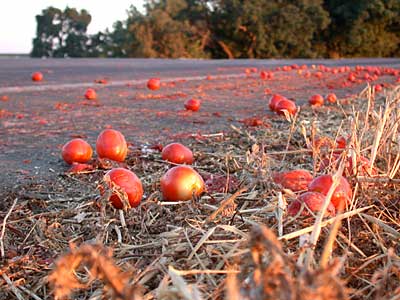 It’s the time of year when tomato trucks are traveling the country roads of Yolo and Solano counties. Some of them gather their wares from the fields just east of here, and then make the right-hand turn from the levee road onto the main road by our house. Some tomatoes inevitably spill out of the overfilled bins of the trucks.
When the first rains come in a month or two, the reconstituted tomato mush on the road surface is very slippery to travel on — be careful.
9 August 08
Out Geary Street
I took the day off and went on a expedition to San Francisco today, heading down by train and then taking the 38 Geary bus to the Outer Richmond district whereupon I walked up to the Legion of Honor museum. I don’t think I’ve been to that art museum in 35 years or so. And they gave me two dollars off admission since I took the bus.
The main exhibition was a show of four women impressionists: Berthe Morisot, Eva Gonzalès, Marie Bracquemond, and Mary Cassatt. I particularly liked Morisot’s work. Also at the museum was a small show of Israeli antiquities, including a couple of Dead Sea Scroll fragments and some 5000 year old pottery.
It’s a very pleasant trip to make, an outing to San Francisco for a one-day vacation. I should do it more often.
30 July 08
Mystery Plant
 This plant recently sprouted and grew quickly in one of Pica’s garden plots, which has since been heavily mulched. If anybody has any idea what it is, do let us know.
21 July 08
Solar Castle
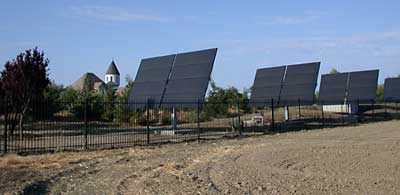 This residence just southeast of Davis on a favorite bike loop of mine intrigues me. On the south side of the residence, one sees a series of 10 massive solar panels mounted on pylons, the panels rotating to track the sun. The residence itself is partly obscured behind some recently planted trees, but one gets a better view of it in its full glory a little further down the road.
Ostentatious? To be sure. How about contradictory? In solar building design, isn’t it the first principle to start with a structure that is small and efficient, just to give yourself a fighting chance to balance a much more limited energy budget?
Or you can throw hundreds of thousands of dollars worth of photovoltaics at your McSolarMansion, I suppose, never mind about efficiency.