
27 March 09
Shops Out Of Time
We went to Berkeley today for a family gathering and early birthday dinner and unexpectedly had a bit of time in the afternoon for some shop-wandering, ending up at two stores that though their contents couldn’t be more different, both seemed like reliquaries rather out of time. The first place was the Lacis Museum of Lace and Textiles. The friendly folks at the Albany yarn store k2tog directed Pica to go to Lacis to find some fine mercerized thread for lace knitting. This storefront and museum, which has been around since 1965, has a fantastic collection of materials, tools, and resources for textile crafts. But not Joann’s Fabrics sorts of crafts. Rather, these are for crafts that are arcane enough that we were both gobsmacked that anybody still practices these. There were the fifty-seven different sorts of tatting shuttles. The doll’s heads for making interesting tassel forms. The horn thimbles. The Battenberg lace kits. And a full range of corset-making supplies, including both plastic and metal stays; the place offers workshops as well and a DVD on corset-making. Pica found her thread, but the true prize was a specially-made wrist yarn holder, good I think for knitting socks while going hiking.
The second store was Al Lasher’s Electronics on University Avenue which has been in Berkeley since 1960 but I don’t think I’ve ever set foot in there before. Electronics components stores are very thin on the ground nowadays, the professional market for these long having given way to mail-order and now online places like Digikey and Mouser. Nevertheless, Al Lasher’s has somehow hung on, and judging from the numbers of customers passing through, still seems to be doing okay. One woman came in there for wiring supplies to resurrect a turntable she found on Craig’s List, the previous owner having been a photographer who didn’t actually play it but rather used it for a backdrop to a photo shoot. Some of the components I think have been in the store since the 1960s, or as they say on their web page, “we tend not to throw things away.” I particularly liked the two tube-testing machines up near one of the front windows (remember those, commonly found in supermarkets and hardware stores in the 1970s). A sign over these said these testers don’t really tell you that much, other than if the tube is shorted out or not, but all the tubes we sell at this store are good. I didn’t buy anything today, but the store has now been added to my places to shop in Berkeley list.
Today, by the way, is the sixth anniversary of Feathers of Hope!
25 March 09
First Birds of Spring, 19th Century Version
Despite my lack of faith in the long-term durability of digital archives, it’s always nice to see digitization projects bringing resources out from dusty basement file cabinets to the light of a world-wide audience. One such project is the North American Bird Phenology Program. Housed in one of these proverbial file cabinets in Maryland is the Migration Observer Card collection, a set of about 6 million handwritten cards giving observations of the timings of the arrivals and departure of migrant birds. These observations were collected between 1880 and the Second World War by a network of up to 3000 birdwatchers. These observations are very valuable today because they help tell the story of how shifts in climate affect the distribution of animals.
Not having the funding to digitize the card files themselves, the biologists at the Patuxent Wildlife Research Center where the collection is housed came up with the idea of crowdsourcing the project. They have started scanning the cards and are recruiting volunteers over the Web to transcribe the information on the scanned images. The project is barely a month old and already has over 400 volunteers. But more are needed, so if you are interested in helping see here.
9 March 09
Living New Deal
Last week I heard Gray Brechin, author of Imperial San Francisco: Urban Power, Earthly Ruin and Farewell, Promised Land: Waking From The California Dream speak on campus. After working on those two books, he needed a cheerier project, so he has been involved with the Living New Deal Project. This is an effort to document the public works in California created through Franklin Delano Roosevelt’s New Deal. These projects included schools, gardens, amphitheatres, infrastructure like power stations and airports, public art works, and many other features on the landscape, constructed by federal programs such as the Works Progress Administration and the Civilian Conservation Corps. Their map of California New Deal projects is here — if you know of other sites that should be added do let them know.
25 February 09
Country In The City
I heard a seminar today by Richard Walker, a geographer at UC Berkeley, on the environmental history of the Bay Area, following the lines of his recent book The Country In The City: The Greening of the San Francisco Bay Area. The tale of how so much of the Bay Area landscape came to be preserved as open space is a remarkable one of grass-roots politics, and Walker gives a good telling of it. The bit that cuts to the bone for me is how much of my own identity (I who roamed Tilden and Wildcat Canyon when young) has been shaped by the results of their efforts. His book now rides high on my reading list (soon to be joined, I suspect, by Grey Brechin’s Imperial San Francisco — Brechin is giving a seminar here in a couple of weeks.)
17 February 09
The Great Parking Lot Bird Count
As Numenius said, we spent hours in the rain on duty on Sunday providing radio support for the start of Stage 1 of the Amgen Tour out of Davis.
I completely spaced this weekend’s Great Backyard Bird Count, but I can report the following birds from my six-hour stint at the east end of the City Hall parking lot in Davis, the first hour of which was in total darkness:
Cedar waxwing (max. 43)
American robin (max. 35)
Rock pigeon (max. 12)
Long-billed curlew (1, flying west-northwest).
The end.
25 January 09
A New Count
Today we participated in the first ever UC Davis winter bird count. Andy Engelis, who heads up the Museum of Wildlife and Fisheries Biology, had the idea to start this count of the 5,300 acre campus (the largest campus of the University of California system), modeling it on the Christmas Bird Counts. This first edition got off to a great start, with about 50 participants (I figure that many of these folks have been suffering from Christmas Bird Count withdrawal and needed their fix.)
We got to do the bit nearest our house; five of us walked the portion of campus east of Old Davis Road and south of the railroad tracks, birding along Putah Creek and in and behind some of the Vet Med field buildings. The most exciting bird was the Purple Finch that we tried very hard to turn into a Cassin’s Vireo based on its call and song, which faked both Pica and me out before Pica finally got a good look at it.
There is a lot less territory to cover on this count than on Christmas Bird Counts, which are based on a 7.5 mile radius count circle, so our count was over by noon and we all convened at Steve’s Pizza in town for our compilation lunch. Some of the good birds seen included a White-Throated Sparrow, a Chestnut-Backed Chickadee, Lark Sparrows, and an immature Golden Eagle. The number of bird species seen in total by everyone today was 102. We all had fun, and are looking forward to next year’s edition!
13 January 09
Flunking African Geography
When I flew back from Maine last November I sat next to two women who were studying a map of Africa, pointing to Kenya. “That’s where Obama’s family’s from,” one of them said. They struck me as people, residents of Sacramento, who had probably backed Hillary in the primaries but were now pleased to have voted for the first African American president and were eager to learn more about him. (We later played poker, badly, cooperatively as women do, which is not how you play poker.)
The current issue of Science News features unmarked maps of Africa showing first percentage of men circumcised by country vs. percent of people with HIV. The negative correlation is high — these maps are a great indicator of how government responses to demand for circumcision have helped slow the spread of AIDS — but to me it was a test. I knew all the countries, right?
Not quite. West Africa remains a jumble; I’d forgotten (how?) all about Liberia and Guinea Bissau, and what is Western Sahara? And how did I miss Congo separating out from Congo Democratic Republic? Oh dear.
My poor father is probably turning in his grave.
Edited to add this, in case you’re interested in taking a quiz…
11 January 09
Walking In Walkabout
This year, at the suggestion of one of our colleagues in the Yolo Audubon Society, we are doing a Big Green Birding Year on foot, rather than by bicycle. That is, we are attempting to see as many species of birds as possible solely by walking from home. I live just close enough to work (2.3 miles each way) that it’s feasible to walk in if I get sufficiently organized in the morning and leave at a reasonable time. This can be a challenge but last week I managed to do this twice and hope to continue this pattern. It’s a wonderful habit to get into plus it’s a good way to get birds on the Walkabout list!
29 December 08
Yard Coop
 Last week I was taking Charlie Cat out for a stroll in the yard when he noticed a lot of sparrow activity about the stacks of bee box stuff. I saw that he wasn’t the only one fascinated by the sparrows: there was a smallish Cooper’s Hawk very intently perched on top of Pica’s cherry tomato stands. I eventually took Charlie back inside, returned to work on sketching the hawk, who after a while flew down to the ground to catch a sparrow, and then flew over the building with it.
Yesterday I returned from an overnight trip to see lots of black phoebe feathers scattered near the carport and around the bend of the path. A little while later I saw the Cooper’s Hawk fly in and perch on the lattice outside our front windows, and I had a chance for another sketch. I saw the black phoebe still about though, so I think he must have had a close escape.
27 November 08
Happy Thanksgiving!
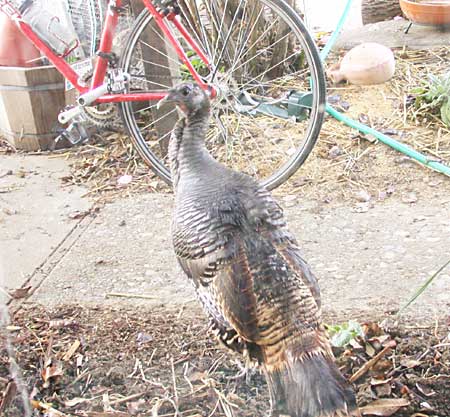 Pica got me out of bed this morning to announce that our neighborhood turkey was in fact in our front yard. I’m sure he would be thankful to know that our feast this evening consisted of dal and rice.