
6 August 10
Mr. Ibis Returns
 Judging by older blog posts we have a pattern here. In August when they cut the alfalfa and irrigate, the white-faced ibis having recently returned to the area from their summertime jaunts find the flooded fields and settle in for an hour or several of feeding. Often they show up quite close to the house, as they do here.
4 May 10
Pondering on a Podcast
 I spoke with my friend Dave Bonta on the phone yesterday. He was recording. Click here
for the results…
25 April 10
Birdathon/Sketchathon

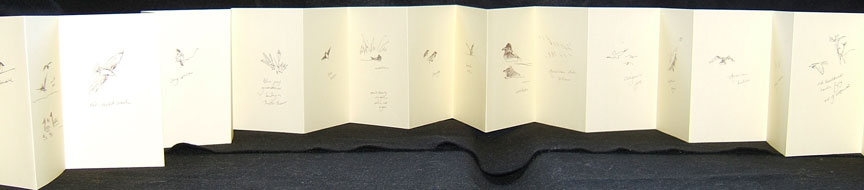
I’m pooped. Between the walk into the campus arboretum yesterday and today’s walk to Pedrick Road from the house, and the three blisters I have that tell me I must have walked at least eight miles, and the pages and pages of the Moleskin accordion-fold notebook that are now full bar the final page (though why they use paper that will hardly take a pen, let alone a light watercolor wash, is beyond me…), I think I’ve finished.
Worst miss: American robin. Birds I heard but couldn’t see to draw: wild turkey, orange-crowned warbler, both towhees. Most unexpected bird: American white pelican. Bird I kept trying to avoid but ultimately failed: European starling. Most spectacular save: hearing Canada geese outside as I was getting out of the shower, grabbing a towel and my pen and notebook and running outside to draw them as they flew west-southwest. (I later saw a pair with three goslings on the creek and added them to the page with the hastily-drawn flyaways.) Birds I saw but wasn’t quite fast enough to draw before they flew off: Eurasian collared dove (a first for our yard and a first for my 2010 walkabout), Western tanager. Booby prize for the bird I think I’ll never be able to draw well no matter how many times I try: Bullock’s oriole.
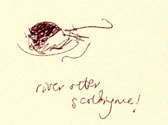 Oh, and the not-a-bird that stopped me dead in my tracks: the river otter in the Arboretum. I hadn’t seen them since New Year’s Day. It was about 6:30 am; I think you just have to be really early.
Total number of birds sketched: 59. I had hoped for 60. But I think I’ll call it a day. If you offered to sponsor me, thank you; if you would still like to support Yolo Audubon in this birdathon, please feel free. You can still pledge the composite list or any one of the participants. More sketches are over on Bird by Bird.
18 April 10
Birds and Boozers
Yesterday we went out to our Breeding Bird Atlas blocks and finally got a couple of confirmed breeding birds, plus a whole lot of probables, including a hooded oriole, red-shouldered hawk, and great-horned owl. We have been lucky to meet someone in Esparto who not only has a fabulously overgrown yard, well-stocked bird feeders, and a good diversity of birds that visit them regularly, but who is also a good birder and is willing to keep an eye on her patch for us.
Back to Davis, and Picnic Day. I volunteered to run Net Control for the first UC Davis Amateur Radio Communications group — folks wandering around Picnic Day (more than 100,000 people) were invited to report incidents that were not worth an emergency 911 call but should still be noted.
Most of the incidents yesterday involved alcohol. There was a roof party on B Street (off campus) where a young woman got seriously injured. There were reports all afternoon of alcohol-related incidents, a couple of them very serious. It seems a shame that Picnic Day has become such a magnet for people intent on getting paralytic, but there you go.
Net Control out.
10 April 10
Swarms of Spring
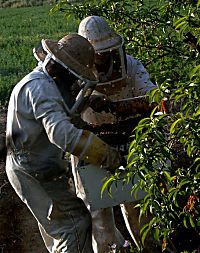 Lisa over at How’s Robb reported yesterday on her adventures in joining some beekeepers who were catching a swarm in a yard in the Oakland Hills; today we got to witness the same process, but out our kitchen window. Our landlord’s son is a beekeeper with a pretty substantial operation that is partly based out of a workshop that is around back where our house is. This past few weeks he and his assistants have been extremely busy building up beehives and starting to truck them around places. When Pica got home today, she saw that there was a swarm of bees in the peach tree just north. The beekeepers didn’t take long to collect it, as shown at left.
22 March 10
In a Vacuum
 Well, I ended up not being able to get on my flight to Maine this morning from Portland (OR). This is one of the hazards when you fly standby. The price is great but the reliability isn’t.
 However, being given a free day in Portland is a fantastic consolation prize. I walked a good bit down Hawthorn Street, had some tea, walked some more, hopped on a bus, hopped off at the Yarn Garden (wow), had a wonderful lunch at a Lebanese restaurant, hopped back on the bus and took myself in to Powell’s, hub of the bookworld. On the way, though, I found a haberdasher (John Helmer’s ) and popped in on the off chance they might have ladies’ handkerchiefs (no, but Kathleen’s on the same block did, amazing).
 The vacuum day. We’ve been considering buying a vacuum cleaner…. on M’s recommendation, I paid a visit to Stark’s, which is the largest vacuum showroom in the country which also contains a vacuum cleaner museum. I made some sketches of these (the earliest of which were operated with a hand pump). I’ll post sketches when I can (ADDED Sunday, March 28).
15 March 10
Slacker Birders
Even though the change to daylight savings time today gave us some excuse, heading out at 10:30 AM for a session of breeding bird atlasing is still quite late. What can we say — we’re slacker birders. For the Yolo County Breeding Bird Atlas project, this year we surveying two 5 by 5 kilometer blocks out by Esparto at the head of the Capay Valley.
On the first block, we didn’t do that well, seeing all of three species. There was a steady 15-knot wind from the northwest, and the supposedly quiet country road we turned off on was in fact quite busy, including the passage of about 15 motorcyclists in a row, off on a Sunday cruise to somewhere. We spent much more time in the block to the west, especially enjoying our session in the Capay Cemetery, a nice birding spot.
In one of those meant-to-turn-right-but-said-left maneuvers, we ended up returning through Esparto, normally a sleepy rural town but we found ourselves in a traffic jam — hundreds of motorcycles, vintage cars, the city park filled with people and stalls, a band playing last century’s rock music — we later learn we had stumbled upon the annual Capay Valley Almond Festival, now in its 95th year. Slackers that we are, we avoided the crowds at the Hog Canyon Deli there, and headed back to Davis for our usual weekend taqueria lunch.
9 March 10
Back From the Desert
 I didn’t quite hit the wildflower peak, but wonderful to see blooming heliotropes and verbena. And black-chinned and Costa’s hummers, and a small flock of Lawrence’s goldfinches…. Lots of movies were watched, and much Ulysses was discussed.

20 February 10
Counting Habits
It really isn’t that difficult. Last weekend was the Great Backyard Bird Count: I ended up doing three counts on three successive days, nothing fancy, just a set of 15 minute stationary point counts. The GBBC is a citizen science bird monitoring effort that takes place in the middle of February. I also logged my point data into eBird, which is in some ways GBBC’s bigger brother — the site hosted by the Cornell Lab of Ornithology provides an easy way for birders to submit their observations to be part of the readily accessible ornithological record.
I have made very little use of eBird in the past. The most challenging thing though was finding my old password to the site; it’s quite easy to enter data. This morning I did another point count here at the house, seeing 8 species and 25 different birds. This could become a Saturday morning habit — being out in the garden, counting the birds.
4 February 10
Weather Hound
You know you’ve become a serious weather hound when of the eight bookmarks in your browser toolbar, seven are weather-related. This phase of mine follows on to my aviation tack of the past month or two, meteorology being the first cousin to travel through the air.
We’re getting a nice little storm right now — the rain starting this afternoon and expecting to last until the middle of Saturday. California weather seems pretty simple though; just watch those cyclonic systems come in eastward from the Pacific. I am much more mystified by the weather elsewhere in the country though. My officemate is heading on a big trip to Africa tomorrow, and was quite dismayed to learn that a major snowstorm is on its way to hit Washington D.C. tomorrow, through where he was scheduled to fly. (The flight has already been cancelled; he was working on rerouting the trip as I left this evening). Where did that storm come from? Why is it expected to be an epic one?
Time to get back to the meteorology texts. It’s not so easy though; there’s a dearth of textbooks on what actually goes into making weather forecasts (there are plenty of texts on physical theory, not so many on the actual practice). I’m nosing out some resources, though.