
27 June 12
More Gray Foxes
 So the gray fox family is doing well. Five pups, now about 12 weeks old. I was able to catch the male this evening as he was guarding the whole territory. They make a funny kind of bark, like a terrier but much deeper, growling in there somewhere. (Below is a photo of the male barking at me.)
Having wild creatures like this so close to an urban area is thrilling but also worrying — too many cars going way too fast. For now, they seem fine.

7 June 12
Gray Foxes
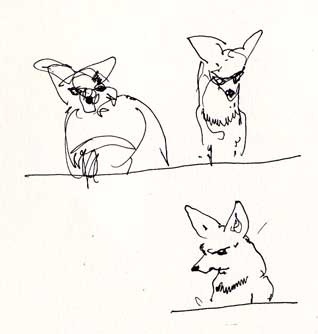 We’ve been noticing a gray fox around where I work. There’s a meadow that is more or less kept mowed between my building and a horse paddock; it hosts a lot of wildlife, much of it prey for things like red-shouldered and Swainson’s hawks, coyotes, and the feral cats we seem never to quite get rid of.
About three years ago I spotted a gray fox near the railway tracks. It was my first ever near our house and I was elated. Seems like they’re moving in, because this fox we’ve been seeing recently is a vixen with two pups. They have a den under the building I work in.
This sketch is of the mother who climbed a toyon tree to get onto a sea container in order to put us under surveillance last night. We made very quick sketches and backed away, not wanting to put her under any more stress. The pups, two of them, played happily in the twilight… Hope they stay away from the road and that they get enough to eat.
20 May 12
Spring Migration
 I left Massachusetts for California in 1996, in mid-June after the end of spring migration. It was the best migration for years. For some strange reason I’ve left it sixteen years to return there in May. I don’t know why. What I do know is I’m not going to leave it another sixteen!
I spent most of the time with my mother who will be 80 this year. We birded. We sketched. We explored the Maine coast north of where she now lives. It was a fantastic visit, punctuated by warbler song and azaleas, warm rain, tearful belly laughs over a lamentable restaurant experience. Movies and popcorn.
Back home: no parulas singing here but I returned to this beautiful Carpenteria californica in bloom. This plant is incredibly rare in the wild: only seven known sites in Fresno and Madera counties. It has a light, orange fragrance. It’s in the arboretum’s moon garden and I’m glad I planted two. As we prepare to go out and watch the annular eclipse this evening, it can do the light and shade thing for us…
1 April 12
Rainy Month
March comes to an end, being the rainiest month so far in the 2011-2012 water year. (Because California has a Mediterranean climate, yearly totals for precipitation are considered to begin on October 1st.) We recorded 4.81 inches this month, bringing the total for the year to about 11.7 inches. This is well behind normal, which is about 15.5 inches to date. Tuesday it poured — 1.5 inches of rain — and today we had showers and big winds, with 0.15” of rain.
Last morning we heard what sounded like a western kingbird, but didn’t believe it, since it seems awfully early for kingbirds. (A mockingbird imitating a kingbird?). But this afternoon I went for a walk out the levee leading past the Raptor Center, and saw at least two and possibly four kingbirds. An early spring for them?
25 March 12
Trees For Contemplation
This morning we went up to FARM 2.6, Pica to feed a couple of lambs there, and I just to check on my plantings. I’m not sure how much clover I’m getting out of my clover field (I do however have quite a crop of mushrooms coming up), but my oak seedlings are doing well. I planted five valley oak seedlings around the perimeter of the property, and so far four of them are budding out or have well-developed leaves.
Trees. Yesterday I went to San Francisco to see upon the suggestion of Dave Bonta an exhibit at the The Contemporary Jewish Museum entitled “Do Not Destroy: Trees, Art, and Jewish Thought”. The title of the exhibit is taken from an injunction in Deuteronomy 20:19 that prohibits the wanton destruction of trees in wartime. This concept has been broadened since rabbinical times to form one of the bases for Jewish environmentalism. I had never been to this museum — now situated near the Yerba Buena Center on Mission Street — and was quite impressed. The tree exhibit was in two parts, the first being a broad look at trees in general contemporary art, the second having more of a focus on Jewish ritual and in particular the holiday of Tu B’Shevat.
Entering the show one sees a sand circle on the ground about ten feet in diameter, covered with what seems to be a forest of two-inch tall trees. Looking closer these are seen to be two-dimensional metal pieces of various plant forms, and getting one’s nose to the ground one sees these to be painted in many different colors. Another highlight from the first section of the exhibit was a 15-minute film entitled The Ground, the Root, and the Air: The Passing of the Bodhi Tree by Jun Nguyen-Hatsushiba.The final sequence of this film is quite striking. It takes place in Laos along the Mekong River as a flotilla of fifty narrow motorboats are being driven downstream. Standing up in the bow of each boat is an art student sketching the landscape in black-and-white on an easel. The fleet approaches a bodhi tree at the site of a monastery along the banks of the river. Many of the students abandon their easels, leap into the river, and swim towards the tree.
My favorite bit from the second part of the exhibit was a short video entitled Grafted Arboreus sabius, or a failed attempt to propagate the Tree of Knowledge. In Jewish tradition the Tree of Knowledge has been linked to everything from wheat to amanita mushrooms, so the filmmaker opted to graft all those possibilities onto a single base. As she puts it: “grafting may be the only way to propagate the Tree of Knowledge, as it does not grow from seed”.
13 March 12
Nitrate Report Released
For the past 20 months, I’ve been working on a project at UC Davis that has been examining nitrate contamination in groundwater in two agricultural regions in California, the Tulare Basin and the Salinas Valley. We just released our report today and we all went to Sacramento today to give a set of briefings. Here’s the UC Davis news service writeup on the report, and the UCD Center for Watershed Sciences has a blog entry on the report here . My role in the project was to compile land cover maps, both current and historical, for the study region. It’s been a pretty amazing collaboration to develop the report — it’s not often you get 27 researchers at a single university all working on the same thing!
4 March 12
FARM 2.6
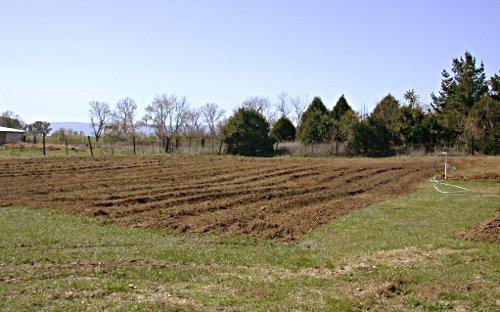 Back in September we went on Yolo Audubon Society’s fall field trip to Point Reyes. Riding with us was a postdoc from Chile who told Pica that she was involved with a fiber collective, mostly UC Davis students, who were interested in spinning, weaving, and dyeing and had ongoing plans to start a fiber garden. Somewhere along the way, this group had met up with a woman named Robyn Waxman, who several years ago during her studies at the California College of the Arts in San Francisco had a thesis project where she created a community garden on an abandoned plot of land near the college. She had since started community gardens near City College in Sacramento where she teaches and one on K Street in Davis. Last summer, she and her husband bought a house with 2.6 acres of land about 6 miles of Davis with the plan of turning this into a community farm, dubbed FARM 2.6.
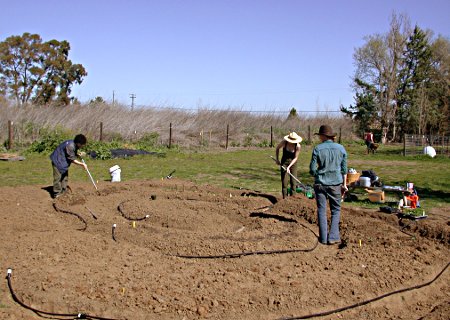 The fiber collective saw this as their chance to start their garden and plant flax, indigo, and so on and began to plan for the farm’s first workday, held in the middle of February. I went to one of their planning meetings, toured the plot of ground, and somehow had the idea of putting in a grainfield. (Now that I’ve been doing some baking again, there’s quite a fantasy of baking bread from wheat I grew myself). The workday was well-advertised and quite a success. The fiber garden got started, about 50 fruit trees were planted to form a food forest, and irrigation pipes were put in. Two big patches had been tilled earlier with a tractor, one for the orchard, one for the grainfield. For the grainfield I decided that I’d put in a cover crop of red clover for now, and plant some portion of it in wheat in the fall, so I did that a couple weeks ago at the subsequent work day. At left and above is a picture of the grainfield plot. It’s huge — about a quarter of an acre. Watering it turns out to be a challenge: we need to come up with a better system than a single high-efficiency sprinkler. At right is the fiber garden, starting to take spiral shape.
24 February 12
Windy and Dry
 There was a wind advisory in effect yesterday and today — big north winds. Not as windy as I was expecting yesterday but it really picked up today, and the weather station recorded a record gust of 38 miles per hour. The air is very dry, too — 21% humidity, so everything is drying out in a hurry. Not that there’s much moisture in the ground to begin with — I think we’re at 40% normal rainfall for the season. At left is the current infrared satellite view with an overlay of surface conditions: note the big high pressure cell off the coast blocking all the moisture, the winds coming down from the intermountain northwest, and the storm system off the British Columbia coast. Pica is up in the Puget Sound area this week getting all that rain; we aren’t.
11 February 12
The Last Crop
We went to see a showing of a film on Thursday night following the travails of an organic family farm near here, Good Humus. We know the produce of this farm intimately and Annie by sight, since she’s often in Davis talking about local food sources. The filmmaker was in attendance along with the protagonists.
Farmland in the Capay Valley is valued way above its farm value because developers have their eye on it for 5-acre ranchettes that will likely end up in foreclosure if the signs in the English Hills to the south are anything to go by. This is prime land, 6” of topsoil in a fertile river valley that is under threat. The Mains are more concerned that their land be continued in farming than that they leave it to their children, none of whom has expressed a firm interest in continuing in farming.
Looking at the film, you can see why. It’s backbreaking work; you’re always behind; there’s always the unexpected huge expense, so that saving for retirement is a risible suggestion. And yet:
The room was filled to capacity with people across the age spectrum who have a passionate interest in making sure these kinds of farms don’t disappear. Hosted by the Agricultural Sustainability Institute on campus, it drew a wide and diverse crowd.
Something seems to be happening, something big, and it doesn’t seem unrelated to Occupy Wall Street. Food security. A passion for growing things. I feel caught up in it and don’t know where it will go, but it seems much more hopeful than some of the alternatives…
3 February 12
Weather Station
 We’ve had a hankering to have our own weather station for a while so recently we finally took the plunge, ordered one, and last weekend I set it up next to the veggie garden. Looking at the displays and graphs on the console in our bedroom of temperature, humidity, dew point, wind speed, wind direction, and barometric pressure has become a frequent ritual. It’s fun watching the anemometer cups spin which they do readily even in the gentlest of breezes. It gets one pondering local meteorological phenomena — for instance the station said that the minimum temperature last night was 36 degrees F, yet there was frost on top of the car. That’s radiative cooling for you. Maybe someday we’ll put the station on the net as part of the Citizen Weather Observer Program, but there’s no shortage of weather stations around Davis so that can wait. If we’d only get some rain now! (we’re at about half normal rainfall for the water year).