
6 December 08
What's New Is Old
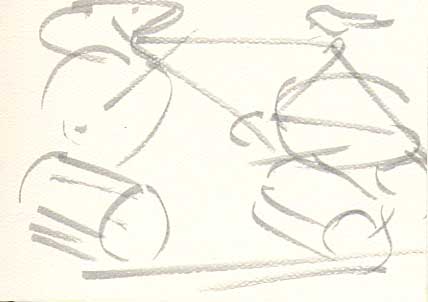 Davis is home to a homeless bicycle museum. The California Bicycle Museum was formed recently after the university in 2001 bought a collection of bicycles dating back to 1823 that was owned by a rancher near Modesto. The museum is seeking a permanent place to display these bicycles, but in the meantime they are on temporary display in the community center adjoining Central Park, open during the times of the Farmers’ Market.
We finally made it to the exhibit today and were quite impressed by the collection, which ranges from the 1823 draisienne with no pedals (you sat over the frame and pushed it along) to the latest design in streamlined human-powered vehicles with a full fairing. What struck me was how little bicycle design has changed in the past century. Once the safety bicycle came along in the 1880s and pneumatic tires were added shortly after that, the bicycle looks quite modern. One of the bikes in the collection was a track bike used by the great American racer of a century ago Major Taylor, illustrated above. The lines of the bike resemble any track bike of today, though the wheelset was made of wood and he trained on a particularly massive set of wooden rollers (as seen below the bike in the illustration).
Of the evolution of bikes in the twentieth century Frank Berto in The Dancing Chain writes:
…around 1908 there was a fork in the road: English cyclists took the right fork and would pedal their three-speed epicyclic hub for the next 40 years. French cyclists took the left fork and rode their derailleur gears right up to the present. American cyclists fell down a hole in the road and continued to pedal single-speed coaster brake bicycles for the next 60 years.
26 November 08
Another Book, Another Blog
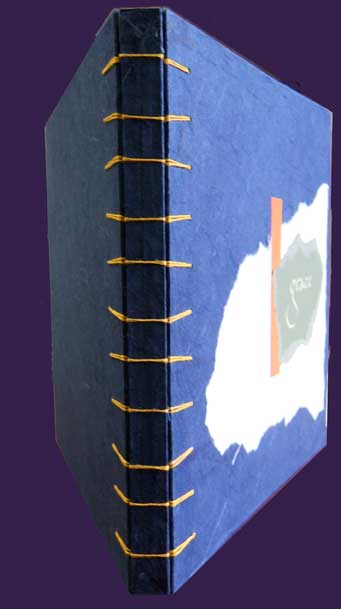
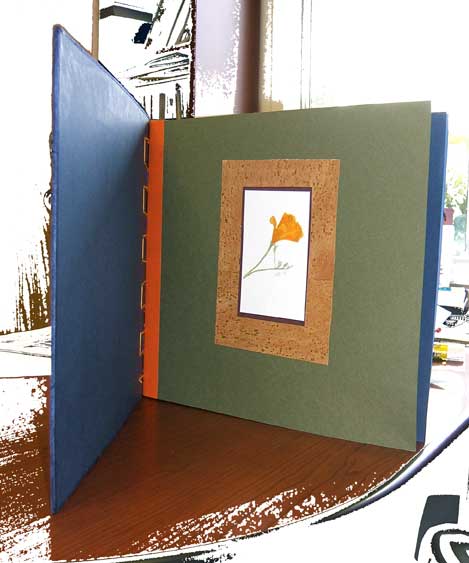
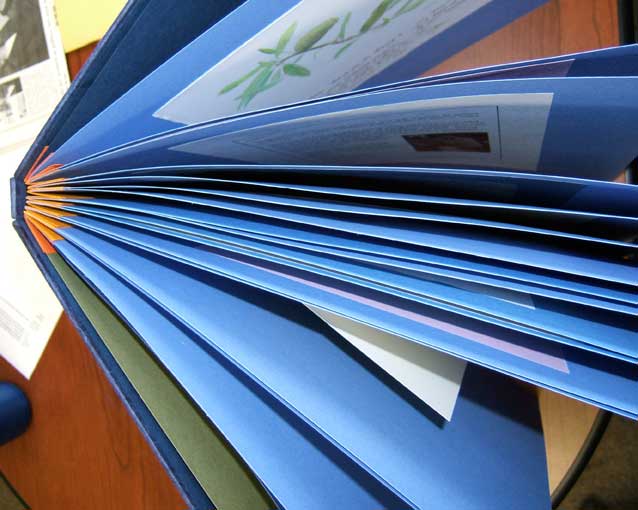
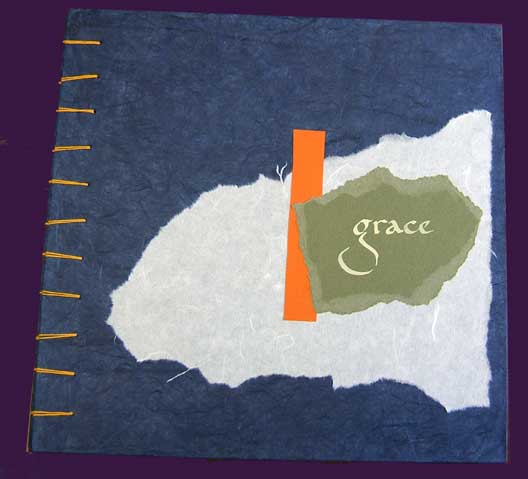 The project I was working on when I hurt my finger last week got finished this morning, a book for a coworker who is moving on after 20 years. I tried a new binding technique, “Belgian Secret Binding,” in which the stiff spine is encased by threads from the front and back. The pages are in turn woven onto the spine’s woven threads. It’s cool but fiddly — maybe I should try these new techniques when there isn’t a deadline, when I don’t have to fit taking a friend to the airport in and around weaving blue and gold cord.
A new blog I’ve been avidly following recently is Urban Sketchers which features a number of fantastic sketch artists including Davis’ own Pete Scully. There’s a lot of material and if you aren’t careful it runs away with you.
23 November 08
Books For Notes, Books For Sketching
As Pica relates, today we went to Stockton to catch Jack Laws’ bird sketching workshop at the Central Valley Birding Symposium. Despite it being too early in the morning when I got up, I actually came up with a coherent idea for how I would take notes in the workshop. Pica once got from the campus print shop castoff 7“x17” sheets of Endeavour Velvet Book paper, and we have several stacks lying around. It’s not very good paper for anything other than color offset printing, but it works as scratch paper and for practice projects. I took eight sheets of this paper, and folded these in half to make a 7“x8.5” single signature pamphlet. I took notes and made sketches on the signature in the workshop, hoping I had neither too few or too many pages. At home I made a little cover for it out of a sheet of ivy Canson Mi-Tientes paper, and bound it with a three-hole pamphlet stitch.
I was doing my class sketches with my Derwent Graphitints, and was thinking didn’t Derwent recently double the range of the Graphitints from 24 to 48 pencils? Some searching revealed this wasn’t the case (I must have been thinking of the expanded range in the Derwent Drawing Pencils), but I did come across a distressing blog post about lack of lightfastness in the Derwent Graphitints. This post however was in a wonderful new blog by Minnesota book artist Roz Stendahl, the themes of which being sketching, visual journaling, bookbinding, and dogs. She had a great post at the beginning of the month about a major reason I’m interested in bookbinding: how else as a sketcher can one be assured of getting a sketchbook that’s exactly in the format, paper, and design that one wants?
16 November 08
Round The Gyre
In the early 1970s Davis was a happening place environmentally. The city was a pioneer in designing transportation infrastructure for bicycles. And over in west Davis, architect and developer Mike Corbett built Village Homes, an ecologically sensitive development with lots of interior green space, solar design, community gardens, edible landscaping, and natural drainages. The 70s came and went. The flourishing of environmental ideas at that time gave way to the growth of the 80s (Reagan removing the solar panels Carter had put up on the White House perhaps being a good symbol of this). Village Homes was much admired but never really emulated.
We spent the day at a Green Summit meeting held up in Woodland, about 10 miles north of here. A number of local environmental groups helped put this event on, including our own favorite, the Yolo Audubon Society (in her capacity as YAS president, Pica got drawn into being on the event steering committee). Despite the weather being spectacular today, the event drew over 230 people. The event was organized as a symposium with about four different concurrent sessions. Topics included habitat issues, water issues, land use and urban design, and outreach.
I settled into going to the urban design sessions, followed by one in the afternoon on youth and the outdoors. The first speaker led off with a bit of Dickens (“It was the best of times, it was the worst of times”) to set off the theme of sprawl versus infill for the Sacramento region and beyond. I agree very much with the premise of these urban planners that infill and compact growth are the key to preserving habitat by keeping development out of the wilder places of our landscape.
Sprawl and infill are not new issues for urban planners. But have we perhaps circled back around to the insights of the 1970s? (Though adapted to the 2010s — Mike Corbett today in response to a question about the non-adoption of the Village Homes model, said that what he would take from that model would be the elements, but not the design itself: we need far higher densities now.) I was heartened by the presentation of Mike McKeever, executive director of the Sacramento Area Council of Governments (SACOG) who talked a lot about their blueprint planning process which through a massive effort to elicit citizen input came up with a compact growth plan for the region. Happily to date, people may be acting on this plan — e.g. vehicle miles traveled are down in the region.
Here are the key factors now in this region. 1) The population in the Sacramento area is expected to grow substantially, probably by well over a million by the year 2050. 2) The region is being hit hard now by the housing crash, and the worst-off areas are the newest, most sprawling developments. 3) Responding to global warming is becoming much more of a political imperative, especially in California where the state has taken a lead on reducing greenhouse gas emissions. 4) People are starting to recognize that cheap energy isn’t always to be counted on. For instance, solar housing design is now a good selling point.
So having looped around this way before in the 1970s, are we now about to set off down the track towards sustainable design for real? We hope so.
11 November 08
Black Book
 My latest exercise in bookbinding has been to make a black-papered book using Canson Mi-Tientes art paper. Each page is 5” high by 8” wide, good I suppose for nighttime landscapes.
The goodies available at Talas are starting to look very tempting.
2 November 08
Cooking, Carpentry, and Sewing
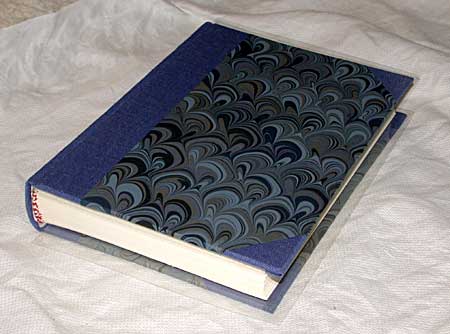 That’s how one of my classmates described the activities in the Bookbinding III class I took this weekend at the San Francisco Center for the Book. This time we only produced one book, but this was a large and complicated one, with 20 signatures, sewn endbands, and a split-board binding. The cooking bit was learning how to make wheat paste glue, for the carpentry we had to do lots of precise cuts with the board shear and guillotine, and the sewing of course was the signatures and the endbands, the latter being very finicky and difficult. I’ve now completed the introductory bookbinding series at SFCB so it’s time to start applying these skills. It would be nice to produce something other than blank books, so my next project might be to typeset some text from Project Gutenberg, print it up on a laser printer, and bind it as my very own book design. Imposition problems here we come.
24 October 08
In Praise of the Doodle
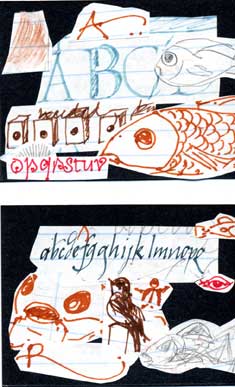 I’m a doodler. I admit it. If you talk to me on the phone, I will almost certainly reach for one of the several fountain pens within my field of view and start making marks on paper. Often they start out abstract, but usually resolve into something figurative. A flourish turns into a letter, which gets followed by another letter.
I make, and swap, Artist Trading Cards (ATCs). There are only two rules with these things: a) they must be 3.5” x 2.5” and b) they can’t be sold. A tiny canvas, a place to try a new medium or technique. I’ve been trading with calligraphers for a while, but recently have joined Swapbot to do one or two trades at a time with a much wider range of options.
It was on Swapbot that I found the call for the Doodle ATC. Go back through your pages and find doodles you’ve made and cut them out, it said. Don’t consciously try to doodle something. Send something you’d like to receive yourself.
Wow. I guess I must really have been on a fish kick over the summer.
19 October 08
Books Five and Six
 They say that after you bind your first hundred books, you can consider yourself to be a practiced bookbinder. This weekend I took Bookbinding II down at the San Francisco Center for the Book where we made two more books, getting me to six total, learning how to do Bradel binding and to work with decorative papers. Pica meanwhile went down to San Francisco with me today and had a grand time touring the city, returning home with sock-knitting supplies!
14 September 08
Books Two and Three
I was inspired by our whirlwind course on binding a sketchbook three weeks ago to start taking the introduction to bookbinding series at the San Francisco Center for the Book. This weekend I went down to the Bay Area and took the Bookbinding I class. I made two books over yesterday and today, so including the one from three weeks ago, these are the second and third books I’ve ever made (at least of the sewn signature hardback book variety).
It’s very satisfying to hold and open a book that you’ve sewn and glued yourself. I’ve already signed up for Bookbinding II, and I think I will take Bookbinding III this fall as well.
9 September 08
Life and Death
This is an exquisite truth:
Saints and ordinary folks are the same from the start.
Inquiring about a difference
is like asking to borrow string when you’ve got a good strong rope.
Every Dharma is known in the heart.
After a rain, the mountain colors intensify.
Once you become familiar with the design of fate’s illusions
Your ink-well will contain all of life and death. – Hsu Yun
I found this on the always surprising, always provocative Whiskey River this morning. I’ve been thinking more about fairyism and the meaning, and purpose, of art. About how Danny Gregory says drawing every day saved his life after a life-and-death event.
I am such a dabbler. A butterfly. I bring people together, give them food, give them work I’ve done, here, have a mudpie, it’s made with love. For the universe, but you’re here, as a deserving member of the universe. You have it. Have a poem, have a book I made, have a painting.
I have lived my life as though this generous spirit somehow let me off the hook of going to the dark places. But we are about to enter some dark places, whoever gets elected here in the US, and it will take only the most supreme pollyannas or the wealthy beyond measure to deny them (they may hope to be dead before New York is 12 feet underwater after the melting ice caps, because if not, they won’t escape either). The question will no longer be “am I really an artist” but “am I really a human being.” There will be tests. Will I be ready?
Here’s what I’m trying to work out, inspired by the likes of her and her and her: how to find wisdom in the dark places. How to be open to it even when it’s terrifying and seems hopeless. How the marks on paper or wood or metal or stone help to make sense of things when there is no sense to be made.
How, in other words, to have art save your life. Or at least contain, direct, preserve your humanity until you die.