
25 May 26
Consciousness and the Imagination
I just finished listening to Michael Sheen’s reading of The Rose Field, the third in Philip Pullman’s second trilogy, The Book of Dust, following the life of Lyra Belacqua/Lyra Silvertongue. I have not seen any of the visual adaptations of any of the books but was happy to listen to Sheen, who can do a convincing griffon queen and a terrified mouse daemon as well as anyone.
The bonus interview between Sheen and Pullman included at the end of this audiobook has sent me on a long ponder. What is the imagination? What separates us, humans, from animals? What is consciousness? What does it mean to make connections and weave metaphors reflecting our own lives, our lived experience, and particularly, how does the timing of our exposure to these potential metaphors affect the meaning we ascribe to them?
17 May 26
A Hot Wind
During our sketchcrawl yesterday it was very windy; today it was worse, so much so that it knocked out power in downtown Davis for six hours. Unlike where we used to live, this is not a big deal, because at least we still have water when the power goes out. We settled into reading and knitting, there being plenty of light available. I finished Christian Cooper’s memoir, Better Living Through Birding: Notes from a Black Man in the Natural World. If you recall, Cooper was the man who was faced with weaponized racism while birding in Central Park on Memorial Day in 2020, just for asking a woman to leash her dog per the rules. (This turned out to be the same day that George Floyd was brutally killed by police officer Derek Chauvins in Minneapolis while his fellow officers looked on.) It’s a great book whose intersectionality unexpectedly includes birders. I recommend it.
The power outage meant, however, that the German class I’d booked for 5 pm, which relies on good wifi, got missed. The topic was “Eine Grafik genauer beschreiben” — since this topic interests me I’ll have to figure out a way to re-book it.
9 May 26
A Really Good German Lesson
I have found the quality of instruction at Lingoda to be very high and worth what I pay for it, but this morning I had an outstanding private lesson. With Lingoda you have the choice to be in a group class (maximum five students) or a private one; I have a lot of class credits saved up so have transferred some of my group credits to private. I always learn a lot more. You also have the choice, when private, either to follow the class content you signed up for (in today’s case, Konjunktiv I Wiederholung, or review of Subjunctive I, which is almost always reported speech) or just to chat.
What made this class in particular so good was that the instructor zeroed in very quickly on where I’m struggling and gently corrected my errors, but also gave me tips on how to remember things. The introductory topic of the lesson was about an astrophysicist discovering a black hole, not something I’m in any way familiar with but which is inherently interesting, and it provided a jumping-off point for a much wider conversation with someone who is interesting, intelligent, and a bloody good teacher. It made me feel great.
(And I still make dumb mistakes.)
3 May 26
In Praise of a Good Grammar
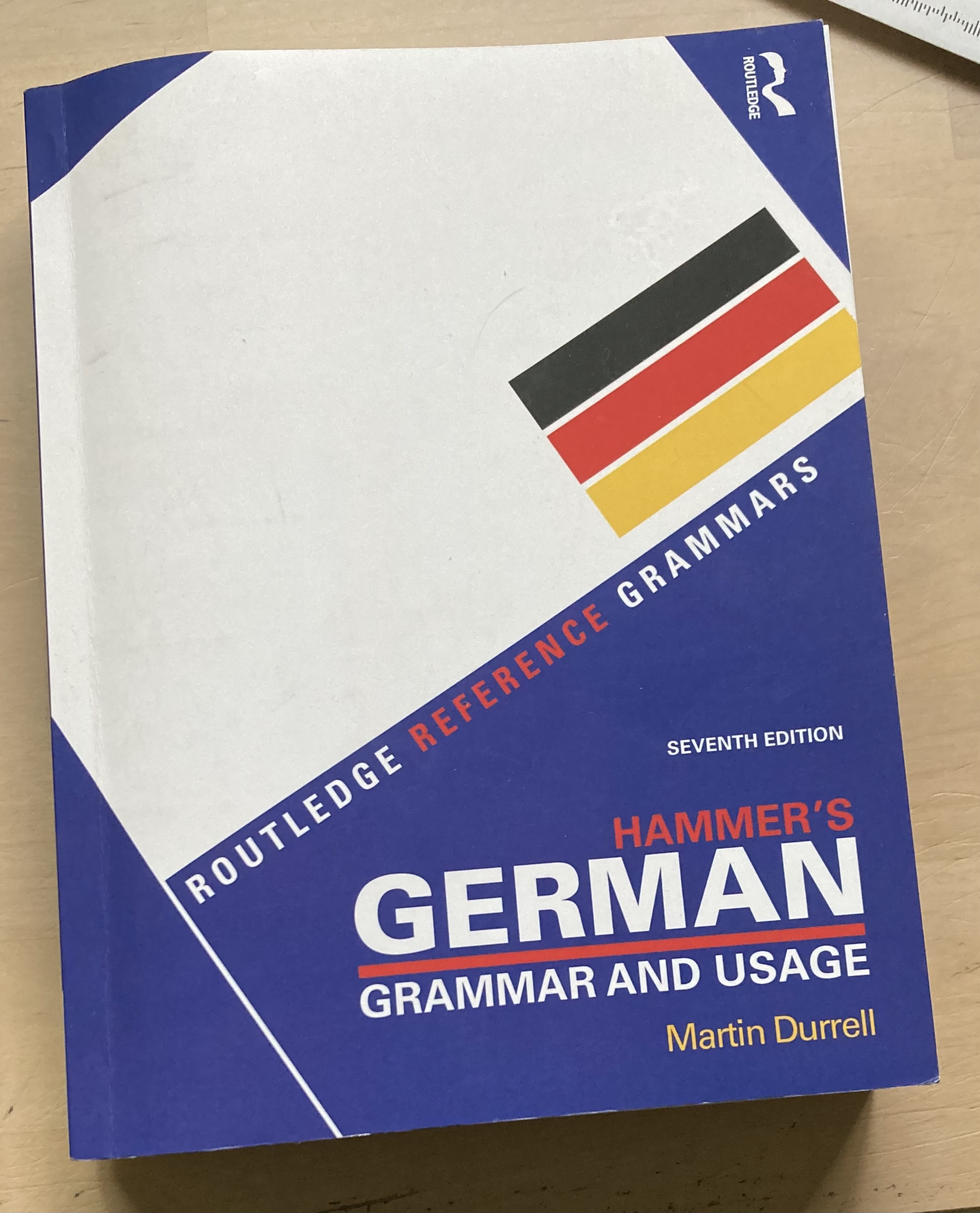 I’ve said before that I was very pleased when not one person in Germany instantly switched to English when I opened my mouth. But I did find myself getting frustrated when I made obvious stupid errors — not stupid in themselves, but stupid in that I KNOW both tea and coffee are masculine, not neuter, in German and I consistently turned them into neuter nouns. Another error I make a lot is to use the dative rather than the accusative case (German has a lot of adjectives that ONLY take either the accusative or dative case, but a number can also take either, depending on context).
The one I found myself getting most agitated about, though, was using the incorrect form of a past participle (this is sort of an easy one to fix: just study them from a verb book and learn them). I turned to my trusty Hammer’s German Grammar and Usage to look this up, and was reminded that German has two participles that don’t exactly match onto present and past (they call them, instead, Partizip I and Partizip II).
This is such a great book. Clear descriptions, good examples with citations when useful. A lot of people hate using a grammar when they’re learning a language, but I like to be given the why of usage. Proponents of comprehensible input say it’s not necessary, that the grammar will seep into your brain with enough external content, but my brain isn’t as plastic as it was sixty years ago and I’m happy to do my bit to keep Routledge in business… (by the way, that first syllable is pronounced as in a boxing rout not root).
29 April 26
On the Loudness of Americans
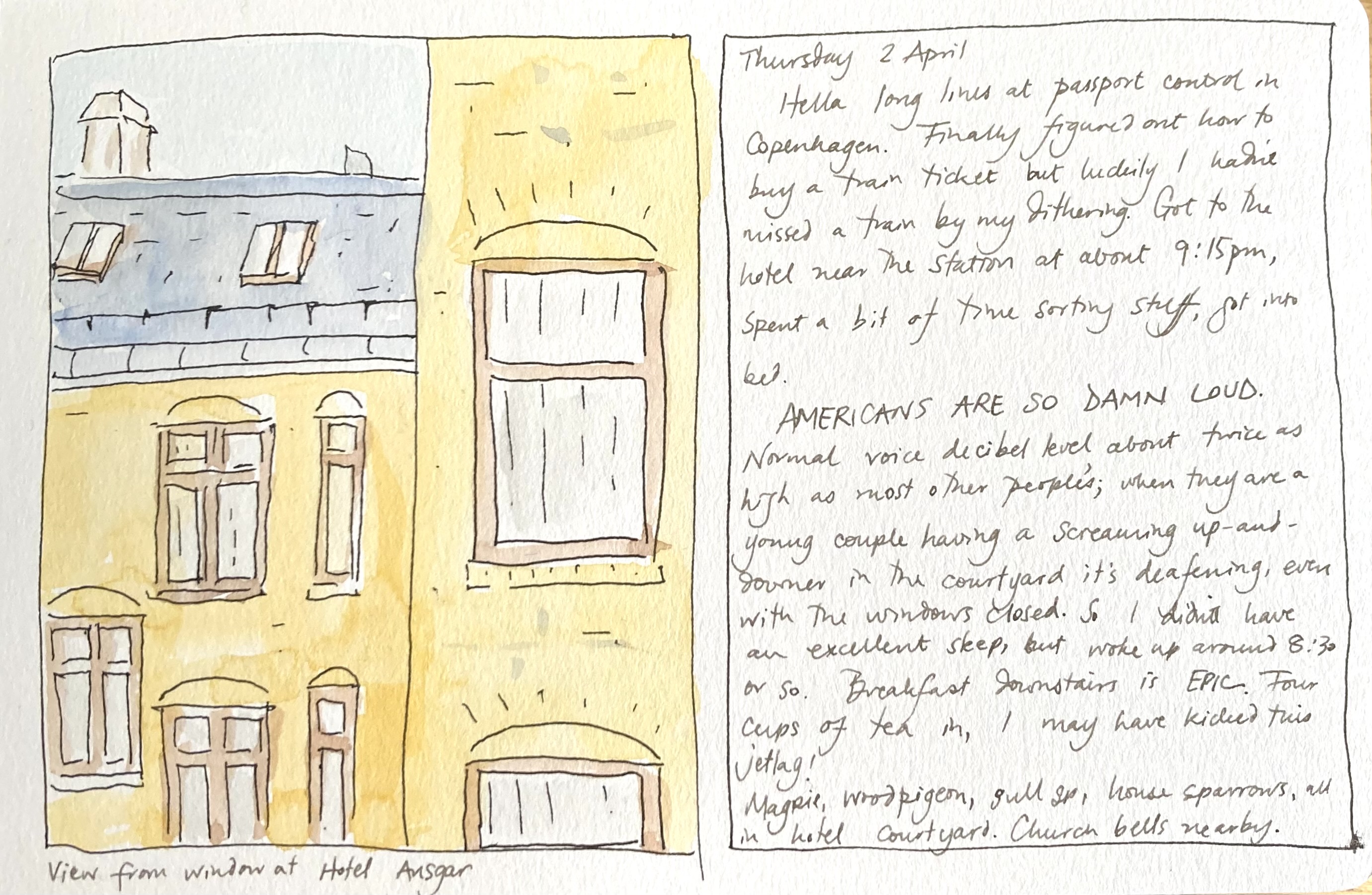 On the first night of my recent trip I arrived in Copenhagen (a long, long day: a train ride, a BART ride, a transatlantic flight, a second flight within Europe, a long line at Danish passport control, another train ride into the city: you get the idea). I was exhausted, wanting nothing more than to fall into bed in a hotel room which was way too hot. So I opened the window.
An American couple was having a very loud argument. Were they in their own hotel room, or in the courtyard? I couldn’t tell, but after a few minutes of this I was very tempted to stick my head out the window and yell “don’t you think they hate us enough already?” — I didn’t, but it did occur to me that I’ve always thought of Americans abroad as loud, brash, uncultured, and basically stereotypically and obliviously throwing their weight around the world in the same way we do politically. Of course not ALL Americans behave this way, the same way that not all men are harrassers or rapists, but it just takes one loud encounter to reinforce the stereotype. And it left a sour taste in my mouth.
Curious about the actual decibel level of American speech I chanced upon this recent article from the Santa Barbara Independent by Julianne Tai which looks at the phenomenon. It’s really a question of perception. I think a better way to approach the question is really to educate young Americans about the perception of Americans in other countries and look at ways to gently thwart it… which requires that they travel (already a tall order) and then that they travel respectfully.
23 April 26
Sant Jordi
April 23rd is St. George’s Day, which in Catalunya is the occasion of a massive festival centering on the giving of books and the giving of a rose. Sant Jordi has evolved into a massive street fair in Barcelona.
Numenius and I celebrated by going out to lunch and then going to our local independent bookstore and buying each other a book. He got a copy of The Serviceberry: Abundance and Reciprocity in the Natural World by Robin Wall Kimmerer; my pick was Christian Cooper’s Better Living Through Birding: Notes from a Black Man in the Natural World. A couple of friends came over later in the day and more books and flowers were passed around.
I am feeling more and more immersed in my Davis life after my trip; tomorrow I’ll finish unpacking and tidying up the kitchen table which looks like a bomb hit it.
24 March 26
Sketching Along with Jill Lepore
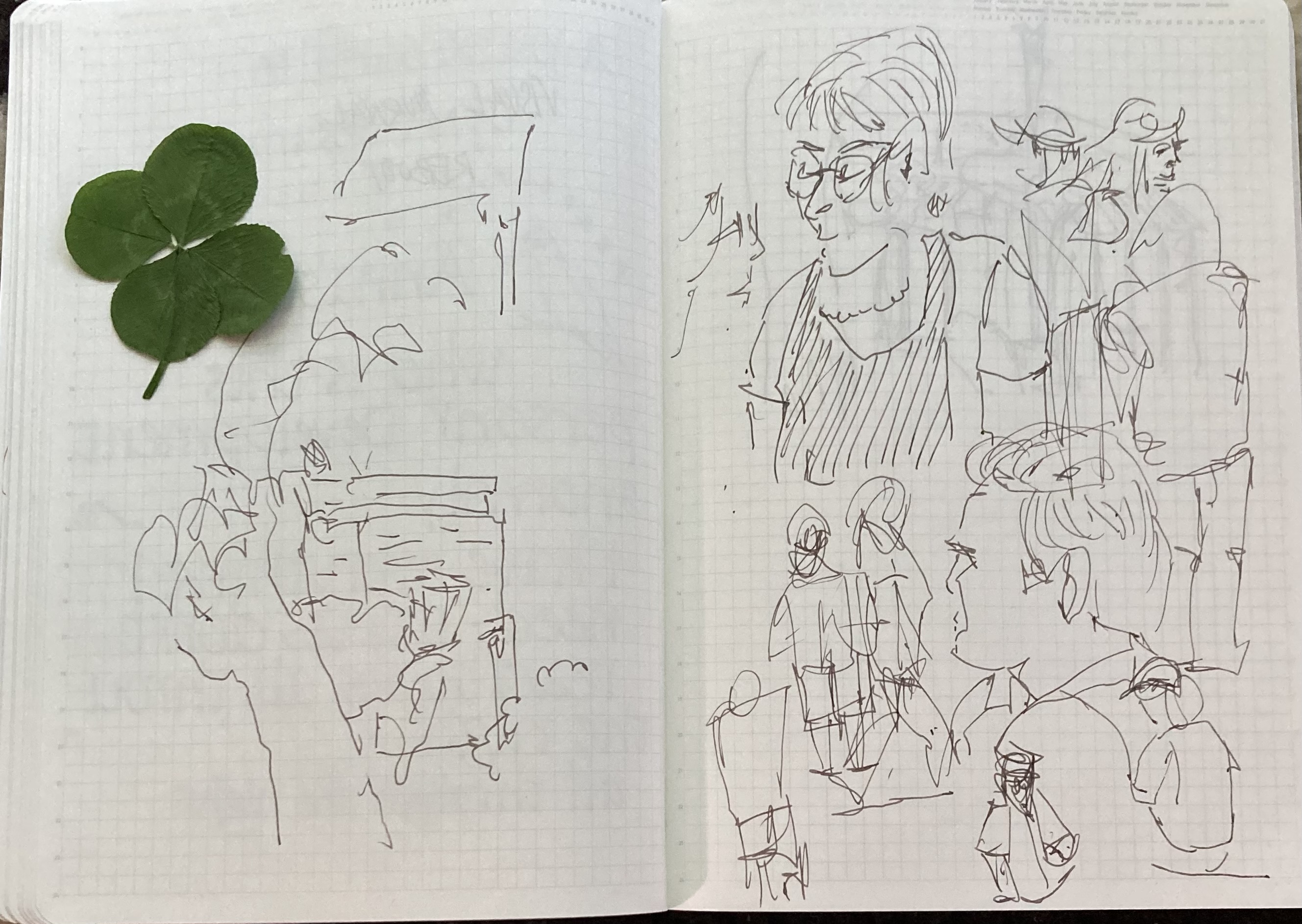 I like audiobooks, especially since there is a good selection of them at either the Yolo County Library or, even better, the Sacramento Public Library, which any California resident can join. I can knit complex patterns because the narrative isn’t competing with a chart (though I do pause the audio when I’m counting stitches!).
I’ve been reading Jill Lepore’s The Deadline, a collection of essays read by the author, always a pleasure. (It’s great that they know WHERE to put an inflection, and where the emotion of a memory cracks the author’s voice.) Lepore is a historian at Harvard and has a knack for capturing events past and present succinctly and intelligently, but even more, is good at capturing the feeling, the zeitgeist, that gives rise to these events.
I drew these sketches while Lepore was reading her essay about gun control and the power of the National Rifle Association, sitting at a café in downtown Davis; I found the four-leaf clover on the way home.
20 March 26
Emily Dickinson's Black Cake
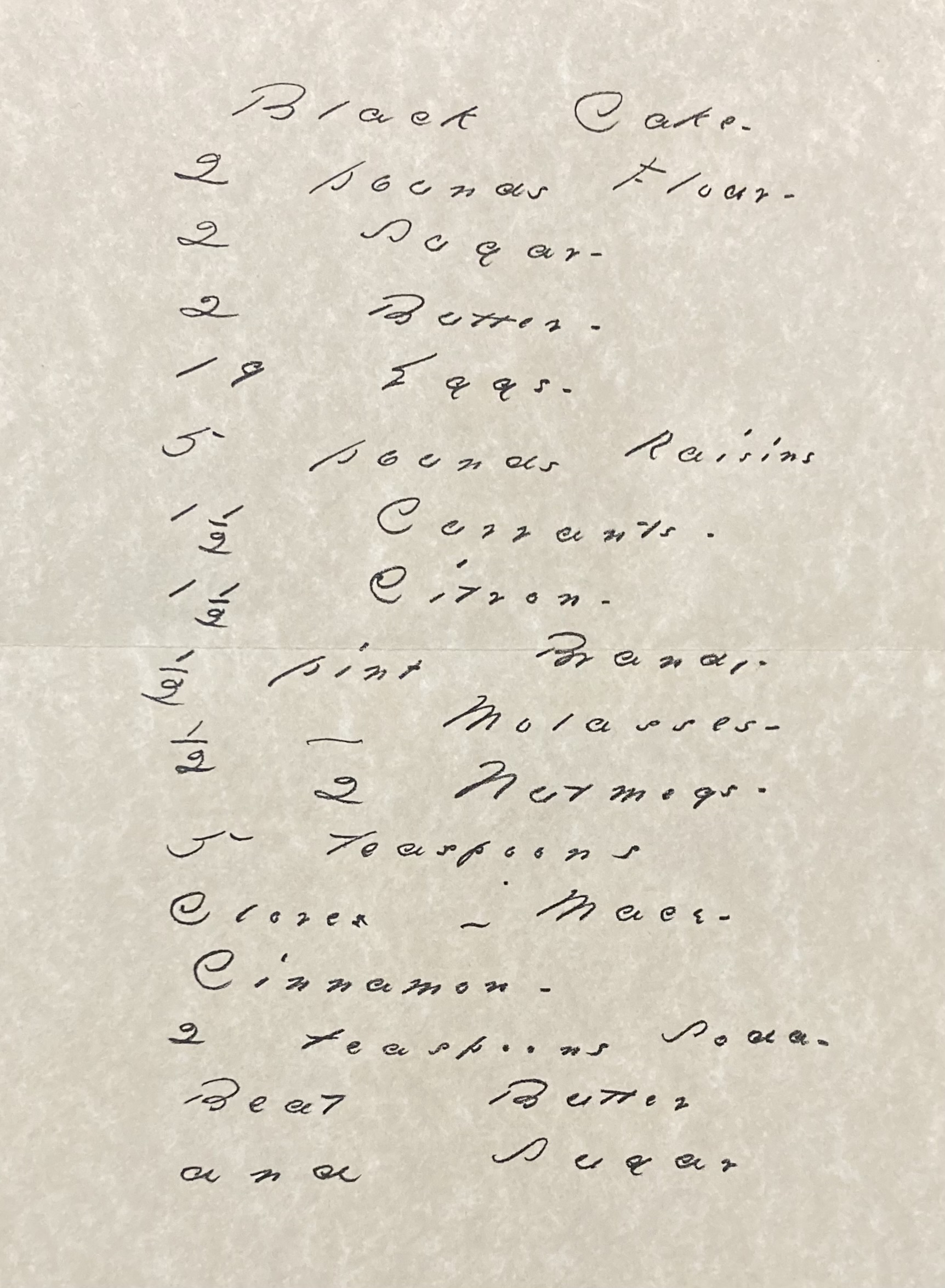 My sister knows I like to receive mail, and she gave me the gift of a monthly History By Mail subscription for my birthday. She’s done this before… but this time it’s recipes by famous people. (Rosa Parks’s recipe for pancake batter includes, surprisingly, peanut butter.) The facsimile of a handwritten recipe is included with a transcription and some background on the person and in this case their relationship to cooking.
Emily was apparently a very keen baker and this recipe includes five pounds (!!) of flour, 19 eggs, and half a pint of brandy in which to soak oceans of dried fruit (the cake thus pickled lasts for about five months and I’m assuming she got over ten cakes out of it). She is said to have written poems on the backs of envelopes while she was baking, with the spatters of her bakes ending up on the poems. Since many of her manuscripts ended up at the Houghton Library at Harvard, maybe somebody should conduct an analysis of these spatters to see what she might have been baking on the day they were written.
A couple of years ago I developed a font of Emily Dickinson’s idiosyncratic handwriting, but looking at this sample I may not have kerned the letterspacing enough…
6 March 26
The Past Continuous
Several friends whose grasp of English grammar is better than mine have been unable to answer a question I have: What is the name of the construction in English, where the word “would” is used as a continuous past tense instead of as a conditional? Here’s an example I made up: “As a child, I would often go and play in a sandbox.”
Trying to figure this out, I remembered one of the most famous opening lines in all of literature, the first sentence in Marcel Proust’s A la Recherche du Temps Perdu: “Longtemps, je me suis couché de bonne heure.” I just came across an interesting discussion between Richard Howard and George Plimpton about different published and unpublished translations of this sentence, but none of them uses the “would” construction.
Which is what I would use, here: “For a long time, I would go to bed early.” It gives the sense of a repeated action happening over time, in the imperfect, though Proust doesn’t use the imperfect here, which, as Howard points out, is jarring: almost nowhere else in the seven volumes is the passé composé used in the narrative. The standard English translation for decades, Scott Moncrieff, reads “I used to go to bed early,” which is a different imperfect continuous…
Such questions keep me up at night, which is better than being kept up by stupid and illegal foreign wars.
5 March 26
Delusions From Middle-Earth
Today I submitted a public comment to the Federal Communications Commission on the proposal from SpaceX to launch up to a million satellites for orbital data centers, which I blogged about last Friday. I am now working on the public comment for the Reflect Orbital proposal to put giant mirrors into space to light up the night particularly for use by solar farms. I retrieved the Reflect Orbital proposal documents from the FCC portal and was disenchanted to find that the name of their initial test satellite with an 18-meter mirror is EARENDIL-1.
This is a name that comes from Tolkien: Eärendil was a half-elf in The Silmarillion who bore on his brow a jewel — a Silmaril — that shone like a bright star. This leads to the question: why are so many tech bros obsessed with Tolkien?
A lot of people have commented on this trait lately. A writer named Samuel Arbesman compiled a list of all the tech companies he could find that have names from Tolkien (there are 22). In an essay entitled Mythic Capital, Lee Konstantinou discusses how Tolkien teaches a lot about capital and politics and the technoutopian vision of breaking free of all limits. In the New York Times Michiko Kakutani writes about how the traditionalism running through Tolkien appeals to the tech bros and that they are drawn to the themes of kingly and magical power rather than the gentle settled life of the hobbits.
It is interesting that when Tolkien first got popular in the late 1960s and early 1970s it was pulling in people mostly from the hippie counterculture. Times have changed.
But Pratchett doesn’t seem to appeal to the tech bros — I don’t see too many companies celebrating the cabbages of the Sto Plains for some reason.