
8 September 25
The Jujube AI
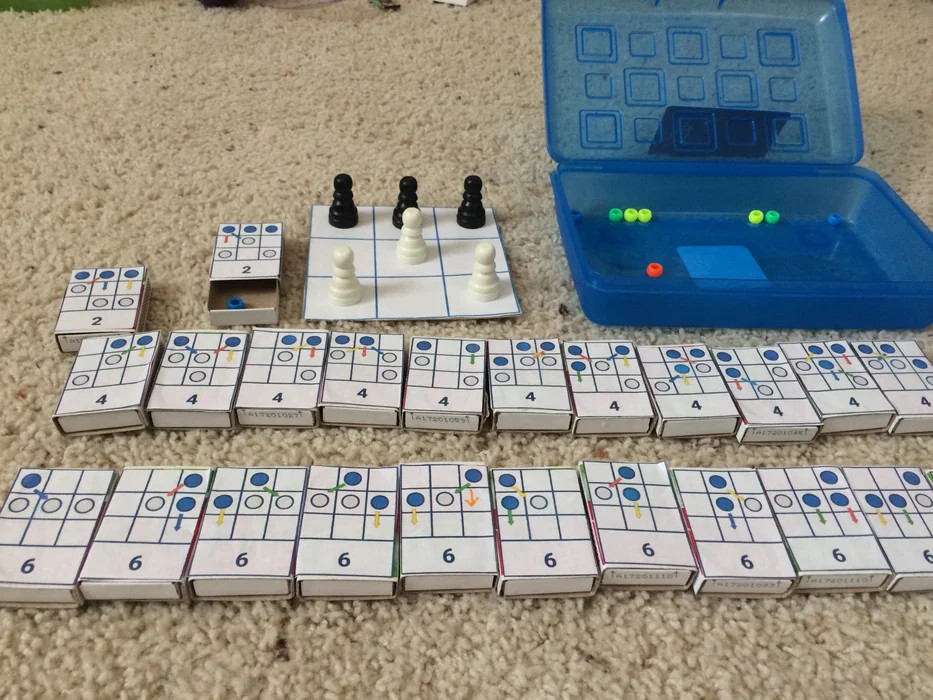 When I was a child, my mother and I crafted an AI out of a set of matchboxes and some jujubes (the small colored gummy candies). I enjoyed reading Scientific American when I was young, and at one point found an intriguing article by Martin Gardner, the columnist who wrote Mathematical Games for 25 years. This article was entitled A Matchbox Game-Learning Machine and was published in 1962 — I probably ran across it in a reprinted book collection.
Gardner’s article shows how to build an analog learning machine to play a simple game called hexapawn which involves moving pawns on a 3×3 chessboard. The rules are given in the article linked above. At right is a photo from a much more recent Instructables article showing the setup. In the game the human player moves first as white. The machine plays the black side. The system works as follows. On top of the boxes are diagrams illustrating all the possible states of the game after moves 2, 4, and 6 (the game can last no more than 7 moves) and the possible moves for black illustrated in different colored arrows. Inside each box are colored beads (or jujubes in my case) corresponding to the colored arrows on top. After the human moves, they find the box corresponding to the state of the game, randomly draw a colored bead on the top, and have black carry out the move indicated on the top by the corresponding arrow. The bead is set aside, and if black loses the game, the bead representing the final move is discarded from the machine. That way the machine learns that the final move is an incorrect one to take.
It turns out that given optimal play, black is guaranteed to win, and it doesn’t take very many rounds for the machine to become invincible — somewhere around 30 or 40 games played.
Does this qualify as AI? Absolutely. This demonstrates that machine learning doesn’t require digital computers. Admittedly, this approach doesn’t scale very well: Gardner’s hexapawn example with 24 matchboxes was based on an earlier system for tic-tac-toe that needs over 300 matchboxes.
I am interested in other examples of analog AI. In particular, contemporary board games often have subsystems for solitaire play that can be quite hard to beat. These generally do not learn from experience, but they do respond to current states of the game by setting goals and carrying out actions.
Previous: The Queen of Passports Next: Game Of Cones