
15 December 07
14 December 07
Back and Scapulars
From our Workshop on Sunday:
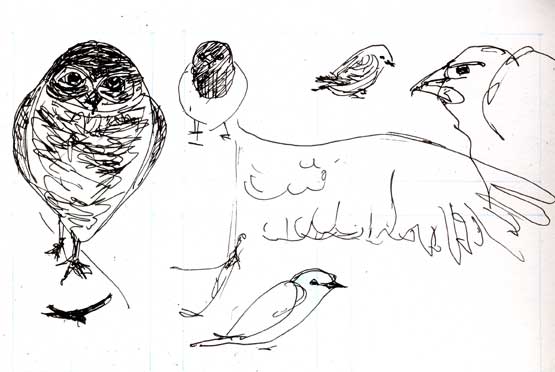
 The back of a bird is much more likely to have streaks than the rump, which is usually simple.
The scapular feathers usually look like back feathers but they’re at a slightly different angle and can often cover the top of the wing.
13 December 07
Cedar Waxwing
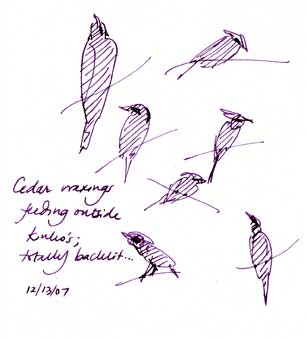 I had no blue pencil in the car when I went to Kinko’s. But I did have a pen and a sketchbook. Waxwings gobbling berries, like they do.
12 December 07
The Head
 Three feather features to be aware of when drawing a bird head:
1) Most birds have some kind of eye ring, formed by tiny bristle feathers.
 2) The ears of most birds are covered by harder, bristly feathers, which extend behind the eye, come down and forward, and then up toward the bottom of the mouth. This makes an angular shape, called the auricular patch. In many birds, the angle of the head protrudes here.
 3) The feathers on top of the lower bill make a mustache stripe or malar stripe. They share a border with the lower auricular patch.
11 December 07
Flight
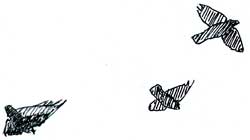 Super excited to try out the new technique of working a bird’s flight planes and then filling in the wings depending on what you See rather than Think. This is much harder than it sounds.
These crows and turkey vulture didn’t give me much time but you look, close your eyes, consolidate the image, and then get it down on paper. Lots more practice needed, but I can already see this is going to make birds in flight a lot easier to render on a two-dimensional surface…
11 December 07
Bird Feet
One of the great things about studying bird anatomy is that you get a sense of what is, and isn’t, possible anatomically by a bird. Jack did some great demonstrations for us on Sunday, which he called the “Hallmark errors” — anatomic impossibilities often found on greeting cards. (The early Disney singing bluebirds are a classic example of this: mouth open wide, both parts of the bill making a moving vee as the bird sings away, tweet tweet tweet. Only the bottom mandible of most birds can move; exceptions are parrots and other birds that need to exert extreme force to feed).
 Another Hallmark error is the foot-death-grip. Notice the arrangement of foot (in reality, toe) bones in the drawing at left. Outside toe, four bones, best for contouring around a branch. Middle toe, three; inside toe, two; rear toe, one.
 One bone, only, in the rear. It can’t bend. Around. Anything. The claw will help it cling for dear life in a hefty wind, but the toe itself is condemned to sitting straight out.
Many thanks to Jack for allowing me to post these drawings of his.
10 December 07
American Goldfinch Again
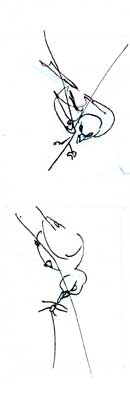 Birds hanging upside-down: now, I dare. It’s easier when you think of it in terms of body masses and where they end up in relation to each other, where the center of gravity now is.
Jack’s tips on how to draw birds in flight have had me seeing birds flying over today with completely new eyes. Crows, magpies, mockingbirds: I feel like I’m seeing them all for the first time. There may be more than a bird a day for a while…
And then there’s this, for those wanting to study wings really closely… or this for anyone wanting to see the only bird whose bill is longer than its body.
9 December 07
Sketching Birds All Day
 We drew birds today at John Muir Laws’ bird illustration workshop hosted by Yolo Audubon. We started off with one-minute sketches from slides, of which this was the first.
 Get the posture line, he said. Then rough in the body and head masses. Stop at this point to check the proportions while there’s still time to do something about them. Then get the bill/eyeline, tail, leading wing edge, angle of legs and feet…
 After a workout on bills, breasts, wings, tails, and feet, we did the original flycatcher again, for a minute. The directional lines were done in non-photo blue, an animator’s trick.
It was fantastic. I wish I could persuade every birder I know that this is worth doing, even if you “can’t draw a straight line” (there aren’t so many straight lines on birds, y’know.)
7 December 07
American Goldfinch
 After 24 hours of rain, we have a beautiful sunny day that will get cooler. The birds have been in puddles and feeding busily, including the American goldfinches in the star-thistle outside my window. They move a lot but I was able to catch this one before it flew off.
6 December 07
Rain and the Crows Wheel
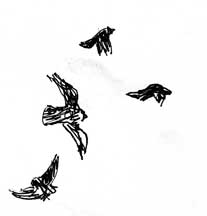 Our first big storm of the season today. Twenty-four hours of rain, they say. But a gentle rain, not wind-lashed.
Very few birds around but this afternoon flocks of crows were wheeling and dancing through the light drizzle. Like them, I feel like dancing in the benevolent wet.