
8 May 08
Western Bluebird
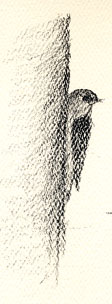 The bluebird was looking in what I thought was the starling’s hole. It may still be up for contention…
7 May 08
European Starling
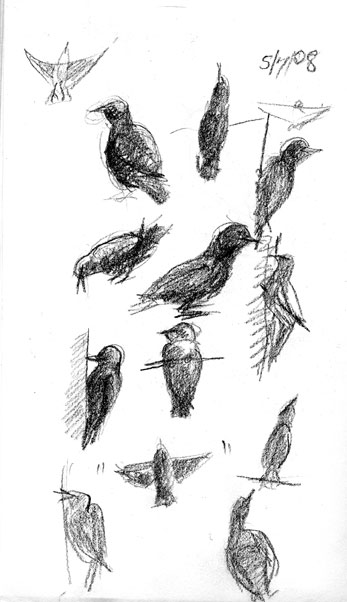 Starlings are ubiquitous here, so much so I almost don’t notice them. But this is an error: an introduced species, they compete for nesting cavities with native birds (some of the sketches at left show a bird at a hole, which it won off a pair of Western bluebirds).
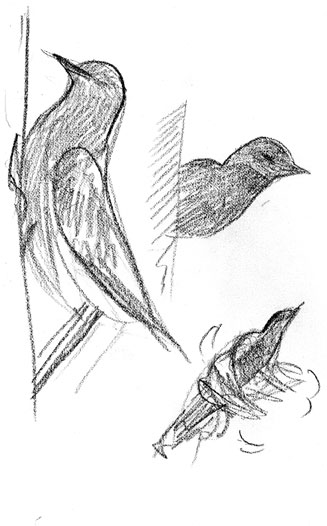 I find this bird unusually hard to draw. It has weird proportions: a small head and very short tail, and the neck seems sinuous. Long, gangly legs. Many of my attempts make it look like a woodpecker (or a bluebird). The hardest part, though, seems to be rendering the shine on the feathers.
I once worked with an Australian woman who called starlings “bodgies,” Oz for greasers on motorbikes. The Bodgie Bird.
6 May 08
Thwarted by the Bullock's Oriole
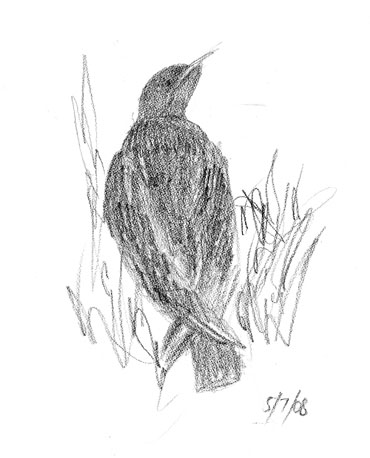
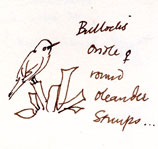 I’ve been waiting to get a long enough (even 30 seconds would be fantastic) look at a Bullock’s oriole in order to be able to sketch it. The male is whistling and squeaking all over the place — at home and at work — and something that bright shouldn’t be able to disappear so easily into green. But he does.
The female helpfully perched briefly on the oleander bushes today at lunch. I caught a glimpse, then she disappeared too.
 Bird artist Julie Zickefoose has been running a fantastic series on her trip to the Cornell Lab of Ornithology and the work of her hero, Louis Agassiz Fuertes, displayed around the library (I am sorry I didn’t pay more attention to Fuertes’ work when I worked at Harvard). Fuertes’ granddaughter reminds Julie — and us — that Fuertes didn’t have the benefit of a camera to figure out wing angles — he had to sketch from life. It’s a great reminder that it can be done. We can’t all be Fuertes, but we can all sketch!
John Muir Laws has kindly linked to Bird by Bird from his techniques page. I took a class from Jack last year and I have to say he’s one of my own heroes. Hard to meet someone more enthusiastic than Jack, for sure. If you’re visiting here from Jack’s page, welcome, and I do hope you’ll try sketching birds regularly. Certainly check his book out on the nature of the Sierra Nevada if you want to be inspired both about the Sierra and about the wonder that can be found in rendering that nature in two-dimensional form.
5 May 08
American Crow Eating Hapless Rodent
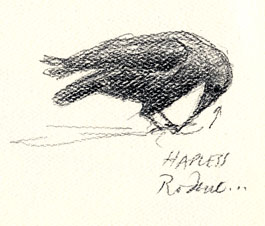 It’s that time of year. Corvids are after protein…
4 May 08
Swainson's Hawk
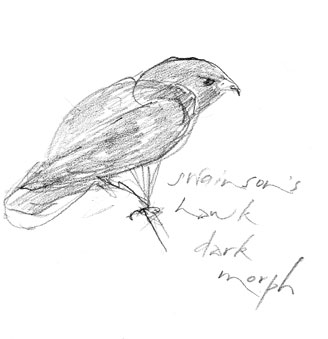 Being away for ten days gave the local birds time to get settled on nests. The Swainson’s at work is nesting in the top of the pine tree that didn’t blow down in our severe January storms. The male is vocal, active, and is harrassed pretty much constantly by crows.
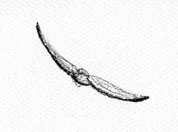 I’m hoping to be able, someday, to render the near 180° roll of a Swainson’s hawk fending off a crow in flight, but for now this will have to do. I saw this bird drop down and pick off a small rodent (probably young ground squirrell) without really stopping; it was like a touch-and-go maneuver.
2 May 08
Montezuma Quail
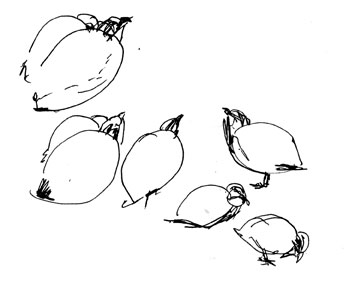 The Montezuma quail was a tough bird because it’s so skittish and was only known to be frequenting one place, the water fountain by the feeders at Indian Lodge. Our first evening we sat out quietly for over two hours with no luck.
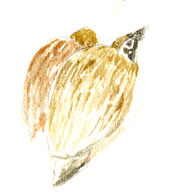 The following morning I volunteered to sit in the pre-dawn light and wait while others had breakfast. When the birds crept in, I had no idea who was behind me but I didn’t dare move a muscle, hardly dared breathe. I sketched quickly and quietly, my hands shaking. (Most of our group and several others were in fact there, quiet and also shaking.)
This is a bird I’ve seen before but it was a highlight — it’s so beautiful, it’s so spooky, it’s so rare.
A note about how I’ve done this. Early on I realized it would be hard to do watercolors of birds on the spot — even in a pared-down form that’s a lot of “stuff” to wield for a bird that might stay for five seconds — so I tried to get multiple sketches of each species as they popped in and out of sight. I then tried to put the sketch into my accordion-fold book as soon as I could, preferably that day, so I still had a good memory of color. In retrospect I wish I’d made some color-pencil sketchnotes, but that will have to be next time…
Postscript, 5/6/08: my final Texas bird list can be found here .
1 May 08
Colima Warbler
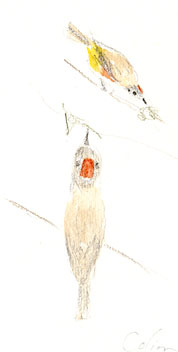 This one was the one for which I got 12 blisters… Working as a pair on the Colima Trail near Boot Spring. We heard several on the way up; saw a glimpse or two here or there; then finally, knockout views (repeated down at Boot Spring, which is where I realized I was not going to get down the mountain without a whole lot more blisters AND bad knees if I went down the steep trail, and even more blisters if I went back the longer, gentler way, which is what I opted to do, having cached a bottle of water there on the way up…)
30 April 08
Canyon Towhee
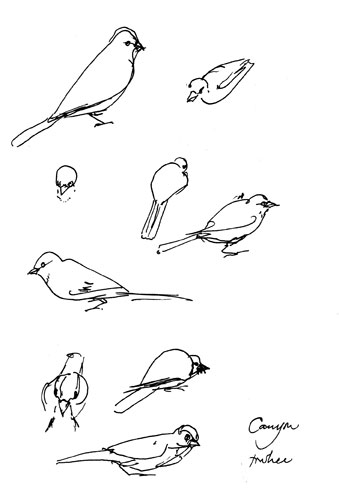 One of the advantages of visiting a place with well-stocked feeders is that you can sketch birds you don’t ordinarily see easily and for hours. (One of the best parts about this trip for me was the ample opportunity for sketching birds, period.)
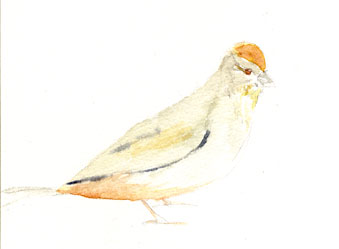 The canyon towhee looks very similar to California towhee but there are important differences. Not all the canyons we saw had a black chest spot, but the bird is overall duller and the pattern around the face and head, while subtle, is quite different. (The songs and calls are VERY different.)
I enjoyed this bird as much as seeing the flashy denizens of the Texas scrubland. It was a huge treat to sit for a long time and try and record it every time it came out, noticing this or that faint line in the throat or face.
Learning the bird: that’s why I do this.
29 April 08
Green Kingfisher (For Teresa)
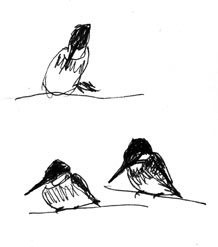 A brief stop in Del Rio on our way west from Concan yielded this gorgeous kingfisher, sitting on a branch in a city park.
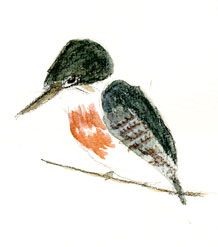 We saw the bird again on our last day, flying toward us, its white forehead shining like a beacon. I don’t seem to have caught the white forehead in the sketches, so this is a bird I’d like to study more. Tiny bird with a huge bill.
28 April 08
The Dolorous Roadrunner
 Roadrunners have a perky, cheerful reputation, fleet-footed and cheeky. Certainly when I’ve seen them in the past I haven’t found anything to contradict this.
Until — until I heard one sing last week at Big Bend. It’s a mournful, descending song, rendered with the bird’s head below its feet as it perches in a tree presumably above the nest. Mourning doves sound cheerful by comparison.
 We sang the canto lacrimoso of the roadrunner for Steve and Nick who had missed the Montezuma quail on Saturday… Ooo. Ooo ooo ooo ooo ooo.