
8 September 08
Solitary Sandpiper
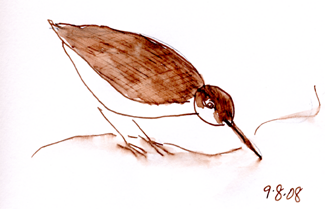 A report of not one but two solitary sandpipers in North Davis had me rushing out at lunchtime on the bike (with a tailwind), seeing the bird despite a bevvy of landscape painters around the pond, sketching it for all of 10 seconds, and rushing back (with a headwind). It was probably a 7-mile round trip. A few more of those and I’ll be starting to think I’m training for something.
Bird # 163 for this year’s birds by bicycle…
7 September 08
White-faced Ibis
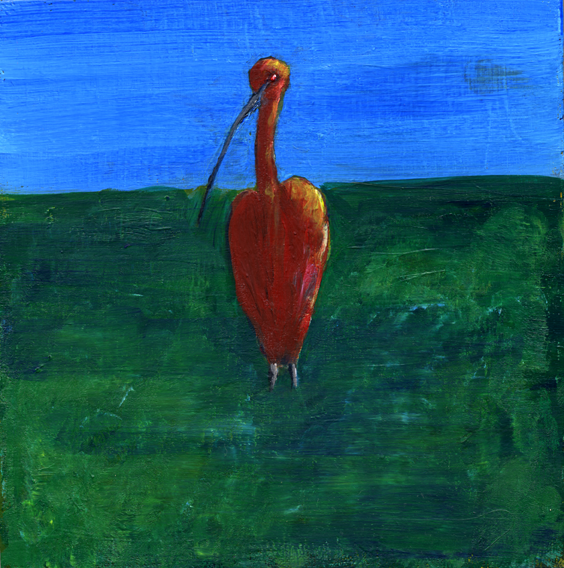 A couple of weeks ago a bunch of us were given a piece of plywood, 8“x8”, and asked to do something on it that could be auctioned off for a fundraiser.
I don’t really paint and I really don’t paint in acrylics, but it seemed like the thing to do if I wanted to get it done in time. Really wish I’d done egg tempera and oil, but that will have to be next time.
There are about 18 glazes on that ibis. I know: you can’t tell, and it doesn’t seem like it looks very different than it would if I had just glommed paint on there in one go. But live and learn.
6 September 08
Wood Duck
 On the way back from lunch I stopped at Lake Spafford on campus, spying a young wood duck. It hit behind its mother, which I was able to draw, here…
5 September 08
Harris' Hawk
 I went over to the Raptor Center again at lunchtime to try and do some more foot studies. I was able to get very close, once again, to their Harris’ hawk (a female, nickname Rosa), which was once used for falconry and is totally imprinted on humans. (She is not releasable for this reason but also because she had a bad infection on her wingtips which destroyed her ability to regrow primary feathers, a dealbreaker if you’re a bird that needs to fly.)
 Anyway: birds’ feet. There are two common traps lying in wait for any would-be bird artist: drawing the bird’s foot clinging on for dear life, and overworking the foot. Jack Laws urged us to work loose — have the foot be in the same style as the rest of your drawing.
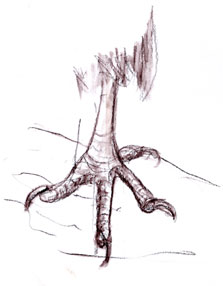 Because of the arrangement of tendons, when a bird perches, the foot contracts, even in a “relaxed” position, and provides all the hold birds really ever need except in very strong winds. Like many other animals such as cats, lizards, horses and hippos, they walk on their toes: the reverse “knee” is really the equivalent to our ankle, and the “shin” is really the tarsus, elongated and properly part of the foot. (The bird’s real knee is almost always hidden under feathers up in front of the hip.)
But the toes: mostly four. The rear one, short, halix: one joint. The joint attaches the halix to the foot. The bird can never, ever bend this digit, no matter how windy it gets. (So no clinging for dear life drawings any more!) Second, inside: two joints. Third, middle, long: three joints. Fourth, outside: four joints. These digits are known to my vet friends as phalanges and abbreviated to P1, P2, P3, P4, with P1 being the most inside (i.e. halix) and working outwards.
4 September 08
Canada Goose
 A small group of us took a walk around the Arboretum at lunchtime hoping for migrants. It was hot and we didn’t see much, though a banded white-breasted nuthatch was fun. We also saw a possible hybrid wood duck/mallard in among the ducks, and looked for cackling geese among the Canadas. No conclusive findings, but I did get a chance to do a quick sketch…
3 September 08
Red-breasted Nuthatch
 I’m working on a longer piece about bird foot anatomy, but couldn’t resist this lightning-fast sketch of a red-breasted nuthatch, my first of the fall… It was checking out the hole where the bluebirds nested.
2 September 08
Feet
 Hopped over to the Raptor Center at lunch to try to draw some turkey vulture feet. They have very long claws which makes me wonder how the “turkey vultures are really storks” lobby can have any idea what it’s about, but they must have their reasons.
Couldn’t resist some others, though: this barred owl’s feet look very much as though they’re zygodactylate (two digits front, two digits back) and a quick glance at the great-horned owls on the way back to my bike revealed the same thing. I’m going to have to look this one up.
 A strange cry behind one of the red-tails led me to a gorgeous Harris’ hawk I couldn’t resist drawing. This bird belonged to a falconer for nine years; it’s quite used to having people close by. It picked up its dead chick and ate it companionably next to me while I drew its feet and, finally, its beautiful head. I’d love to come back and spend more time on this one…
UPDATE: yes, owls are zygodactyl. They can move the third digit forward for perching, though apparently they hunt with the 2-2 formation. See what you learn by sketching?
1 September 08
Steller's Jay
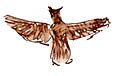 While we were eating paella on a deck in Kensington, a Steller’s jay popped into the oak trees to check us out. By the time I was ready to sketch it, there was no sign. But I heard them way across the canyon, and finally caught a glimpse…
1 September 08
White Longhorns
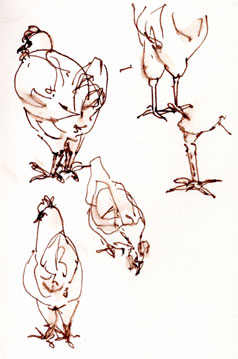 Fun to share space with chickens over dinner with friends…
30 August 08
Chasing One Bird but Finding Others
 We got a call about a possible green-tailed towhee along Putah Creek. We decided to head out for it after tacos but went first through Willowbank Ditch, where we found a little clump of warblers.
It has been brutally hot the past few days and has cooled down a lot, but after lunch it was still hot enough in the sun that any self-respecting towhee would be resting under a coyote brush. We found a fat carp and two black phoebes.
 On the way home, though, I came across a major roost of turkey vultures in a eucalyptus patch in Willowbank. They were a little too high for me to do good foot studies, but it was fantastic to watch them, sitting and moving from perch to perch.