
2 September 08
Feet
 Hopped over to the Raptor Center at lunch to try to draw some turkey vulture feet. They have very long claws which makes me wonder how the “turkey vultures are really storks” lobby can have any idea what it’s about, but they must have their reasons.
Couldn’t resist some others, though: this barred owl’s feet look very much as though they’re zygodactylate (two digits front, two digits back) and a quick glance at the great-horned owls on the way back to my bike revealed the same thing. I’m going to have to look this one up.
 A strange cry behind one of the red-tails led me to a gorgeous Harris’ hawk I couldn’t resist drawing. This bird belonged to a falconer for nine years; it’s quite used to having people close by. It picked up its dead chick and ate it companionably next to me while I drew its feet and, finally, its beautiful head. I’d love to come back and spend more time on this one…
UPDATE: yes, owls are zygodactyl. They can move the third digit forward for perching, though apparently they hunt with the 2-2 formation. See what you learn by sketching?
17 January 08
Sketching in the Dark
 Last night Yolo Audubon hosted Larry Arbanas, a brilliant bird videographer from the Cornell Lab of Ornithology who now lives in Bishop. He showed us lots of mini-movies with gorgeous shots of birds. I started sketching, though I was sitting at the back and it was very dark.
It’s a good exercise: you learn to look at the bird, not your paper, which you can’t see. My scribbles are hard to decipher but I’m pleased with a few of these lines (I think it’s a white-tailed kite in case you’re wondering).
12 January 08
Cooper's Hawk in the Garden
 We rode our bikes north today to try and see some gulls for our BIGBY. We saw plenty, but I didn’t sketch them. Instead, I’m offering a few feathers that were out back. An immature Cooper’s hawk has been hanging around. Unwary sparrows are dinner, fast.
14 December 07
Back and Scapulars
From our Workshop on Sunday:
 The back of a bird is much more likely to have streaks than the rump, which is usually simple.
The scapular feathers usually look like back feathers but they’re at a slightly different angle and can often cover the top of the wing.
12 December 07
The Head
 Three feather features to be aware of when drawing a bird head:
1) Most birds have some kind of eye ring, formed by tiny bristle feathers.
 2) The ears of most birds are covered by harder, bristly feathers, which extend behind the eye, come down and forward, and then up toward the bottom of the mouth. This makes an angular shape, called the auricular patch. In many birds, the angle of the head protrudes here.
 3) The feathers on top of the lower bill make a mustache stripe or malar stripe. They share a border with the lower auricular patch.
11 December 07
Bird Feet
One of the great things about studying bird anatomy is that you get a sense of what is, and isn’t, possible anatomically by a bird. Jack did some great demonstrations for us on Sunday, which he called the “Hallmark errors” — anatomic impossibilities often found on greeting cards. (The early Disney singing bluebirds are a classic example of this: mouth open wide, both parts of the bill making a moving vee as the bird sings away, tweet tweet tweet. Only the bottom mandible of most birds can move; exceptions are parrots and other birds that need to exert extreme force to feed).
 Another Hallmark error is the foot-death-grip. Notice the arrangement of foot (in reality, toe) bones in the drawing at left. Outside toe, four bones, best for contouring around a branch. Middle toe, three; inside toe, two; rear toe, one.
 One bone, only, in the rear. It can’t bend. Around. Anything. The claw will help it cling for dear life in a hefty wind, but the toe itself is condemned to sitting straight out.
Many thanks to Jack for allowing me to post these drawings of his.
9 December 07
Sketching Birds All Day
 We drew birds today at John Muir Laws’ bird illustration workshop hosted by Yolo Audubon. We started off with one-minute sketches from slides, of which this was the first.
 Get the posture line, he said. Then rough in the body and head masses. Stop at this point to check the proportions while there’s still time to do something about them. Then get the bill/eyeline, tail, leading wing edge, angle of legs and feet…
 After a workout on bills, breasts, wings, tails, and feet, we did the original flycatcher again, for a minute. The directional lines were done in non-photo blue, an animator’s trick.
It was fantastic. I wish I could persuade every birder I know that this is worth doing, even if you “can’t draw a straight line” (there aren’t so many straight lines on birds, y’know.)
28 October 07
Mallard Bills
 When we got to the Arboretum today after lunch and a trip to the local nursery by bike, there were predictably lots of mallards to draw. But lots of them were tucked up like this female at left, not exactly what I wanted for bill practice. (But the pose the “garganey” spent most of yesterday morning in…)
 I’ve said it before: bird bills are hard. You have to do lots of them. I was having a difficult time getting the bill proportions right and the angles. Keep working at it, I think, is the key…
7 October 07
Yellow-billed Magpie: Skull
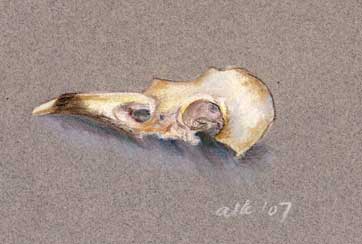 The walnuts are falling to the ground outside the kitchen window, and it’s a race to get them before the various squirrels do. I was out picking up walnuts yesterday and came across this skull, which looks to be a yellow-billed magpie’s.
Definitely interesting to see the bill at its attachment point to the skull… and good, also, to have a bit more time to work on the drawing. I am really enjoying these pastel pencils (CarbOthello).
3 September 07
Remedial Bills I: Sacramento Zoo
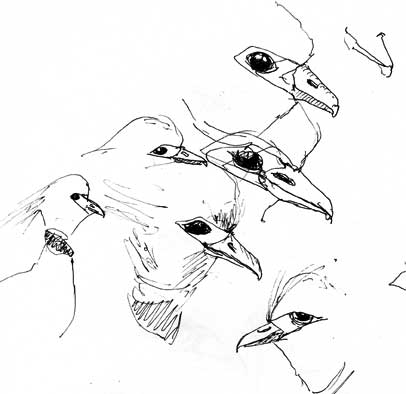 If you have to do remedial bird sketching, the zoo’s a good place. You can get very close to the birds and they’re used to people, so it’s a good way to scrutinize them at length. We spent a couple of hours this morning at the Sacramento Zoo.
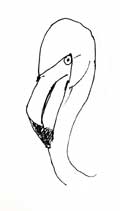 The disadvantage is that zoos tend to have outlandish, outrageous birds, the kind that appeal to people whose main interest is really not birds but who like bright colors and weird bird shapes. So the bills aren’t really representative of what I’m mostly going to be working on.

 It’s okay, though. By far the most interesting thing I learned today was that the point where a bird’s mouth opens is way behind, sometimes by a huge amount, the part of the bill that’s visible. There’s connective tissue and ceres and feathers and all kinds of other things going on — the bill is part of the skeleton and protrudes through all the soft stuff. Where, and at what angle, is key to drawing the bird at all accurately.
 Worth the $9 admission, the 100 degree heat, and the kids screaming for ice cream, that was. The penguins were moulting and were safely behind glass in what I assume was climate-controlled coolth…