
6 September 08
Wood Duck
 On the way back from lunch I stopped at Lake Spafford on campus, spying a young wood duck. It hit behind its mother, which I was able to draw, here…
5 September 08
Harris' Hawk
 I went over to the Raptor Center again at lunchtime to try and do some more foot studies. I was able to get very close, once again, to their Harris’ hawk (a female, nickname Rosa), which was once used for falconry and is totally imprinted on humans. (She is not releasable for this reason but also because she had a bad infection on her wingtips which destroyed her ability to regrow primary feathers, a dealbreaker if you’re a bird that needs to fly.)
 Anyway: birds’ feet. There are two common traps lying in wait for any would-be bird artist: drawing the bird’s foot clinging on for dear life, and overworking the foot. Jack Laws urged us to work loose — have the foot be in the same style as the rest of your drawing.
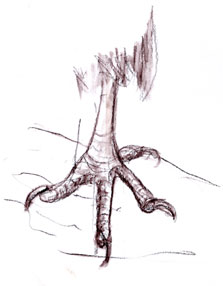 Because of the arrangement of tendons, when a bird perches, the foot contracts, even in a “relaxed” position, and provides all the hold birds really ever need except in very strong winds. Like many other animals such as cats, lizards, horses and hippos, they walk on their toes: the reverse “knee” is really the equivalent to our ankle, and the “shin” is really the tarsus, elongated and properly part of the foot. (The bird’s real knee is almost always hidden under feathers up in front of the hip.)
But the toes: mostly four. The rear one, short, halix: one joint. The joint attaches the halix to the foot. The bird can never, ever bend this digit, no matter how windy it gets. (So no clinging for dear life drawings any more!) Second, inside: two joints. Third, middle, long: three joints. Fourth, outside: four joints. These digits are known to my vet friends as phalanges and abbreviated to P1, P2, P3, P4, with P1 being the most inside (i.e. halix) and working outwards.
4 September 08
Canada Goose
 A small group of us took a walk around the Arboretum at lunchtime hoping for migrants. It was hot and we didn’t see much, though a banded white-breasted nuthatch was fun. We also saw a possible hybrid wood duck/mallard in among the ducks, and looked for cackling geese among the Canadas. No conclusive findings, but I did get a chance to do a quick sketch…
3 September 08
Red-breasted Nuthatch
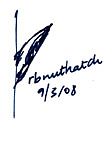 I’m working on a longer piece about bird foot anatomy, but couldn’t resist this lightning-fast sketch of a red-breasted nuthatch, my first of the fall… It was checking out the hole where the bluebirds nested.
1 September 08
Steller's Jay
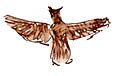 While we were eating paella on a deck in Kensington, a Steller’s jay popped into the oak trees to check us out. By the time I was ready to sketch it, there was no sign. But I heard them way across the canyon, and finally caught a glimpse…
31 August 08
White Longhorns
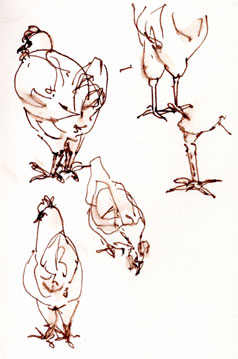 Fun to share space with chickens over dinner with friends…
28 August 08
Turkeys in the Shade
 It’s been hot today—very hot. The turkeys were all in the shade of the walnut tree at lunchtime. I think I’m going to try and do some studies of feet soon — they have very cool feet, and they’re a size you can actually see.
26 August 08
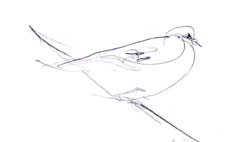
Mourning Dove Before Hunting Season
25 August 08
White-faced Ibis
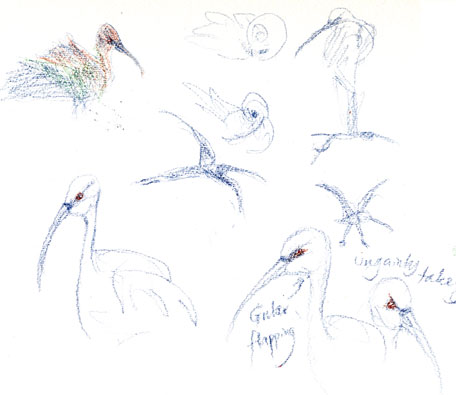 Lunchtime: a large flock of ibis in our flooded field, comparatively close to the kitchen window. I got out the prismacolors. I’m quite enjoying sketching, as opposed to drawing, with them — I used only four colors, terra cotta, indigo, apple green, pink.
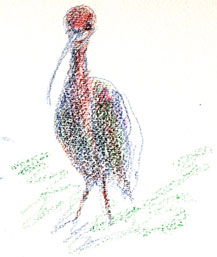 One bird stood up tall to preen and held the pose for quite a long time, moving only its head. I was able to do a more detailed study of this one…
22 August 08
Cooper's Hawk
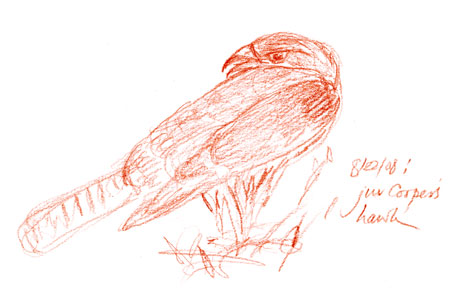 Cooper’s hawks are accipiters, which means their main prey items are birds. Songbirds. Their long tails and short wings are ideal for blasting through wooded thickets, chasing down any passerine foolish enough to linger.
This young one, though, is trying its luck on the ground squirrels. It loses the element of surprise because it has to come out into the open to get them, and they disappear down holes fast (and loudly warn all their companions of the danger.) Empty talons this time…