
2 June 26
21 May 26
Very Simple Knitting
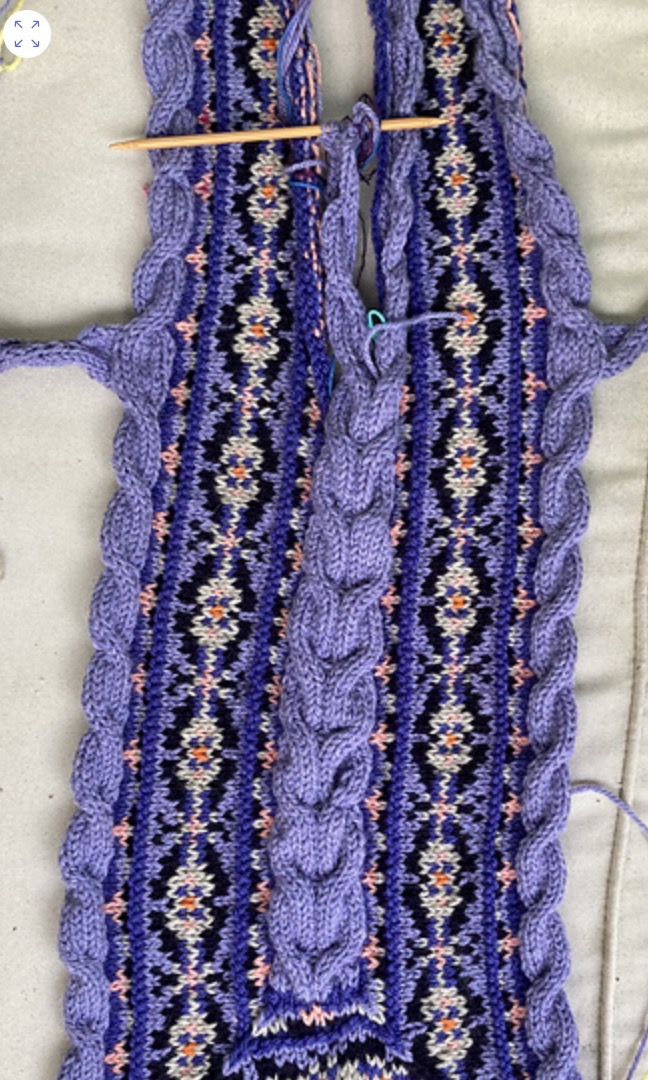 I was in the middle of knitting an extremely complicated cardigan, pictured at right, when I left for Europe at the beginning of April. This is an unusually structured piece with cables going over the shoulders, where stitches are picked up and then a stranded colorwork panel is worked, double moss-stitch forms side panels and sleeves, which also feature the cables and a smaller stranded panel going along their length. I’m knitting this with a worsted-weight yarn and it’s lovely but I’m finding it difficult to resume my work on it. (Note to self: don’t start a complex project when you know you’re going to be going away for a while; it’s now too hot to be knitting a heavy project.)
There are several knitting designers who are deeply influenced by the knitting cultures they grew up in yet who have managed to bring a contemporary feel to their designs. Ysolda Teague, a Scottish designer based in Edinburgh, has produced fascinating designs that draw on the traditions of her culture but are always unmistakably modern. I’m reminded of her Blank Canvas pullover which I’ve knit, which gives a well-fitting design in multiple sizes and encourages knitters to customize it freely. (One of the problems a lot of contemporary knitters face is their fear of modifying patterns either to suit their taste or individual bodies, resulting in a lot of sweaters that don’t get worn.)
Petite Knit is the brand of a Danish designer, Mette Wendelboe Okkels. This designer has taken a lot of flak for charging as much as she does for designs that are really very simple — no unusual stitches, no flamboyant shapes, just timeless, classic pieces (mostly sweaters) that highlight gorgeous, top-quality yarns. But simple doesn’t mean easy to design, and the care and effort that has obviously gone into each piece is a lovely testimony to the clean Scandinavian esthetic embraced by Petite Knit. (I’m of the opinion that designers deserve a fair price for their labor and get screaming angry when people find workarounds to paying for a pattern. It’s stealing, people. If you don’t want to pay for a pattern there are lots of free ones available on Ravelry.) Rosemary and Pines Fiber Arts looks into how Petite Knit took over the knitting world in a video here.I’m knitting Ysolda’s Musselburgh hat — my fifth — for a friend and I have cast on the Petite Knit Maggie Cardigan. Both of these are straightforward, stockinette projects. This is my first top-down sweater and a lot of concentration is required for the shaping around the shoulders, but once I reach the armpits, it will be very simple. (And, in this case, easy.)
26 March 26
A New Short Row Technique
 Short rows in knitting are used when you want a different amount of fabric in one section of a row than another without adding length at the end of the row. Typical uses include knitting a sock heel to make the L-shape of a foot, adding length to the back or front of a sweater (this can be extreme to accommodate a dowager’s hump or slumping shoulders or a large bust), or to shape a sleeve knit horizontally, as I’m doing with my Fort Amherst sweater.
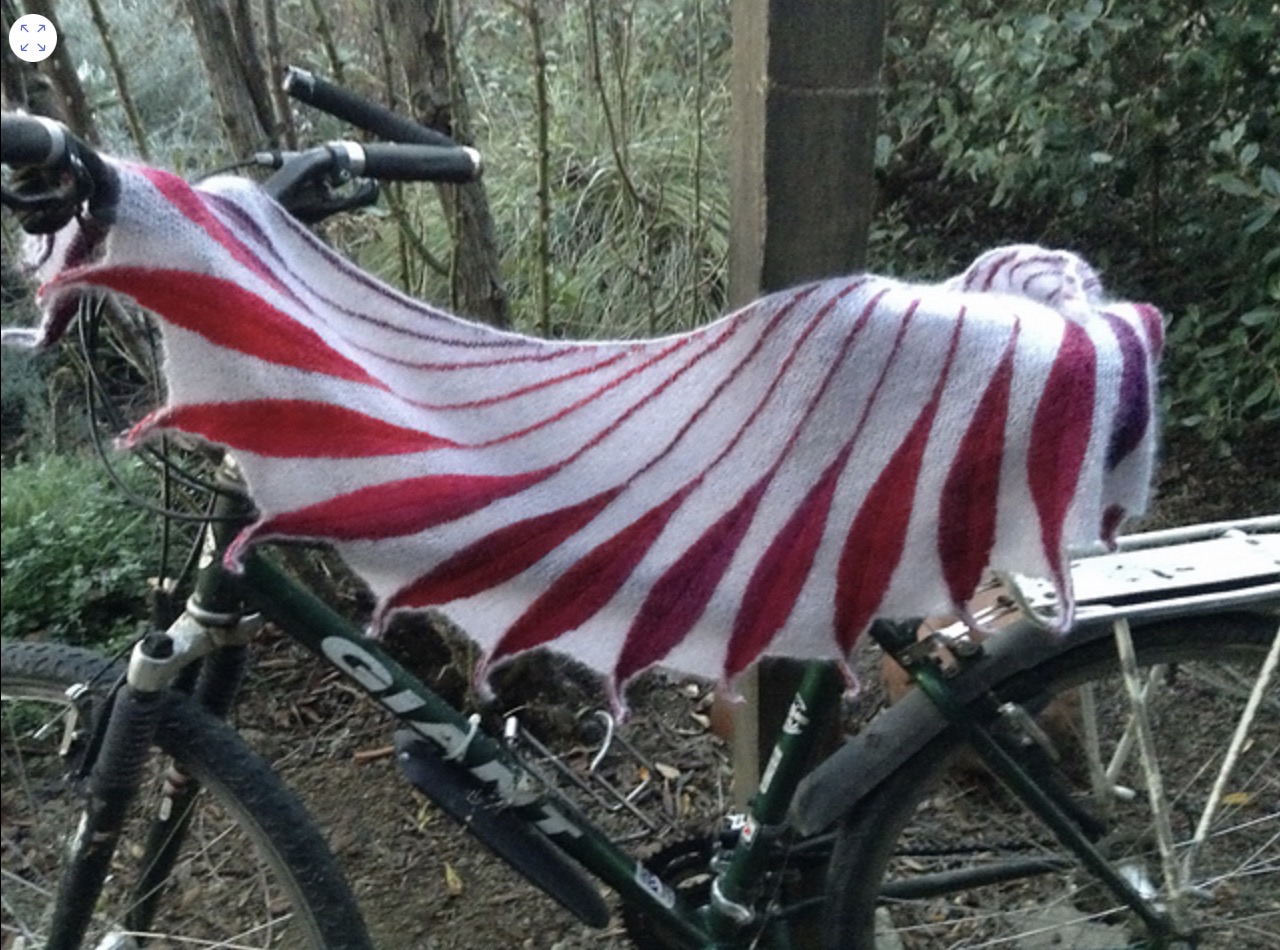
For years the only short row turn I knew was the wrap-and-turn, where you knit to the desired stitch, yarn forward, slip next stitch, yarn back, turn work (in the middle of a row). It’s clunky and inelegant except in garter stitch, where the bulk of the knitting hides a multitude of sins… With the internationalization of knitting I learned, and much preferred, the “German” short row, where the stitch is yanked hard over the needle making a “double-stitch” which you then knit as one on the next row. This has been invaluable in the swing-knitting technique where short rows are flung around with abandon to make some very interesting effects (I’ve knit the Dreambird shawl several times using this technique, pictured at right draped over my late-lamented bicycle which got stolen a couple of years ago).
The Fort Amherst project has introduced me to a third method, the Japanese short row (though designer Jennifer Beale calls this “Sunday short rows” in her pattern). Here, a removable stitch marker is placed over the working yarn, the return row is knit, but on the way back, you pick up the yarn held by the stitch marker and knit it together with the following stitch, removing the stitch marker. It is all but invisible! It might become my go-to method.
18 March 26
Progress Report
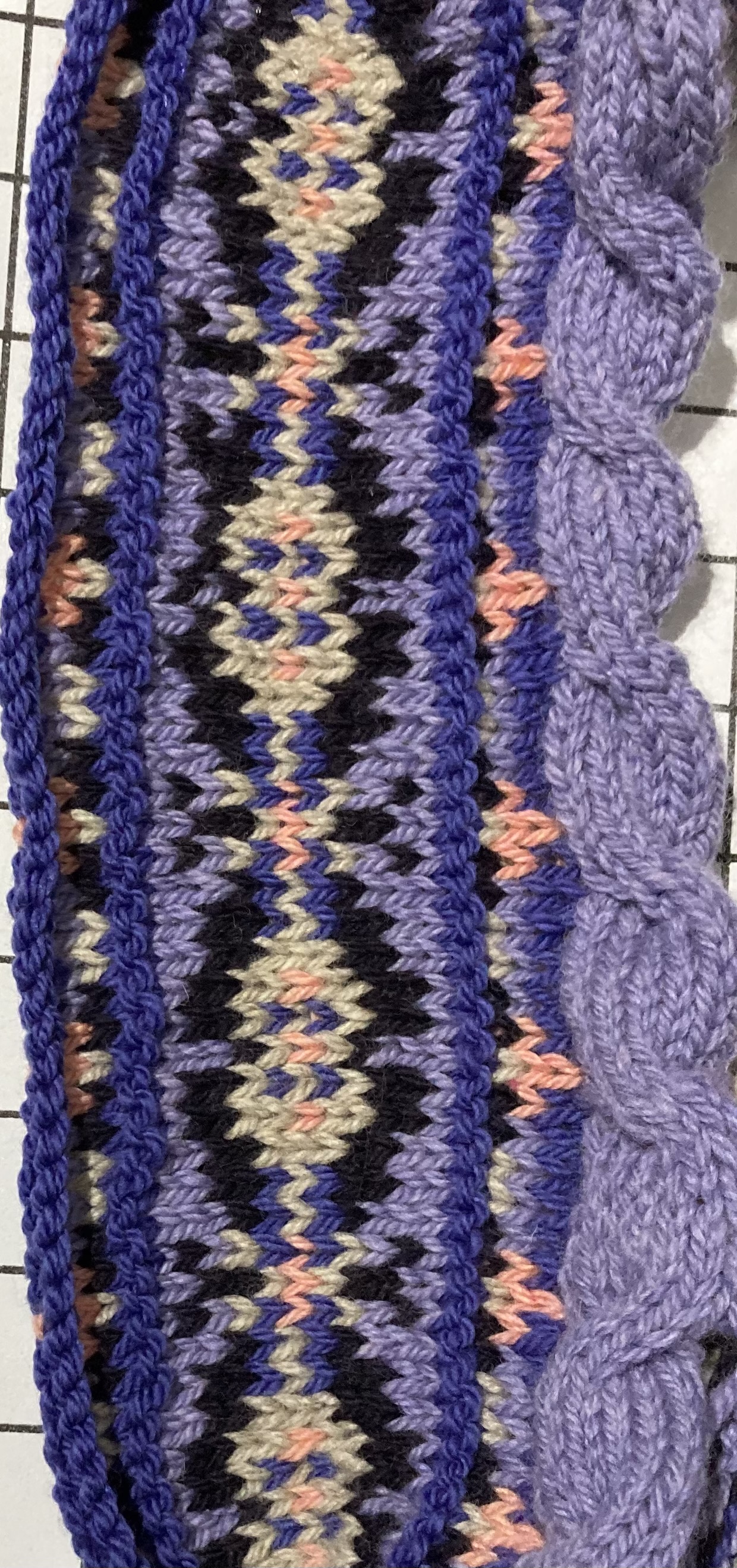 I’ve nearly finished the central back and front of the Fort Amherst cardigan. It’s a compelling knit: I’ve never done aran-weight colorwork before and it goes quite fast!
16 March 26
Duplicate Stitchery
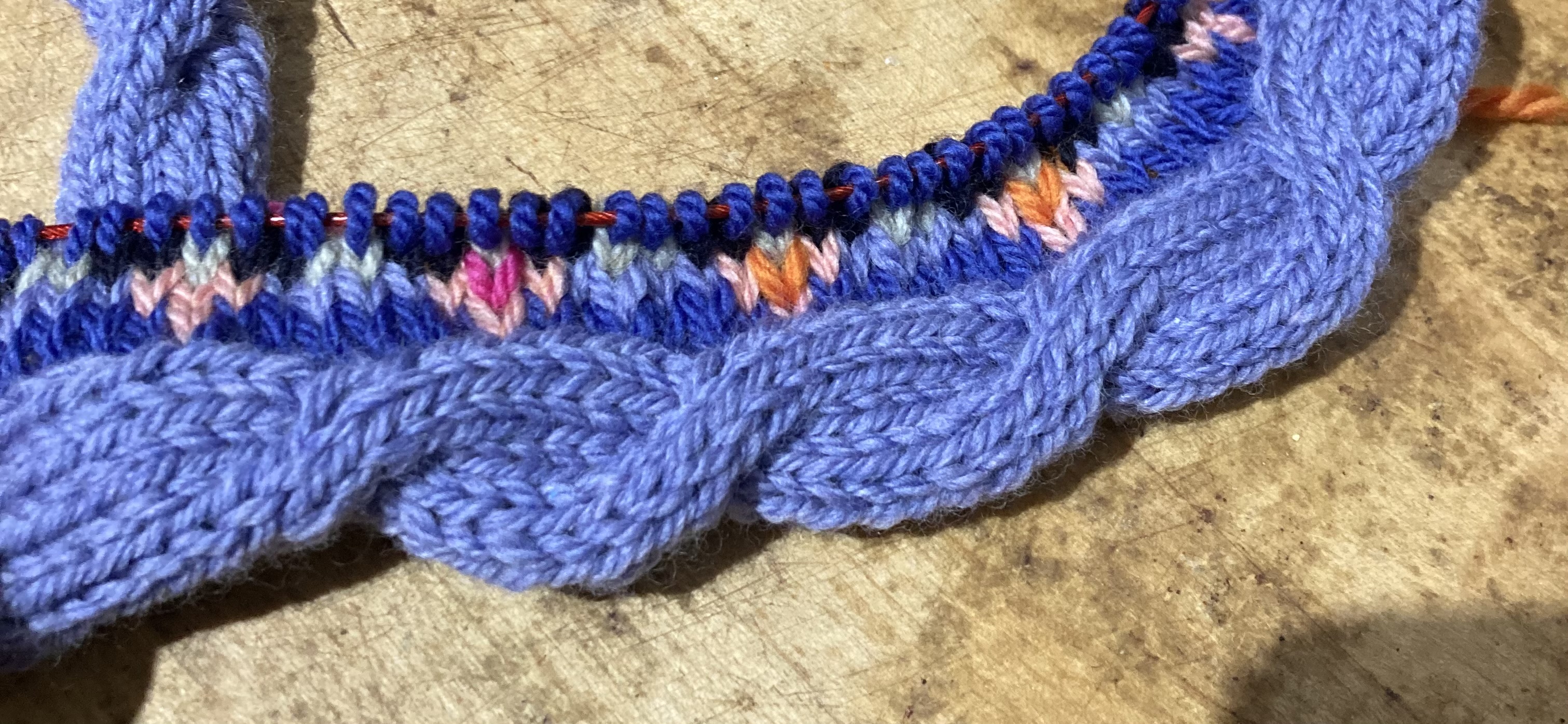 Most stranded colorwork is worked with only two colors at a time, because a) we only have two hands, b) color dominance is a thing, c) the knitting looks complicated enough on the back without adding a bunch of twisted, gnarled craziness.
I cast on the Fort Amherst cardigan and tried doing the peach color here in a much stronger orange in the colorwork section, but didn’t like it. I also have a very bright pink in this same aran-weight yarn. So I have sewn both these colors in to test out how they’d look in that central spot, which was otherwise looking a bit insipid, in a technique known as duplicate stitch or Swiss darning. It allows you to throw in a third color on a row, the embroidered stitch sitting happily on top of the stitch below it.
Not sure how this will all work out but I’m happy to have the option.
10 March 26
Swatching for a Cardigan
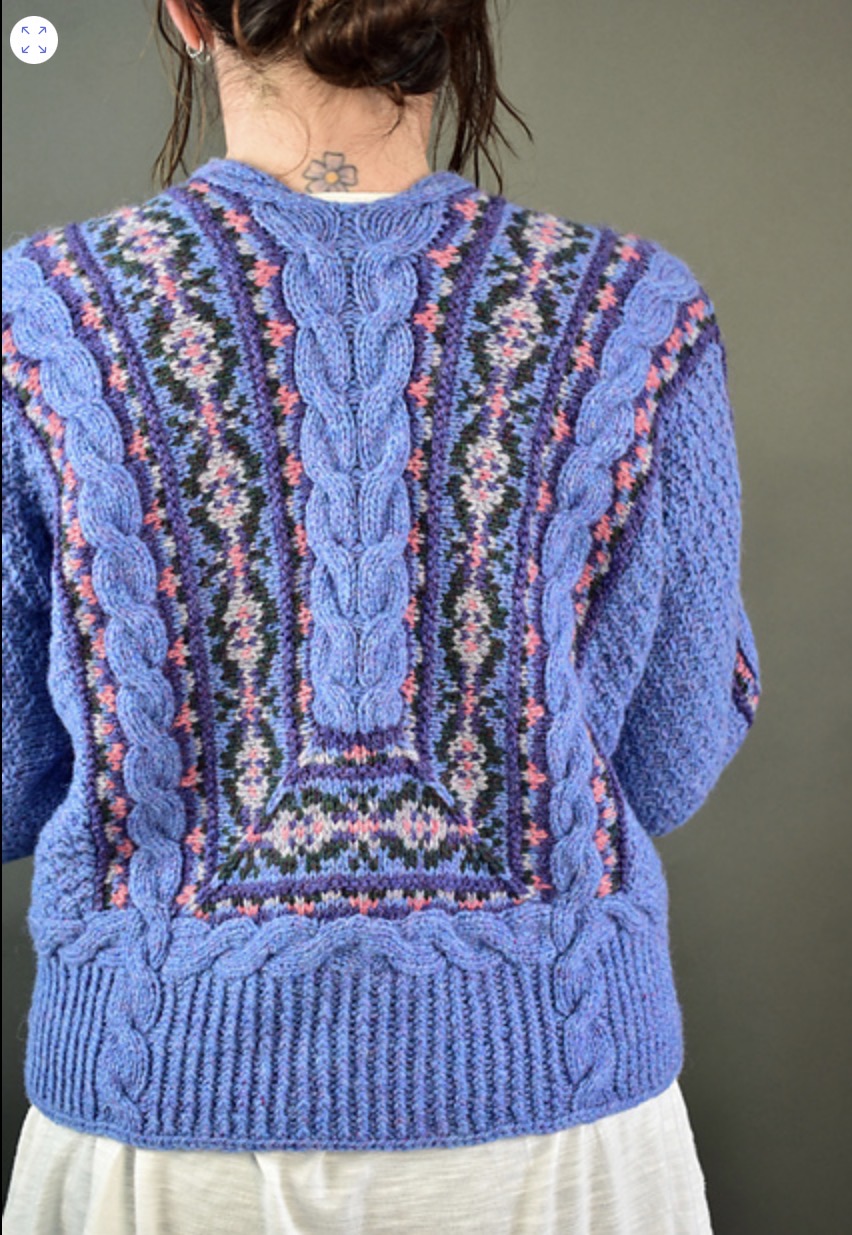 Trying to decide what knitting to take on a trip is always a challenge: it should be portable, it shouldn’t be too challenging technically, but it should be interesting enough to be entertaining.
I’ve had Jennifer Beale’s Fort Amherst cardigan in my queue for a while now and this might actually fit the bill, despite the fact that it’s a sweater and lugging a sweater around while I’m knitting it doesn’t seem so smart. But it has an incredibly unusual construction: The long vertical cables are knit first, on their own, an 8-stitch pattern that goes on for 25 inches or so; then side cables are attached to them and knit down; then the fair isle strips are attached to the cables and worked in the round and steeked. All of this seems fairly straightforward and might just work. But because you’re attaching vertically knit pieces to horizontal ones, the row gauge as well as the stitch gauge is going to need to work in order to avoid some very complex math, certainly beyond my capabilities.
Which is where swatching comes in: I’m swatching double moss-stitch, the single cable ropes, and the stranded colorwork separately. I measure the swatches before blocking then soak the swatch, allowing it to dry flat after being gently rolled in a towel, and measure again, noticing the difference.
My lilac moss stitch swatch is going to have to be redone on a larger size needle; the cable is perfect as is, and I’m not sure yet about the stranded colorwork…
26 February 26
Wear your Melt the Ice Red Hats Today
 I have recounted my knitting several (by now six) red Melt the Ice Hats. Today commemorates the 1942 banning of red hats in occupied Norway by the Nazis. Seems apt.
My sister had a wretched time of it in the bank this morning. At least she was wearing her red hat!
19 January 26
Resistance Through Knitting
 Numenius drew my attention this morning to a thread on Blue Sky about the Melt the Ice Hat, a knitting pattern released a few days ago to emulate a hat worn (and subsequently banned) in Norway to protest the Nazi occupation. The pattern notes contain this narrative:
In the 1940’s, Norwegians made and wore red pointed hats with a tassel as a form of visual protest against Nazi occupation of their country. Within two years, the Nazis made these protest hats illegal and punishable by law to wear, make, or distribute. As purveyors of traditional craft, we felt it appropriate to revisit this design.
Norwegians are ingenious people and this story gives an account of how the resistance moved to creating Christmas cards that echoed the sentiment as a way of getting around the ban.
I have no red yarn in my stash, at least yarn that isn’t particularly scratchy, so I ordered some online today. I already have requests for four hats, and I’m going to knit them two at a time — not like the double-knit socks in War and Peace, which is really a party trick, but using the magic loop method.
The outrages of ICE in Minneapolis are being well documented. We have GOT to stand up to this thuggery.
26 December 25
Barbara Walker: In Memoriam
Having been deeply involved in the knitting renaissance since about 2008, I have come to know about the Knitterati who were there all along, through the bad ol’ acrylic 70s, still knitting with wool, still curiously curating the craft that their grandmothers had known, knitting socks in WWI. Elizabeth Zimmermann was one of these. Barbara Walker was another. I have three of her books, stitch dictionaries that involved massive amounts of research in the pre-internet days. But she was much, much more than this. Her son has made a modest website outlining her various far-flung achievements, some of which were not known to me (for example, her humanism; I did know a bit about her feminism and tarot work, though not so much.)
He has also written a diary of her last few weeks and days. Having been through something like this recently myself, my heart aches for him, especially since his mother was in considerable pain from her cancer and was on painkillers sufficient to dull it but that also made communication difficult.
Sleep soundly, dear Barbara. You were so generous with your knowledge, your mind, your self. May your cable always twist in the direction you want, may your mosaics be rich and always a surprise, and may your ssk’s lie flat and even. We’ll miss you.
24 December 25
A Jacket, Almost Finished
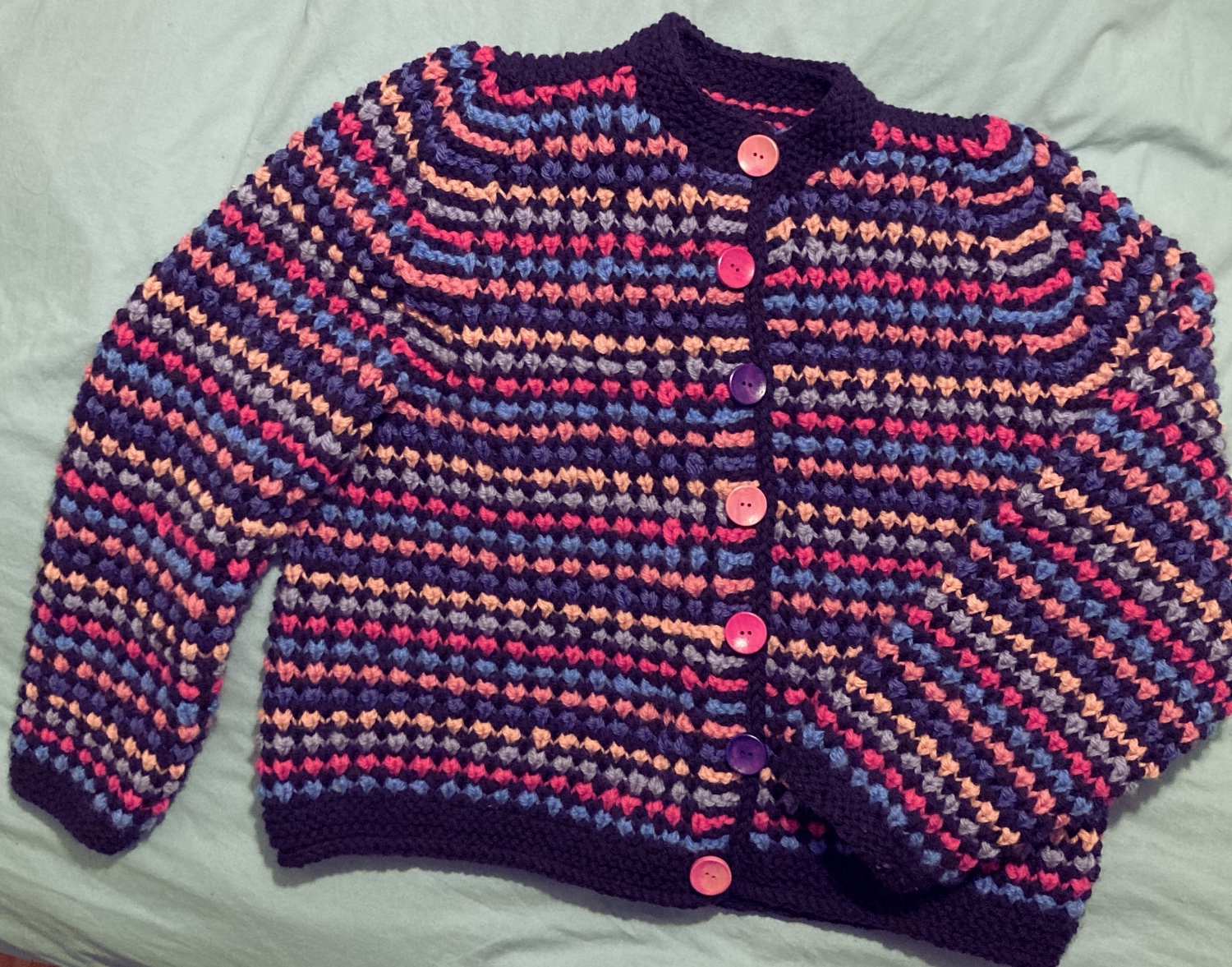 I finished knitting this jacket today. I want to line it, one of the armhole seams needs grafting, and the pattern is calling for an i-cord edging on the sleeves, which I’m very close to ignoring. But I probably won’t ignore it, because this is a magnificently written pattern and I want to give the designer, Kate Harvie, as much credit as I possibly can. The garter stitch saddle shoulders are brilliant.
The problem is this: two strands of aran weight yarn held double make for an especially dense fabric, and with this atmospheric river we’re in, it has basically zero chance of drying for four or five days. I want to block it before I line it and before I sew the buttons on, but jeez.
Was hoping to wear this on Saturday, but it might be a while.
I remember stressful Christmas knitting in the dim and distant past and am glad I don’t have any deadline more pressing than wanting to wear this on Saturday…